Executive Takeaways
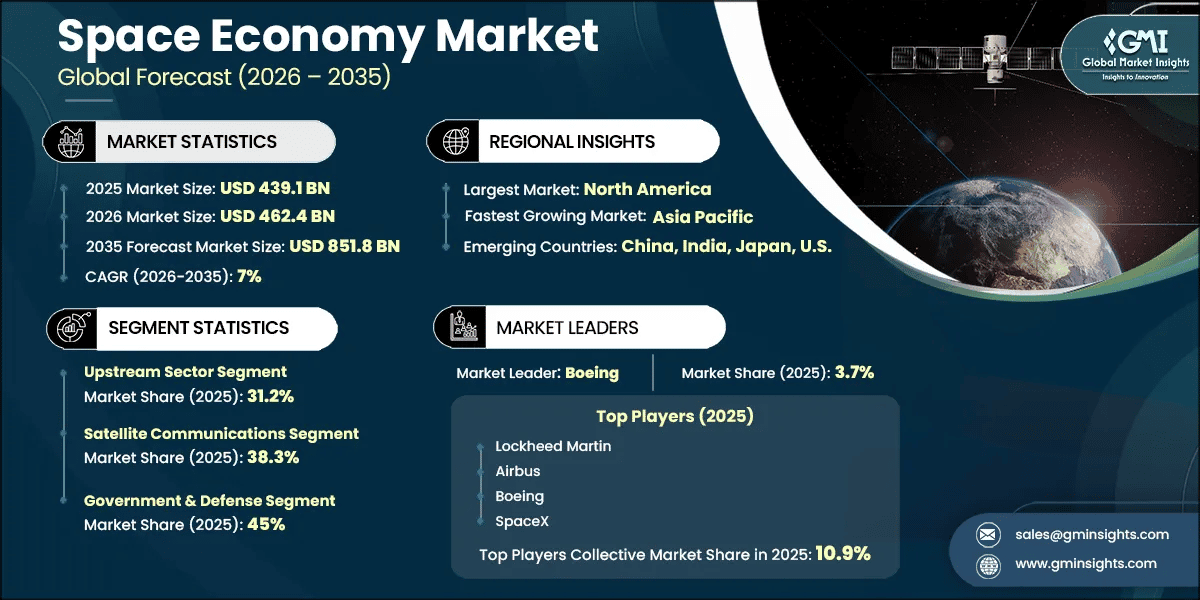
- Valuation Trajectory: According to benchmark data from Future Market Insights, the global space economy market is valued at $439.1 billion in 2025, scaling to $462.4 billion in 2026, and is projected to surge to $851.8 billion by 2035 at a compound annual growth rate (CAGR) of approximately 7%.
- <Investment Momentum: The sector's current expansion phase marks the second double-digit jump in the past decade, driven by aggressive capital allocation, enterprise infrastructure scalability, and robust commercial-government partnerships.
- Geographic Hegemony: North America retains absolute market dominance, with the United States capturing roughly 88.2% of regional revenues, underpinned by an unparalleled concentration of venture capital, private-equity backing, and advanced aerospace engineering.
- Commercialization Drivers: Growth is fundamentally decoupled from legacy defense spending, heavily propelled by commercial demand for low Earth orbit (LEO) constellations, high-resolution Earth observation data, and real-time cloud-to-satellite data streaming.
For decades, the final frontier was the exclusive domain of sovereign states and state-funded defense apparatuses, defined by bloated budgets, lengthy development cycles, and astronomical risk aversion. Today, that paradigm has fundamentally shattered. A rigorous market analysis reveals an industrial transformation of unprecedented scale: the global space economy is transitioning from an era of exploratory science into a high-yield, self-sustaining commercial ecosystem. Driven by structural shifts in capital allocation, reusable launch vehicle economics, and surging enterprise demand for space-derived intelligence, the sector is charting an aggressive path toward an estimated valuation of $851.8 billion by 2035.
Data released by Future Market Insights underscores a profound acceleration in market liquidity and investor confidence. Valued at $439.1 billion in 2025, the market is positioned to climb to $462.4 billion in 2026, maintaining a steady, resilient 7% CAGR across the forecast decade. While trailing the historic 15.5% post-pandemic recovery surge of 2021, the current growth velocity stands as the fourth-highest annual expansion rate recorded since the Space Foundation initiated its comprehensive global economic tracking in 2006. For institutional investors, venture capitalists, and corporate strategists, this inflection point signals that the space economy has graduated from speculative venture to an indispensable pillar of modern enterprise infrastructure.
The Catalysts of Commercialization: Beyond the Von Kármán Line
Test Our Free AI & Tech Utilities Suite
Calculate LLM API token costs, analyze article dwell-time, or simulate tech DCA returns.
To understand the mechanics driving this multi-hundred-billion-dollar expansion, one must examine the fundamental convergence of technological maturation and economic necessity. Historically, high capital expenditure (CapEx) barriers and prolonged regulatory compliance hurdles restricted market entry to legacy defense contractors. However, the maturation of private-launch architectures has drastically compressed payload delivery costs per kilogram, unlocking unprecedented infrastructure scalability in low Earth orbit.
Simultaneously, traditional industries are undergoing a quiet revolution, increasingly reliant on orbital assets for operational continuity. Precision agriculture, global supply-chain visibility, maritime logistics, and telecommunications backhaul now depend entirely on high-throughput satellite constellations and real-time geospatial analytics. This systemic integration has transformed space from an isolated vertical into an essential layer of the global cloud compute architecture. Enterprises are no longer buying hardware; they are procuring actionable data streams, driving predictable recurring revenues for satellite operators and driving up valuation multiples across the sector.
Private sector investment strategies have mirrored this operational shift. Venture capital firms and private equity syndicates are deploying dry powder into agile, vertically integrated aerospace startups capable of iterating hardware at software-like speeds. This influx of non-dilutive and equity financing has effectively mitigated early-stage risk, allowing emerging market entrants to fast-track product-market fit and capture market share in high-margin domains such as orbital manufacturing, debris mitigation, and deep-space communications.
Geographic Concentration and North American Dominance

A granular review of regional performance highlights a stark disparity in capital deployment and technological infrastructure. North America commands an overwhelming share of the global space economy, anchored by the United States, which single-handedly accounts for approximately 88.2% of the region’s aggregate revenues. This commanding lead is not accidental; it is the direct result of a mature, synergistic ecosystem comprising deep capital markets, advanced research institutions, and a sophisticated regulatory framework that actively encourages public-private partnerships.
Programs administered by agencies such as NASA and the Department of Defense have long served as strategic venture incubators, subsidizing early-stage research and guaranteeing initial demand for commercial launch and resupply services. This "anchor tenant" model has allowed U.S.-based prime contractors and disruptive private entities to achieve economies of scale virtually unmatched in Europe, Asia, or emerging markets. Consequently, North American firms retain a decisive competitive moat in intellectual property, patent portfolios, and specialized aerospace engineering talent.
However, international markets are beginning to mount strategic counter-offensives. European Union initiatives, coupled with surging indigenous space programs in India, Japan, and the United Arab Emirates, are steadily decentralizing global manufacturing and launch capabilities. While North America will retain its macroeconomic crown through 2035, cross-border joint ventures and sovereign investments in regional launch sites will introduce new dynamics into the competitive landscape.
Verified Data & Metrics Breakdown
The following verified market data, sourced from comprehensive industry analyses, illustrates the historical context, current valuation, and long-term trajectory of the global space economy.
| Year / Period | Global Market Valuation | Growth Metric / CAGR | Key Market Driver |
|---|---|---|---|
| 2021 | -- | 15.5% Annual Gain | Post-pandemic recovery surge & aggressive VC deployment. |
| 2025 (Current) | $439.1 Billion | 4th-highest annual growth since 2006 | Commercial data demand & LEO constellation scaling. |
| 2026 (Projected) | $462.4 Billion | ~7% YoY Expansion | Enterprise cloud integration & expanded launch cadence. |
| 2035 (Forecast) | $851.8 Billion | 7% CAGR (2026–2035) | Maturation of space-based manufacturing & deep-space logistics. |
Industry & Market Implications: Winners, Losers, and Economic Realities
As the space economy scales toward the $851.8 billion threshold, the structural reorganization of corporate value chains will create clear economic winners and laggards. Understanding these dynamics is essential for institutional risk mitigation and capital deployment.
Who Wins
- Agile Private Launch Providers: Companies utilizing reusable rocket technology and high-cadence manufacturing are capturing outsized market share, squeezing legacy providers unable to compete on cost-per-kilogram metrics.
- Downstream Data Analytics Enterprises: Firms specializing in translating raw telemetry and high-resolution imaging into actionable enterprise intelligence are realizing high-margin recurring revenue models.
- Semiconductor and Specialized Hardware Manufacturers: The demand for radiation-hardened microprocessors, advanced solar arrays, and lightweight composite materials is creating windfall profits for specialized component suppliers.
Who Loses
- Legacy Aerospace Contractors Slow to Adapt: Defense primes reliant on cost-plus contracting models and rigid bureaucratic development cycles face severe margin compression.
- Unfunded Startups Facing Capital Crunches: Early-stage ventures unable to demonstrate near-term enterprise ROI or clear paths to operational self-sufficiency are experiencing severe valuation markdowns in a tightened liquidity environment.
Frequently Asked Questions (People Also Ask)
What is the projected size of the global space economy by 2035?
According to market analysis from Future Market Insights, the global space economy is projected to reach $851.8 billion by 2035, expanding at a compound annual growth rate (CAGR) of approximately 7% from its 2026 baseline of $462.4 billion.
Which region dominates the global space economy market?
North America commands the vast majority of the global space economy. The United States alone accounts for approximately 88.2% of regional revenues, driven by heavy private sector investment, advanced technological infrastructure, and robust government-commercial partnerships.
What are the primary growth drivers for the modern space economy?
The sector's expansion is primarily propelled by declining launch costs via reusable rocketry, escalating enterprise demand for real-time satellite data, integration with cloud compute architecture, and diversified commercial applications in agriculture, logistics, and telecommunications.
How does current space market growth compare to historical trends?
The 2025 valuation of $439.1 billion marks the second double-digit annual gain of the past decade—trailing only the post-pandemic recovery spike of 15.5% in 2021—and represents the fourth-highest growth rate since the Space Foundation began tracking the metric in 2006.
Future Outlook: Strategic Milestones to Watch
As the industry marches past mid-decade, the next critical chapter of the space economy will be defined by regulatory evolution, environmental orbital management, and the commercial viability of off-world manufacturing. Investors and analysts must closely monitor several key milestones over the coming years: the establishment of international frameworks for space traffic management, the scaling of orbital debris remediation ventures, and the commercial rollout of microgravity pharmaceutical and material-science laboratories.
Ultimately, the $851.8 billion projection for 2035 is not merely a statistical milestone; it is a testament to the irreversible commercialization of low Earth orbit and beyond. For corporate leaders and institutional capital allocators, the directive is clear: space is no longer an ancillary frontier of scientific curiosity, but an essential, high-yield operational theater that will fundamentally shape the global economic landscape of the twenty-first century.