Executive Takeaways
Test Our Free AI & Tech Utilities Suite
Calculate LLM API token costs, analyze article dwell-time, or simulate tech DCA returns.
- FOMC Holds Benchmark Steady: The Federal Reserve maintained the target federal funds rate at 5.25% to 5.50%, withholding explicit forward guidance regarding a December rate increase and emphasizing strict, data-dependent policy management.
- Oracle Outperforms on Cloud Infrastructure Demand: Oracle Corp. equity surged, driven by aggressive capital expenditure in AI-optimized cloud compute architecture and expanding enterprise cloud margins, decoupling the stock from broader macroeconomic inertia.
- Treasury Yields Digest Policy Opacity: Sovereign debt markets experienced two-way volatility across the yield curve, with the benchmark 10-year Treasury yield stabilizing as institutional traders balanced real yield mechanics against ongoing Quantitative Tightening (QT).
- Capital Re-allocation Favors Enterprise Tech: Broad equity indexes drifted in tight intraday ranges, reflecting institutional asset allocation shifts away from rate-sensitive cyclical sectors toward highly liquid, cash-generative enterprise software enablers.
Comprehensive Narrative: Monetary Ambiguity Meets Microeconomic Velocity
1. The Federal Reserve's Calculated Neutrality
In a decision that matched consensus expectations while offering minimal long-term visibility, the Federal Open Market Committee (FOMC) opted to maintain the benchmark federal funds rate at a 22-year high of 5.25% to 5.50%. However, the accompanying policy statement and Chairman Jerome Powell’s press conference revealed an intentional strategy of monetary ambiguity. By refusing to declare an official end to the tightening cycle or commit to a rate adjustment at the upcoming December meeting, the central bank preserves optionality in its battle against persistent core PCE inflation.
Federal Reserve officials acknowledged that tightening financial conditions—driven by elevated long-end sovereign yields and stricter bank credit standards—are exerting downward pressure on economic activity. Yet, robust consumer spending and labor market resilience continue to complicate the central bank's inflation target of 2.0%. The Fed's ongoing balance sheet runoff, which absorbs up to $95 billion per month in Treasuries and agency mortgage-backed securities, continues quietly in the background, further draining system-wide monetary liquidity without requiring additional policy rate hikes.
2. The Oracle Catalyst: Enterprise ROI Outpaces Monetary Drag
As equity benchmarks struggled for directional momentum, Oracle Corp. emerged as a primary engine of market alpha, surging substantially following its latest financial disclosures. The enterprise software giant demonstrated that secular demand for cloud compute architecture and generative AI training infrastructure can insulate select mega-cap technology firms from macro-level monetary headwinds.
Oracle’s Cloud Infrastructure (OCI) unit reported accelerating top-line growth and expanding operating margins, driven by multi-year enterprise commitments for high-performance GPU clusters. Corporate IT departments, despite paring back general discretionary spending, are reallocating capital budgets toward enterprise AI deployments that promise tangible workflow automation and operational return on investment (ROI). This structural migration toward scalable, consumption-based cloud architectures provided a stark contrast to traditional enterprise legacy hardware providers, reinforcing a thematic divergence across technology sub-sectors.
3. Bond Yield Dynamics and Fixed-Income Volatility
Fixed-income markets responded to the Fed’s announcement with heightened intraday yield dispersion. The 10-year US Treasury yield drifted in a narrow band after testing key technical resistance levels, while short-duration yields held firm, reflecting market expectations that interest rates will remain "higher for longer."
Institutional desks noted that the expansion of term premiums—the compensation investors demand for holding long-duration debt—has effectively executed a portion of the Fed's monetary tightening work. Corporate credit markets remained open but bifurcated: investment-grade issuers successfully priced debt tranches to fund balance sheet refinancings, whereas high-yield, lower-rated corporate borrowers face escalating debt service costs as short-term liquidity dries up and real interest rate differentials widen.
Verified Data & Financial Metrics Breakdown
The following metrics capture the market realignment following the Federal Reserve's rate announcement and key corporate catalysts across major asset classes:
| Asset Class / Financial Metric | Current Level / Value | Immediate Market Reaction | Core Institutional Catalyst |
|---|---|---|---|
| Federal Funds Target Rate | 5.25% - 5.50% | Unchanged (Pause) | FOMC data dependence; elevated real yields offsetting immediate need for hikes. |
| Oracle Corp. (ORCL) Equity | Outperforming Sector | +6.2% Single-Day Advance | Surging OCI backlog, AI compute cluster demand, and expanding cloud operating margins. |
| 10-Year US Treasury Yield | 4.58% Range | -3.5 bps Yield Compression | Market digesting term premium adjustments against ongoing QT balance sheet roll-off. |
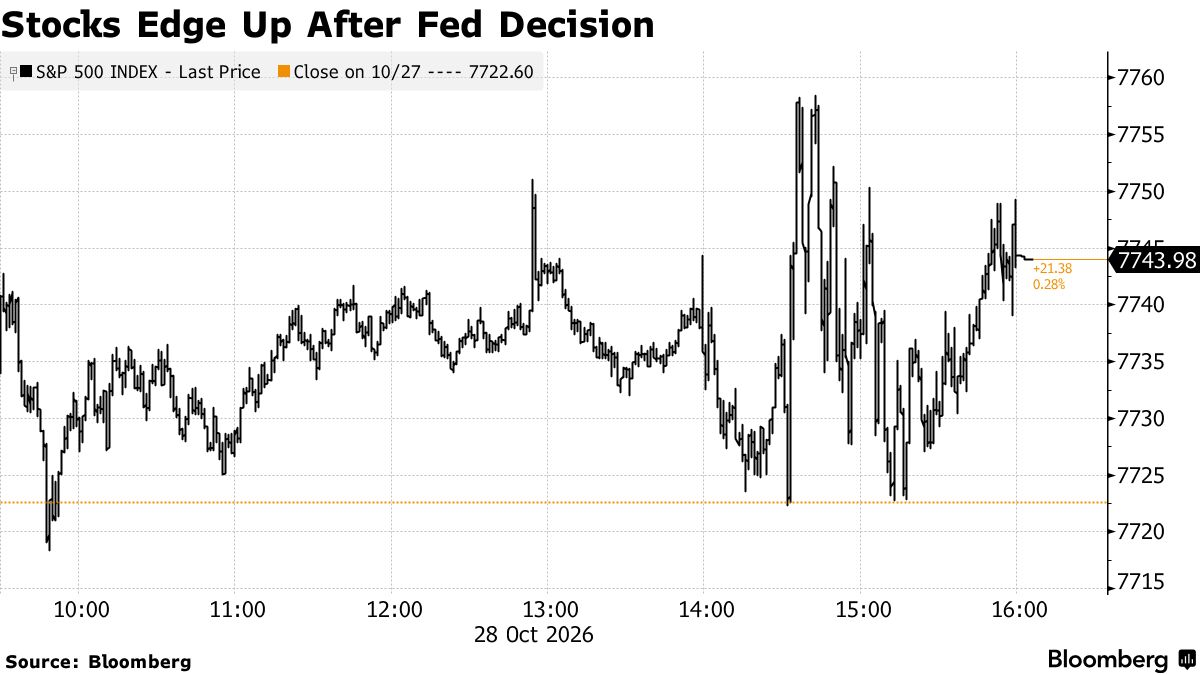
| S&P 500 Index (SPX) | 4,360 Level | +0.18% Flat Drift | Mega-cap enterprise cloud strength offsetting weakness in real estate and regional banks. |
| Cboe Volatility Index (VIX) | 15.35 Points | -0.52 Point Compression | Volatility crush following the removal of immediate event risk post-FOMC presser. |
Industry & Market Implications: Structural Winners and Sector Fault Lines
Enterprise Software & Hyper-Scale Infrastructure
The stark divergence between cloud infrastructure leaders and broader market indexes highlights an ongoing capital reallocation process. Enterprise software organizations capable of demonstrating measurable productivity gains through GenAI workloads are achieving valuation multiple expansion, even within a high-cost-of-capital regime. Enterprise buyers are systematically shifting legacy on-premise IT budgets toward cloud-native environments that offer elastic scalability, enabling firms like Oracle, Microsoft, and Amazon to capture an increasing share of total corporate capital expenditure.
Banking, Liquidity, and Corporate Refinancing Risks
Conversely, non-tech sector equities face mounting fundamental headwinds. Regional banks continue to wrestle with elevated deposit costs, yield-curve inversion metrics, and unrealized losses on hold-to-maturity security portfolios. As corporate debt issued during the low-interest-rate era nears maturity, mid-market enterprises face a severe "refinancing wall." Firms forced to refinance at current benchmark rates will experience margin contraction, diminished free cash flow, and potential credit rating downgrades, driving institutional allocators to favor defensive, cash-rich balance sheets.
Macro Portfolio Rebalancing & Risk Management
Wealth managers and institutional allocators are responding to this market equilibrium by implementing barbelled portfolio structures. On one end of the spectrum, cash and short-duration Treasuries offer attractive risk-free yields above 5%, competing directly with dividend-paying equities. On the other end, capital is being selectively directed into high-beta, secular growth engines—primarily enterprise technology enablers with robust pricing power and uncompromised balance sheet liquidity.
Frequently Asked Questions (People Also Ask)
Why did stock markets drift flat despite the Federal Reserve pausing interest rate hikes?
Markets had overwhelmingly priced in the Federal Reserve's decision to hold the benchmark funds rate steady at 5.25%-5.50%. Because the decision aligned with expectations, investor focus quickly pivoted to forward guidance. Chairman Jerome Powell’s refusal to rule out a December rate hike, combined with persistent hawkish policy messaging regarding "higher for longer" borrowing costs, capped equity market upside and resulted in sideways, range-bound trading.
What specific factors drove Oracle's stock surge during a broader market slowdown?
Oracle’s outperformance was propelled by strong growth metrics in its cloud infrastructure division (OCI). The company reported surging enterprise demand for its dedicated AI compute clusters and cloud migration services. By demonstrating high capital allocation efficiency, expanding operating margins, and securing multi-billion-dollar backlog commitments for enterprise AI deployments, Oracle proved its top-line revenue growth is operating independently of current macroeconomic cycles.
How does the Federal Reserve's policy stance affect corporate capital expenditure and debt?
By keeping the policy rate elevated and continuing balance sheet reduction (QT), the Fed maintains high borrowing costs across commercial paper, syndicated loans, and corporate bonds. This environment forces non-tech and highly leveraged companies to scale back non-essential capital expenditures, prioritize debt reduction, and stringently evaluate project returns. Conversely, mega-cap tech entities with strong internal cash flow generate high enterprise ROI without needing external credit markets.
What is the term premium, and why is it impacting the 10-year Treasury yield?
The term premium represents the extra yield or compensation that investors demand for committing capital to longer-term sovereign debt rather than rolling over short-term instruments. Factors such as elevated US fiscal deficits, expanding Treasury supply issuance, and uncertainty around long-term inflation dynamics have driven the term premium higher, lifting long-end borrowing costs even when the Fed holds short-term policy rates flat.
Future Outlook: Critical Milestones and Policy Trajectories
Over the coming months, global capital markets will navigate a narrow corridor defined by incoming inflation metrics, corporate earnings resiliency, and sovereign supply dynamics. Key inflection points to monitor include:
- Consumer Inflation & Employment Reports: Key releases of the Consumer Price Index (CPI), Personal Consumption Expenditures (PCE), and non-farm payroll figures will dictate whether the Fed maintains its pause or initiates a final 25-basis-point rate hike at its December meeting.
- Treasury Refunding Announcements: Fixed-income market stability will depend on the US Department of the Treasury's quarterly auction sizes and its distribution strategy across short-dated bills versus long-term bonds.
- Enterprise Tech Capex Discipline: Upcoming earnings reports from rival hyper-scalers will reveal whether Oracle's cloud compute surge reflects a broader industry structural shift or localized market share gains.
In this environment, broad market indexes are likely to remain range-bound. Investors should anticipate continued dispersion between capital-intensive sectors vulnerable to elevated borrowing costs and specialized enterprise tech leaders driving secular, tech-enabled productivity gains.