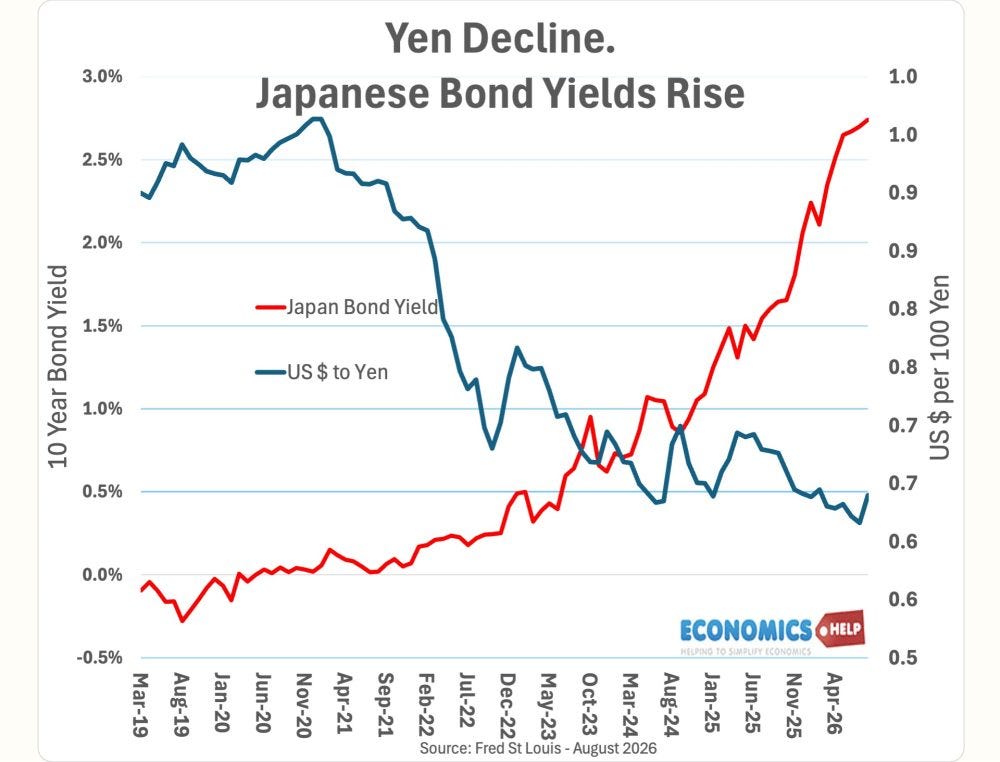
For decades, Wall Street has obsessed over Federal Reserve rate cuts, non-farm payroll reports, and Silicon Valley earnings multiples. Yet, a far more potent and volatile mechanism quietly dictates the cost of capital across the Western world: Tokyo. According to a landmark analysis published by Desmond Lachman at the American Enterprise Institute (AEI) on March 3, 2026, Japan’s colossal bond market holds the structural integrity of US financial markets in a delicate, precarious balance. As global macroeconomic pressures mount, the repercussions of Japanese monetary policy shifts are reverberating directly into American corporate balance sheets, mortgage rates, and Treasury auctions.
Executive Takeaways
- The Core Exposure: Japan commands an astonishing $8 trillion sovereign debt market, serving as the ultimate shock absorber for global capital allocation and liquidity.
- The Carry Trade Unwind: Decades of Japanese quantitative easing funded the global carry trade; as Tokyo normalizes rates, capital repatriation threatens US asset valuations.
- Treasury Demand Shock: Japanese institutional investors—traditionally the largest foreign holders of US Treasuries—are reallocating capital domestically, straining Washington’s deficit financing.
- Risk Mitigation Imperative: Institutional portfolio managers must execute aggressive risk mitigation strategies as Japanese bond yields test historical multi-decade ceilings.
The Anatomy of Interdependence: How Tokyo Funds Wall Street
Test Our Free AI & Tech Utilities Suite
Calculate LLM API token costs, analyze article dwell-time, or simulate tech DCA returns.
To understand why a movement in Japanese government bonds (JGBs) sends immediate shockwaves through the New York Stock Exchange, one must analyze the plumbing of global liquidity. For over thirty years, Japan maintained a regime of zero—and later negative—interest rates. Trapped in a protracted deflationary cycle, the Bank of Japan (BOJ) flooded domestic markets with liquidity while capping sovereign bond yields via Yield Curve Control (YCC).
Faced with a domestic landscape offering nominal or negative yields, Japanese institutional giants—including massive pension funds like the Government Pension Investment Fund (GPIF), life insurance behemoths, and major megabanks—were forced to look abroad to fulfill their fiduciary obligations and target enterprise ROI thresholds. They found their primary destination in United States dollar-denominated assets, most notably US Treasury securities and high-grade corporate debt.
This dynamic created a symbiotic financial loop. Japan recycled its massive current account surpluses into American sovereign debt, effectively subsidizing the US government's fiscal deficits while keeping long-term US borrowing costs artificially suppressed. Mortgage rates, corporate bond issuances, and equity valuation multiples in the US all benefited from this relentless wave of inbound Japanese capital.
However, as AEI’s Desmond Lachman highlights, this foundational pillar of global financial stability is fracturing. Domestic inflation in Japan, long dormant, has finally materialized. Driven by imported commodity costs and a weakening yen, Japanese wage growth has forced the BOJ to pivot away from ultra-loose monetary policies. As Tokyo allows domestic bond yields to rise, the fundamental calculus for Japanese institutional capital is undergoing a violent tectonic shift.
The Catalytic Shift: The Great Capital Repatriation

When sovereign bond yields in Tokyo rise from near-zero toward competitive modern thresholds, the opportunity cost of holding foreign assets skyrockets for Japanese investors. Hedging costs—the expenses incurred by Japanese institutions to protect against yen depreciation when buying US dollar assets—have historically eaten into foreign returns. When combined with rising domestic JGB yields, these hedging costs make US Treasuries increasingly unattractive on a risk-adjusted basis.
The immediate consequence is capital repatriation. Japanese institutional portfolio managers are systematically unwinding their foreign debt holdings, liquidating US Treasuries, and bringing capital back to home shores. This structural selling pressure occurs precisely at a time when the US Department of Treasury is issuing record volumes of debt to finance ballooning federal deficits. With the Federal Reserve actively engaging in quantitative tightening (QT) and foreign buyers like Japan and China stepping back, the marginal buyer of US debt is becoming increasingly scarce.
The resulting supply-demand imbalance directly impacts infrastructure scalability, corporate borrowing, and consumer credit across America. As US Treasury yields spike in response to waning foreign demand, long-term borrowing costs—from commercial real estate loans to consumer mortgages—drift higher, putting severe pressure on interest-sensitive sectors of the economy.
Verified Data & Metrics Breakdown
To fully grasp the magnitude of structural exposure between the Japanese and American financial ecosystems, consider the following macro-financial metrics compiled from central bank reporting and economic analyses:
| Metric / Indicator | Historical Baseline | Current Macro Environment (2026) | Direct US Economic Impact |
|---|---|---|---|
| Japan Sovereign Debt Market Size | ~$7.5 Trillion (2020) | ~$8.0+ Trillion | Anchors global benchmark yield curves and capital flows. |
| BOJ Policy Rate Benchmark | -0.10% (Negative Rate Policy) | Normalized to positive territory (0.50% - 0.75%) | Eliminates cheap funding legs for the global carry trade. |
| Japan Holdings of US Treasuries | Peak > $1.3 Trillion | Decline via gradual liquidation / reallocation | Elevates US Treasury yields and widens fiscal financing gaps. |
| US 10-Year Treasury Yield Reaction | Sub-2.0% (Secular stagnation era) | Volatile trading range reflecting global term premiums | Increases debt service costs for US corporations and consumers. |
Industry & Market Implications: Winners, Losers, and Systemic Risk
The normalization of Japanese monetary policy creates a complex matrix of winners and losers across global financial sectors. Understanding these dynamics is critical for executive decision-making and institutional asset management.
Who Loses: High-Valuation Equities and Highly Leveraged Corporates
Corporations that rely on cheap, abundant liquidity to sustain inflated valuation multiples face immediate headwinds. Technology sectors dependent on low-cost cloud compute architecture investments and aggressive R&D funding find their cost of capital rising. Furthermore, US regional banks holding legacy, fixed-rate assets face persistent margin compression as depositors demand higher yields to counter economy-wide inflation.
Additionally, emerging market economies heavily indebted in US dollars face severe strain as capital flees back to developed markets, driven by higher yields in both Tokyo and Washington.
Who Wins: Domestic Fixed-Income Yield Seekers and Value Sectors
Institutional investors and conservative asset managers who prioritize fixed-income yield finally find viable alternatives in government-backed paper without venturing deep into high-yield junk territory. Japanese domestic banks, long starved of net interest margin (NIM) growth under negative rates, experience a structural resurgence in profitability as lending spreads widen.
Frequently Asked Questions (People Also Ask)
Why does Japan’s bond market impact the US economy when they are entirely different countries?
Japan operates the world’s third-largest economy and commands an $8 trillion sovereign debt market. For decades, Japanese institutional investors parked vast amounts of capital in US Treasury securities. When Japanese bond yields rise, capital flows back to Tokyo, reducing foreign demand for US debt and driving up American borrowing costs.
What is the "carry trade" and how does the Bank of Japan's policy affect it?
The carry trade involves borrowing in a currency with low interest rates (like the Japanese yen) to invest in higher-yielding foreign assets (like US stocks or bonds). As the Bank of Japan raises interest rates and normalizes monetary policy, the profitability of this trade evaporates, triggering rapid unwinding and sudden volatility in global equity and debt markets.
How does this affect everyday American consumers and businesses?
When Japanese investors stop buying US Treasuries or sell existing holdings, US bond yields rise. Because benchmark interest rates dictate the pricing of corporate loans, mortgages, auto loans, and credit cards, higher Treasury yields translate directly into increased borrowing costs for US households and enterprises.
What is Desmond Lachman's core thesis regarding Japan in his AEI report?
Desmond Lachman emphasizes that policymakers and market analysts frequently overlook foreign structural vulnerabilities—specifically Japan's $8 trillion bond market. He warns that as Japan addresses its domestic inflation and alters its monetary stance, the resulting global liquidity contraction poses under-appreciated risks to US financial stability.
Future Outlook: Critical Milestones and Risk Mitigation
As we navigate the remainder of 2026, market participants must closely monitor several key macroeconomic milestones coming out of Tokyo and Washington:
- BOJ Policy Rate Trajectory: Watch for official announcements regarding further rate hikes or the formal tapering of BOJ purchases of Japanese Government Bonds. Any acceleration in quantitative tightening by Tokyo will instantly compress global liquidity.
- US Treasury Auction Metrics: Pay close attention to bid-to-cover ratios and indirect bidder participation (a proxy for foreign demand) during major US Treasury refunding auctions. Weak foreign demand will force primary dealers to absorb larger inventories, pushing yields higher.
- FX Intervention and Currency Volatility: The USD/JPY exchange rate remains a primary transmission channel for stress. Rapid depreciation of the yen forces aggressive policy responses, while swift appreciation signals aggressive carry trade unwinding.
For executive leadership, portfolio managers, and regulatory compliance officers, the message from AEI’s analysis is unambiguous: global capital markets are deeply interconnected. Ignoring monetary policy developments in Tokyo is no longer an option. Implementing robust risk mitigation strategies against rising term premiums and foreign liquidity shocks will define successful financial navigation in an increasingly multipolar and volatile economic landscape.