The Trillion-Dollar Pivot: Inside Tesla’s Departure from the Automotive Business and the Illusion of the Flying Roadster
Executive Takeaways
- The End of the Pure-Play Auto Thesis: Facing structural EV margin compression and relentless price-war erosion from Shenzhen to Stuttgart, Tesla is formally abandoning its identity as a mass-market automotive original equipment manufacturer (OEM), staking its corporate survival on artificial intelligence, autonomous robotics, and radical aerospace-adjacent halo hardware.
- The Engineering Reality of the "Flying" Roadster: The long-delayed, second-generation Roadster—re-engineered in collaboration with SpaceX using cold-gas thruster technology—functions less as a production road vehicle and more as an aggressive public relations distraction from the delayed $25,000 mass-market passenger vehicle.
- Valuation Multiple Preservation: Tesla's pivot is an existential capital markets imperative; retaining a technology software multiple (60x to 80x forward earnings) versus a commoditized automotive multiple (6x to 8x) requires moving capital allocation away from traditional assembly line infrastructure toward autonomous compute architecture.
- Regulatory and Jurisdictional Impasse: Integrating rocket propellant or ultra-high-pressure gas thrusters into consumer transport pushes vehicle certification outside standard Federal Motor Vehicle Safety Standards (FMVSS), triggering unprecedented joint-jurisdictional scrutiny from the National Highway Traffic Safety Administration (NHTSA) and the Federal Aviation Administration (FAA).
The Great Decoupling: From Assembly Lines to Rocket Thrusters
For more than a decade, institutional equity research desks modeled Tesla Inc. on a single, clean industrial trajectory: scale high-volume manufacturing, drive down battery pack cost per kilowatt-hour, capture the global mass market, and collect high-margin recurring software revenue via Full Self-Driving (FSD) fleet activation. That investment thesis has officially broken down.
Across automotive capitals, the reality has settled in: the commoditization of the electric vehicle has arrived faster than anticipated. With BYD, Geely, and state-subsidized Chinese manufacturing clusters flooding global shipping lanes with sub-$20,000 electric platforms boasting superior fit-and-finish and hyper-localized infotainment ecosystems, the era of unassailable automotive gross margins exceeding 30% has vanished. In response, Tesla is not merely adjusting its product roadmap; it is actively waving goodbye to the traditional automotive industry altogether.
The catalytic symbol of this profound strategic transformation is the revived, re-engineered Next-Generation Tesla Roadster. First revealed in prototype form in late 2017 with an initial 2020 delivery window, the vehicle has been elevated from an ultra-high-performance electric hypercar into an aerospace hybrid. Elon Musk’s public confirmations that the production Roadster will feature a "SpaceX package"—utilizing composite overwrapped pressure vessels (COPVs) and cold-gas thrusters to achieve sub-one-second 0-60 mph acceleration and brief levitation capabilities—are widely viewed by Detroit and Wall Street veterans as the ultimate philosophical break from automotive fundamentals.
The Death of the Volume EV and the Rise of the Halo Distraction
Behind the spectacle of a thruster-propelled sports car lies a brutal corporate calculation. Throughout 2023 and 2024, internal engineering resources previously tasked with delivering the long-awaited entry-level platform (frequently dubbed the "Model 2") were systematically redeployed. While the broader public anticipated a high-volume, low-margin people's car to sustain automotive production growth targets of 50% year-over-year, corporate capital expenditure quietly shifted toward the Cybercab, the Optimus humanoid robot, and enterprise-scale compute clusters.
Automotive analysts note that building a functional $25,000 EV in North America or Western Europe requires razor-thin operational discipline, complex tier-1 supply-chain risk mitigation, and extensive capital outlays with enterprise ROI cycles stretching across seven to ten years. Conversely, announcing a rocket-assisted halo vehicle revitalizes brand equity, captures global media cycles at zero cost-per-impression, and justifies an exorbitant deposit structure that functions as interest-free bridge capital—all while the underlying passenger car portfolio (Model 3 and Model Y) continues to age against increasingly modernized legacy competition.
Deconstructing the Physics: Thrusters, COPVs, and Jurisdictional Chaos
To understand why the flying Roadster signals the end of Tesla's automotive chapter, one must examine the engineering and regulatory architecture required to make a terrestrial consumer vehicle lift off the pavement. The proposed technology does not rely on aerodynamic lift generated by wings, but rather on direct kinetic expulsion via compressed gas.
The proposed design replaces the vehicle's rear passenger jump seats with an array of cold-gas thrusters fed by an ultra-high-pressure air system compressed at approximately 10,000 pounds per square inch (psi), housed within military-grade COPV hardware identical to that used in Falcon 9 upper stages. Mechanically, the system faces immense hurdles:
- Thermal and Acoustic Dissipation: The rapid expansion of gas at supersonic velocities produces acoustic signatures easily surpassing 130 decibels—approaching the threshold of permanent auditory damage—violating standard municipal noise ordinances globally.
- Pedestrian and Bystander Safety: High-pressure pneumatic bursts at street level present catastrophic foreign object debris (FOD) risks, transforming loose gravel, asphalt fragments, and street detritus into ballistic hazards.
- Structural Dynamics and Suspension Torquing: Downward- and rearward-facing thrusters create instant structural loads that exceed the shear strength of conventional passenger automotive chassis and road-going tire compounds, demanding specialized aerospace-grade composite monocoques.
Furthermore, the regulatory compliance apparatus for such a vehicle does not exist within the current automotive taxonomy. The NHTSA is legislated to enforce FMVSS protocols designed around rollover dynamics, seatbelt anchors, structural crumple zones, and pedestrian crash mitigation. The moment a vehicle incorporates pneumatic thrusters designed to break contact with the tarmac, the platform falls into a regulatory void between FMVSS jurisdiction and the FAA’s stringent airworthiness directives under Title 14 of the Code of Federal Regulations (14 CFR).
The Multiple Arbitrage: Why Tesla Cannot Afford to Be a Car Company
The driving force behind this deliberate post-automotive transition is neither engineering bravado nor aerospace vanity; it is the brutal mathematics of enterprise valuation multiples. Pure-play automotive manufacturers trade at low-growth, cyclical industrial multiples. As EV saturation increases and macroeconomic interest rates constrain consumer auto financing, the market rapidly reprices pure automotive operations to fundamental realities.
| Strategic Metric | Legacy Automotive Model (2018–2022) | AI/Frontier Tech Model (2025 Onward) | Investigative Assessment |
|---|---|---|---|
| Primary Valuation Driver | Global vehicle deliveries, assembly plant capacity utilization. | Autonomous FSD licensing, robotaxi take-rates, Optimus labor replacement. | Pivots corporate narrative away from unit sales volume metrics. |
| Automotive Gross Margin (ex-credits) | 25% – 30% (Peak profitability). | 14% – 17% (Compressed by global price wars). | Traditional auto metrics no longer justify a $700B+ market cap. |
| Forward P/E Multiple Range | 10x – 20x (Premium auto tier). | 60x – 100x+ (Frontier compute / SaaS tier). | Management must sell radical moonshots to prevent multiple collapse. |
| Flagship CapEx Focus | Gigafactory tooling, stamping presses, battery supply chain. | High-density GPU data centers (Dojo/H100 clusters), neural training networks. | Capital allocation transitions from metal-bending to compute architecture. |
| Regulatory Counterparty | NHTSA, EPA, European Commission. | NHTSA, FAA, FCC, municipal transport agencies. | Expands compliance overhead; introduces regulatory gridlock. |
Institutional investment committees allocating capital based on free cash flow conversion and enterprise ROI recognize that if Tesla is valued as an automaker—comparable to Toyota Motor Corp., Stellantis, or Volkswagen Group—its market capitalization would instantly correct downward by 70% to 80%. By positioning the company at the nexus of artificial intelligence, autonomous drone networks, and rocket-boosted hypercars, executive leadership preserves market liquidity and access to cost-effective capital markets, despite sequential slowdowns in mass-production automotive deliveries.
Industry Implications: Winners, Losers, and the Capital Fallout
This structural repositioning reshapes the competitive dynamics of the global mobility industry, creating clear tiers of disruption across several asset classes:
- Legacy Automakers (The Incumbent Opportunity): Traditional OEMs such as Hyundai-Kia, General Motors, and Volkswagen find an open lane to capture the sensible, middle-market consumer segment. As Tesla divests focus from high-volume, standard-utility electric vehicles, legacy players with deeply integrated tier-1 dealer networks and conventional platform architectures stand to absorb unserved mass-market EV demand.
- Chinese EV Conglomerates (The Structural Winners): Chinese manufacturers like BYD, SAIC, and NIO have secured control over critical mineral supply chains, localized cell manufacturing, and low-cost structural production. Tesla’s tactical retreat from the cutthroat low-margin car business validates the reality that Western manufacturing ecosystems cannot easily win an industrialized cost war without permanent tariff barriers.
- Institutional Equity Investors (Heightened Volatility & Execution Risk): Investors seeking pure-play exposure to the global automotive electrification transition are forced to rebalance portfolios. Holding Tesla equity now represents an allocation into an unhedged speculative technology incubator focused on neural networks, general robotics, and boutique aerospace stunts, rather than a predictable industrial compounder.
Frequently Asked Questions (People Also Ask)
Can the new Tesla Roadster actually fly?
The proposed "SpaceX package" for the Tesla Roadster does not make it an aircraft in the traditional sense. It utilizes high-pressure cold-gas thrusters—powered by compressed air stored in composite overwrapped pressure vessels (COPVs)—to generate instantaneous downward, lateral, or upward propulsion. While Musk has asserted the vehicle may be capable of brief, low-altitude "hops" or extended wheel-independent levitation, structural, thermal, and regulatory realities make continuous civilian flight unfeasible under current highway and airspace laws.
Why is Tesla pivoting away from building affordable consumer cars?
Mass-market automotive manufacturing yields notoriously compressed operating margins, especially amidst intensified pricing pressure from Chinese original equipment manufacturers. To defend its trillion-dollar valuation multiple, Tesla must generate software-like recurring margins (such as autonomous subscriptions and robotaxi platforms) rather than low-margin vehicle hardware. Transitioning from a vehicle manufacturer to an AI and robotics enterprise allows the company to justify higher enterprise valuation metrics to institutional investors.
Which regulatory agencies will govern the thruster-equipped Roadster?
A vehicle fitted with rocket-derived cold-gas thrusters triggers unprecedented dual-agency jurisdiction. On the ground, the National Highway Traffic Safety Administration (NHTSA) must evaluate its structural integrity, pedestrian safety, and acoustic compliance under Federal Motor Vehicle Safety Standards (FMVSS). If the thruster system enables the vehicle to break sustained physical contact with the roadway, the platform concurrently intersects with the Federal Aviation Administration's (FAA) oversight regarding experimental unmanned or manned low-altitude flight hardware.
How does the Roadster's cold-gas thruster system work technically?
The system is an adaptation of the reaction control systems (RCS) used by SpaceX to orient spacecraft in orbit. Rather than burning combustible hypergolic propellants, it takes ambient air, compresses it using an onboard electric pump to approximately 10,000 psi, and routes it to ultra-high-pressure cold-gas thruster nozzles located behind the license plate and beneath the chassis. Actuating these valves releases instant kinetic energy to radically alter the vehicle's vector dynamics.
The 2025–2030 Outlook: Milestone Realities and Downside Hazards
As Tesla systematically phases out its reputation as an ordinary passenger car company, market participants must monitor critical milestones to distinguish technological execution from balance-sheet engineering.
The decisive tests will not occur on drag strips or during closed-circuit theatrical unveilings. Instead, the market will measure the viability of this post-car pivot through raw balance-sheet metrics: the percentage of capital expenditures directed toward physical tooling versus high-performance data centers; the concrete certification status of autonomous Cybercab systems across strict municipal regulatory boards; and the eventual legal compliance documentation submitted to federal regulators for the thruster-equipped Roadster.
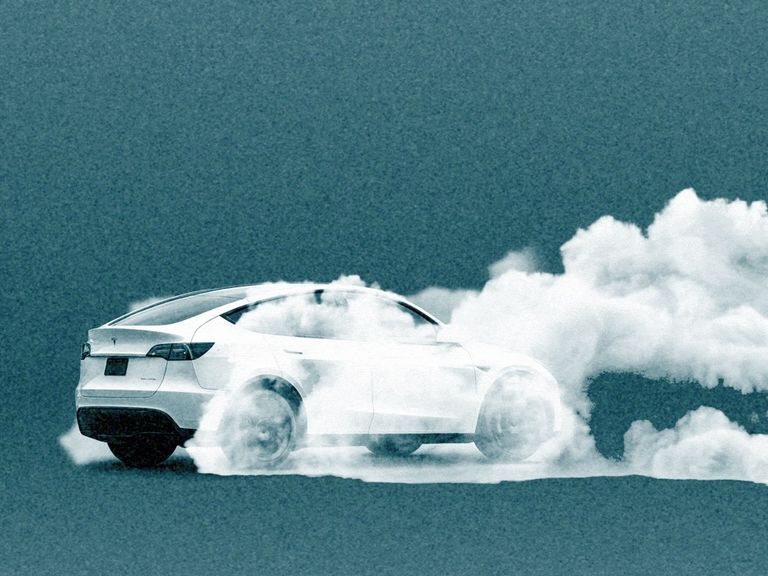
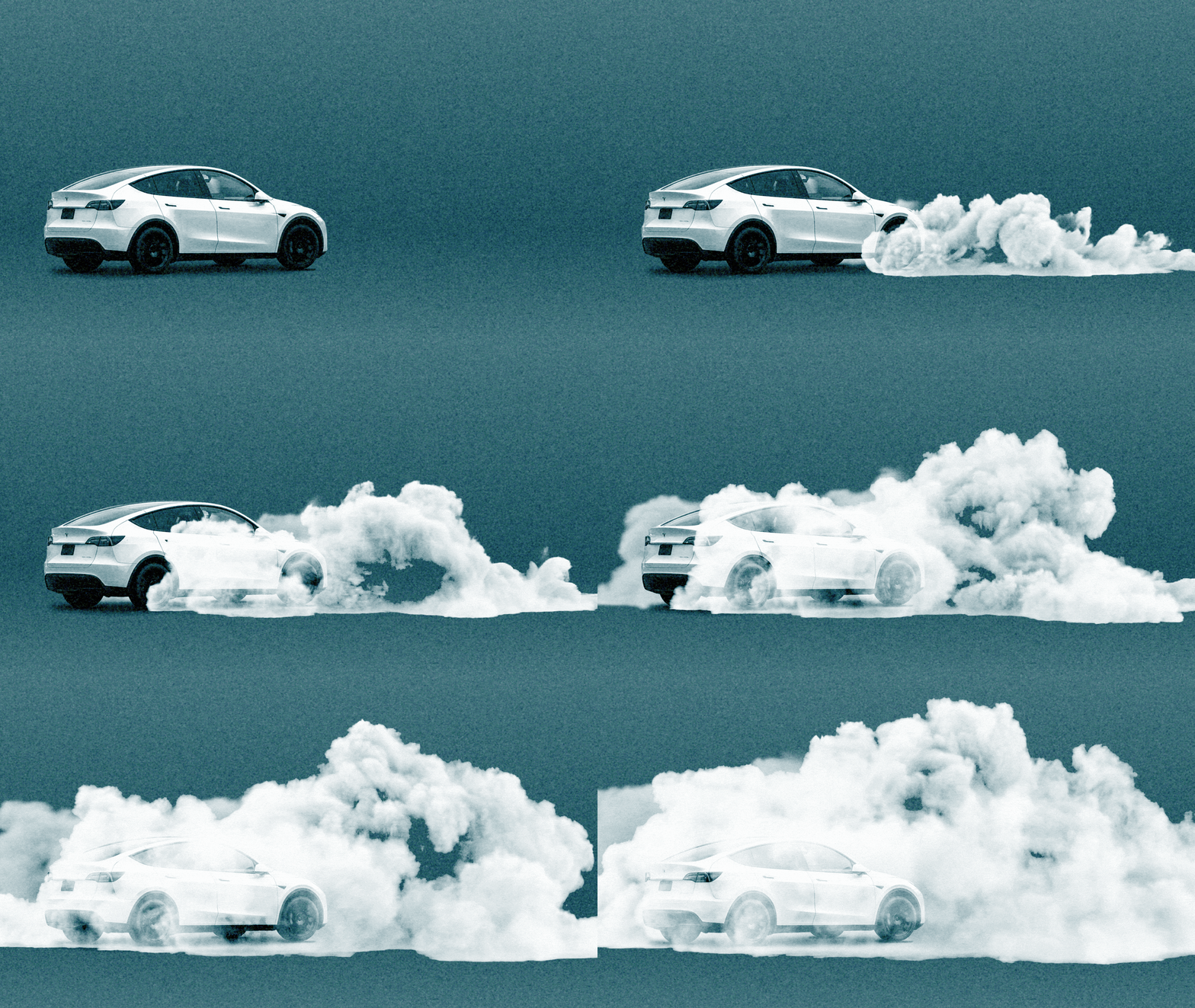
Should regulatory gridlock or physical manufacturing limits derail the cold-gas thruster concept, Tesla risks alienating its original institutional base while remaining exposed to aggressive Chinese EV price erosion. However, if the company successfully executes its re-rating into a multi-vertical robotics, autonomous mobility, and extreme hardware leader, the flying Roadster will be remembered not as an eccentric engineering anomaly, but as the high-velocity smoke screen that masked the most lucrative strategic pivot in corporate industrial history.