Executive Takeaways
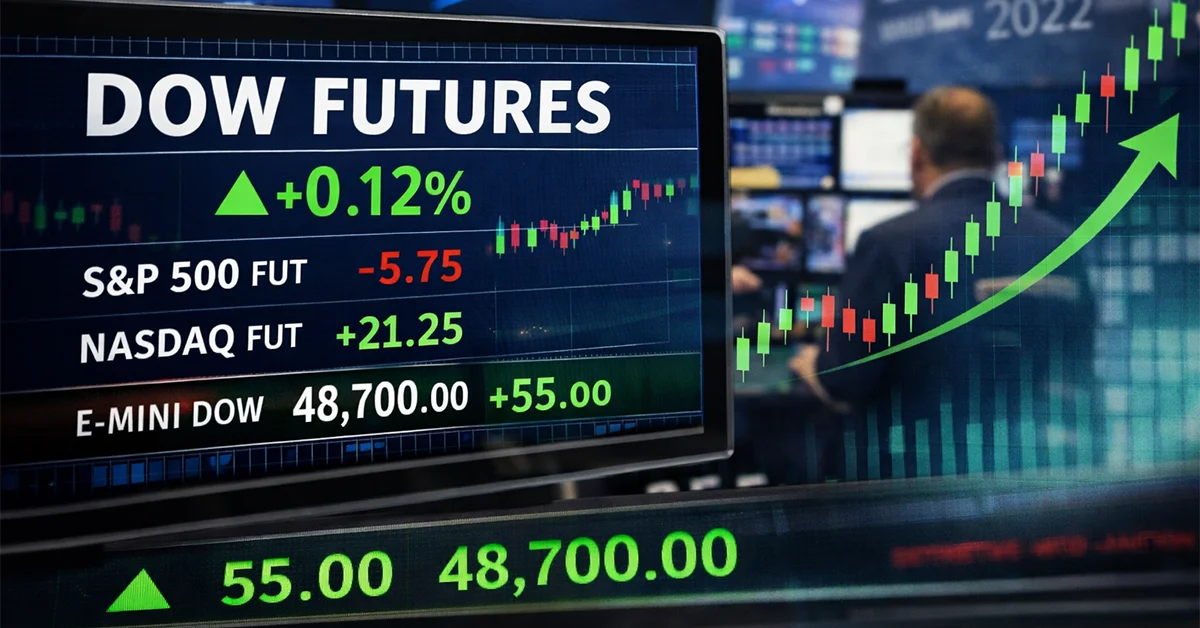
- Broad Market Volatility: Dow Jones, S&P 500, and Nasdaq futures are showing persistent instability following a severe, broad-based sell-off across equities.
- Macroeconomic Catalyst: Market participants are aggressively recalibrating capital allocation ahead of the Bureau of Labor Statistics' pivotal non-farm payrolls report.
- Valuation Compression: High-multiple tech stocks and cyclical enterprises face intense scrutiny as investors re-evaluate risk mitigation strategies and interest rate trajectories.
- Liquidity & Capital Flows: Institutional portfolios are executing defensive rotation models, prioritizing cash equivalents and high-yield fixed-income assets over equity growth vectors.
NEW YORK — Global financial markets are navigating a high-stakes inflection point this week, characterized by acute nervousness across major U.S. index futures. Following a brutal, cascading sell-off that erased billions in market capitalization, equity benchmarks including the Dow Jones Industrial Average, the S&P 500, and the technology-heavy Nasdaq Composite are currently hovering in a narrow, precarious band. Traders, institutional portfolio managers, and risk mitigation desks are holding their breath as they await the definitive employment data release, a metric universally expected to dictate monetary policy for the remainder of the fiscal year.
The sudden deterioration in market sentiment underscores a fragile macroeconomic ecosystem. For months, corporate executives and institutional investors have balanced the promises of artificial intelligence infrastructure scalability against persistent inflationary pressures and shifting central bank signals. However, the recent price action suggests that the margin for error has evaporated. As valuation multiples contract, corporate boardrooms are being forced to re-examine their enterprise ROI, capital expenditure cycles, and balance sheet liquidity in real-time.
Anatomy of the Sell-Off: Catalysts and Mechanics
Test Our Free AI & Tech Utilities Suite
Calculate LLM API token costs, analyze article dwell-time, or simulate tech DCA returns.
The roots of the current market wobble lie in a convergence of profit-taking, stretched valuations, and shifting bond yields. Throughout the previous quarter, aggressive capital allocation into mega-cap technology equities drove historical concentration in major indices. This heavy reliance on a handful of market drivers created an asymmetric risk profile. When preliminary economic indicators suggested a faster-than-anticipated cooling in consumer demand coupled with stubborn wage growth, algorithmic trading models triggered synchronized sell signals.
The mechanics of the recent drawdown were exacerbated by thinning market liquidity. As stop-loss orders were executed across automated platforms, institutional block trades accelerated the downward momentum. Sectors that previously enjoyed robust investor confidence—particularly cloud compute architecture providers, semiconductor fabricators, and discretionary retail giants—experienced sharp valuation adjustments. This unwinding exposed vulnerabilities in leveraged portfolios, prompting a rapid flight to quality as institutional allocators sought safety in short-term U.S. Treasury bills and defensive consumer staples.
Furthermore, regulatory compliance pressures and evolving macroeconomic headwinds have complicated strategic corporate planning. Chief Financial Officers are finding it increasingly difficult to project forward earnings against a backdrop of erratic consumer behavior and fluctuating input costs. Consequently, the sell-off is not merely a technical correction; it is a fundamental reassessment of corporate pricing power and earnings durability.
The Employment Report Catalyst: What the Street is Pricing In

All eyes are now locked on the upcoming employment report from the Department of Labor. This macroeconomic release serves as the primary compass for the Federal Reserve’s dual mandate of maximum employment and price stability. Wall Street consensus estimates suggest a moderate cooling in job creation, yet traders remain acutely sensitive to any statistical surprise—whether a hotter-than-expected payroll print that could reignite fears of prolonged high interest rates or a sharp contraction signaling an impending economic recession.
A stronger-than-expected jobs report would likely validate the "higher-for-longer" interest rate thesis, delivering a fresh blow to growth-oriented equity valuations and increasing debt servicing costs for capital-intensive enterprises. Conversely, a significantly weaker print could trigger immediate relief rallies in fixed-income markets while simultaneously stoking recessionary anxieties among equity investors. This dichotomy has paralyzed directional conviction, resulting in the current wobbly, low-conviction futures trading environment.
| Index / Asset Class | Recent Trend / Action | Primary Driver | Risk Outlook |
|---|---|---|---|
| Dow Jones Industrial Average | Defensive consolidation; minor losses | Industrial cyclicality & interest rate sensitivity | Moderate |
| S&P 500 | Broad-based index pullback | Valuation compression & profit-taking | Elevated |
| Nasdaq Composite | Sharp volatility & high beta swings | Tech multiples & infrastructure spending | High |
| U.S. Treasury Yields | Fluctuating / Flight to safety demand | Monetary policy expectations & jobs data | Critical |
Industry & Market Implications
The ripple effects of this market turbulence extend far beyond Wall Street trading desks, directly impacting corporate strategy, venture capital deployment, and enterprise technology investments.
- Winners: Cash-rich enterprises, defensive consumer staples conglomerates, and fixed-income managers stand to benefit as capital flees volatile equities. Short-duration bond funds and money market instruments are experiencing record inflows.
- Losers: High-beta technology startups, pre-profit growth firms reliant on continuous venture capital rounds, and highly leveraged enterprises face severe challenges in securing cost-effective capital.
- Broader Economic Impact: Corporate boardrooms are implementing stringent cost controls, delaying non-essential infrastructure expansion, and prioritizing operational efficiency over aggressive top-line growth. This macroeconomic conservatism is beginning to reflect in labor market utilization rates.
Frequently Asked Questions (People Also Ask)
Why are stock market futures fluctuating after the recent sell-off?
Market futures are experiencing instability as investors digest the implications of recent equity losses and position themselves ahead of critical macroeconomic data releases, specifically the monthly employment report. Uncertainty regarding Federal Reserve interest rate decisions and corporate earnings durability continues to drive intraday volatility.
How does the jobs report impact the Dow, S&P 500, and Nasdaq?
The non-farm payrolls and unemployment rate data provide vital signals regarding the health of the U.S. economy and inflationary pressures. A robust job market can prompt the Federal Reserve to keep interest rates elevated, which typically compresses valuation multiples for the Nasdaq and S&P 500, while influencing cyclical sectors within the Dow.
What strategies are institutional investors employing during market corrections?
Institutional allocators frequently utilize risk mitigation strategies such as portfolio rebalancing toward defensive sectors, increasing cash allocations, purchasing protective put options, and shifting capital into short-term fixed-income instruments to weather heightened volatility.
Are high-growth technology stocks more vulnerable to sell-offs?
Yes. High-growth technology stocks often trade at elevated valuation multiples based on projected future cash flows. When interest rates rise or economic growth slows, the present value of those future earnings decreases, triggering steeper corrections in tech-heavy indices like the Nasdaq compared to traditional value sectors.
Future Outlook and Key Milestones to Watch
As the financial markets move past the immediate shock of the recent sell-off, strategic focus will shift toward upcoming corporate earnings seasons and central bank communications. The overarching trajectory of equities will depend heavily on whether corporate America can successfully defend profit margins in an environment characterized by moderate economic expansion and disciplined capital allocation.
Key milestones for investors to monitor include the official release of the Bureau of Labor Statistics jobs report, subsequent commentary from Federal Reserve officials regarding monetary policy easing timelines, and early corporate guidance indicators for the upcoming quarter. In this climate of heightened sensitivity, maintaining disciplined risk management, rigorous balance sheet analysis, and diversified asset allocation will remain paramount for navigating the evolving market landscape.