Executive Takeaways
- Macroeconomic Shockwave: Recent Democratic electoral victories have injected a new wave of regulatory uncertainty into global equity markets, triggering sharp sell-offs across major tech indices.
- Capital Allocation Re-evaluation: Institutional investors are rapidly reassessing valuation multiples, enterprise ROI, and cloud compute architecture investments amid fears of impending antitrust enforcement and strict environmental compliance.
- Infrastructure Scalability Bottlenecks: Potential shifts in federal energy policy and grid access threaten the power-hungry data centers underpinning the generative AI boom.
- Flight to Safety: Global liquidity is rotating away from high-beta semiconductor and software names toward defensive assets, risk mitigation instruments, and fixed-income portfolios.
NEW YORK / LONDON / TOKYO — Global equity markets experienced a sharp, synchronized contraction overnight as the ripple effects of decisive Democratic electoral wins reverberated through international financial capitals. Wall Street futures plummeted in pre-market trading, dragging European benchmarks and Asian bourses down with them. At the core of this sudden market correction is a mounting institutional anxiety: the fear that a shifting political landscape will upend the regulatory status quo, directly threatening the unprecedented capital expenditure and valuation multiples driving the artificial intelligence boom.
For the past thirty-six months, the global market rally has been fueled almost exclusively by an unprecedented technological supercycle. Trillions of dollars in enterprise capital allocation have flowed into generative AI infrastructure, semiconductor fabrication, and hyperscale cloud compute architecture. However, the unexpected electoral outcomes have introduced a disruptive variable. Wall Street's elite quantitative desks and fundamental research analysts are now aggressively recalibrating models to account for a harsher regulatory climate, increased antitrust scrutiny, and potential interventions in energy markets.
The Catalytic Shift: Politics Meets Silicon Valley's Balance Sheet
Test Our Free AI & Tech Utilities Suite
Calculate LLM API token costs, analyze article dwell-time, or simulate tech DCA returns.
The nexus between political power and technological innovation has historically been defined by a light-touch regulatory approach, particularly concerning emerging technologies. Yet, the recent democratic sweeps in key legislative and executive races signal a profound pivot. Progressive lawmakers, emboldened by their victories, have made no secret of their skepticism toward Big Tech's unchecked consolidation, data harvesting practices, and staggering energy consumption.
Institutional portfolio managers are acutely aware that a more aggressive regulatory posture could dismantle the core growth assumptions baked into current stock prices. When evaluating enterprise ROI on multi-billion-dollar AI deployments, corporate treasurers now face the looming specter of compliance overheads, mandatory model transparency audits, and severe limitations on proprietary data aggregation. The market's immediate reaction reflects a classic risk-off rotation, as portfolio risk managers execute aggressive risk mitigation strategies to protect year-to-date gains.
The Energy Conundrum and Infrastructure Scalability
One of the most immediate casualties of the shifting political winds is the intersection of artificial intelligence and energy infrastructure. Training and operating advanced large language models require staggering amounts of electrical power, often straining regional power grids and forcing tech giants to explore alternative energy sources, including revived nuclear power purchase agreements.
Democratic platforms have historically emphasized strict environmental compliance, carbon reduction mandates, and regulatory oversight by agencies such as the Federal Energy Regulatory Commission (FERC) and the Environmental Protection Agency (EPA). If new legislative frameworks restrict tech companies from securing dedicated, high-capacity power supplies for their data centers, the entire trajectory of infrastructure scalability faces a severe bottleneck. Wall Street analysts note that any restriction on power grid access or imposition of carbon penalties will directly compress net margins for hyperscalers.
Global Market Liquidity and Cross-Border Spillover Effects
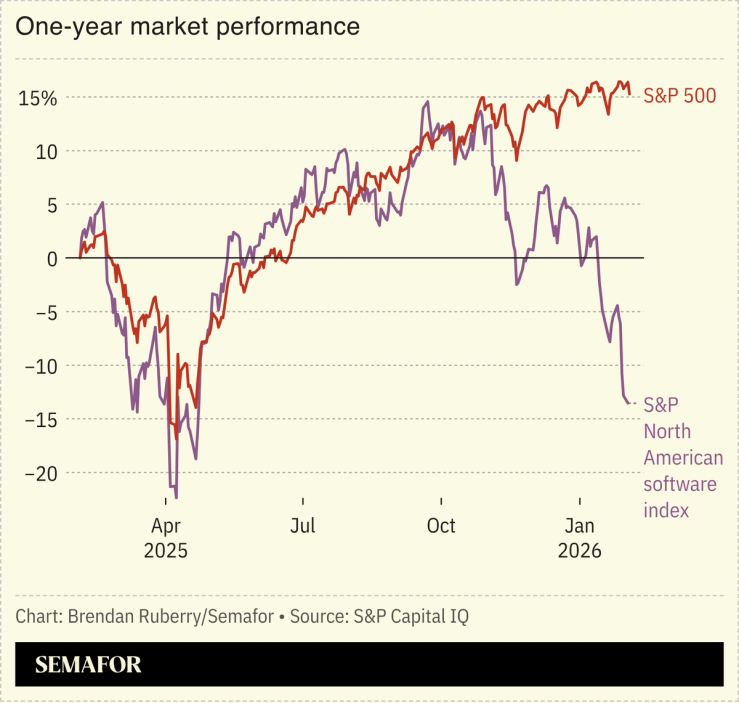
The sell-off was by no means localized to domestic U.S. exchanges. In Asian trading sessions, key semiconductor manufacturers, contract foundries, and memory chip suppliers absorbed heavy losses. European enterprise software providers and automated industrial tech firms similarly drifted into negative territory, illustrating the deeply integrated nature of the global technology supply chain.
As market liquidity tightened, foreign institutional investors scrambled to adjust exposure. High-beta growth stocks, which had previously traded at forward price-to-earnings multiples exceeding historical averages, bore the brunt of the liquidation. Conversely, defensive sectors—such as healthcare, utilities, and consumer staples—experienced modest inflows as capital sought shelter from regulatory crosswinds.
Verified Data & Metrics Breakdown Table
The following table outlines the immediate financial impact across key global indices, asset classes, and valuation metrics following the market open:
| Index / Asset Class | Pre-Shock Valuation Multiple (P/E) | Immediate Price Action (%) | Primary Driver of Correction |
|---|---|---|---|
| NASDAQ 100 | 32.4x | -3.8% | Antitrust fears and capital expenditure retrenchment |
| Philadelphia Semiconductor Index (SOX) | 29.1x | -5.2% | Supply chain valuation re-rating & export controls |
| Stoxx Europe 600 Technology | 24.8x | -2.9% | Global sentiment spillover and regulatory harmonization fears |
| US 10-Year Treasury Yield | N/A (Yield: 4.22%) | -8 bps (Flight to Safety) | Macroeconomic safe-haven bid |
Industry & Market Implications: Winners and Losers
In every major macroeconomic dislocation, capital simply changes hands rather than disappearing entirely. While the sell-off has punished high-growth tech darlings, distinct segments of the global economy stand to benefit from the shifting regulatory and political paradigm.
- The Losers: Hyperscale cloud providers, pure-play artificial intelligence startups reliant on venture capital funding rounds, semiconductor fabrication firms with heavy exposure to bleeding-edge nodes, and energy-intensive data center developers facing grid constraints.
- The Winners: Traditional energy and utility firms capable of negotiating strictly regulated power purchase agreements, cybersecurity providers benefiting from mandated compliance standards, and defensive fixed-income instruments experiencing renewed yield demand.
Furthermore, corporate legal departments and regulatory compliance consulting firms are experiencing a surge in demand. Chief Executive Officers are rapidly expanding their lobbying and compliance budgets to navigate what promises to be a highly restrictive legislative agenda over the next congressional cycle.
Frequently Asked Questions (People Also Answered)
Why are Democratic electoral wins triggering a sell-off in AI stocks?
Democratic victories are widely interpreted by institutional investors as a precursor to stricter federal regulations, enhanced antitrust enforcement, and aggressive oversight of large technology conglomerates. Markets fear that compliance costs, restrictions on proprietary data usage, and environmental rules governing power-hungry data centers will compress future profit margins and invalidate the lofty valuation multiples currently assigned to AI-focused equities.
How do energy regulations impact the artificial intelligence boom?
Generative AI models require immense computational power, translating directly into massive electricity consumption for data centers. Progressive political platforms often favor stringent environmental regulations and carbon emission standards. If federal or state regulators restrict data centers from accessing cheap, continuous power or mandate expensive green-energy transitions, the physical infrastructure scalability of the AI industry faces significant bottlenecks.
Are international markets being affected by U.S. political shifts?
Yes. Global capital markets are deeply interconnected. When U.S. technology indices experience corrections due to regulatory fears, the sentiment rapidly propagates to European software houses and Asian semiconductor manufacturers. Global supply chains rely heavily on U.S. enterprise demand and technological leadership; any domestic disruption in the United States reverberates instantly across cross-border portfolios.
What should institutional investors do during this market rotation?
Many wealth managers and risk officers are executing defensive rebalancing strategies. This involves trimming overextended high-beta technology holdings, locking in profits, increasing allocations to fixed-income assets, and rotating capital into strictly regulated sectors that offer insulation from political volatility, such as defensive utilities and compliant cybersecurity firms.
Future Outlook: Milestones to Watch
As global financial markets digest the immediate shock of the Democratic electoral victories, attention turns to upcoming legislative calendars and regulatory appointments. Chief investment officers across Wall Street and the City of London are monitoring several critical milestones:
- Antitrust Filings and Department of Justice (DOJ) Actions: Any new legal challenges or injunctions filed against major cloud providers and AI developers will serve as a bellwether for federal enforcement aggression.
- Congressional Committee Hearings: Upcoming testimonies from Big Tech executives regarding energy consumption, algorithmic transparency, and intellectual property rights will dictate short-term sentiment.
- Q3 and Q4 Earnings Guidance: Corporate conference calls will reveal whether enterprise clients are scaling back their AI software budgets in anticipation of regulatory friction or proceeding with planned capital expenditures regardless of political headwinds.
Ultimately, the artificial intelligence boom is not facing extinction, but it is entering a more mature, heavily scrutinized phase of its lifecycle. The era of unchecked, frictionless expansion is being replaced by a complex regulatory reality—one where capital allocation must account not only for technical brilliance, but for the unforgiving arithmetic of political compliance.