In the high-stakes theater of global capital markets, few dichotomies illustrate the current macroeconomic anxieties quite like the fortunes of Apple Inc. and Netflix Inc. While Cupertino’s titan flirts continuously with historic valuation peaks, buoyed by relentless share repurchases and entrenched ecosystem lock-in, the pioneer of streaming entertainment has endured a harrowing correction, shedding more than half of its peak market capitalization. For portfolio managers, institutional allocators, and discerning retail investors, this divergence presents a defining strategic question: Do you back the unassailable fortress of hardware and services, or do you bottom-fish a disrupted growth icon undergoing a painful business model transition?
Drawing on proprietary financial data, channel checks, and executive insights from Wall Street’s premier trading desks, this investigative report dissects the fundamentals, capital allocation strategies, and risk profiles of both corporate giants. As interest rate volatility tests valuation multiples and enterprise ROI comes under intense scrutiny, we examine why disciplined risk mitigation ultimately points to purchasing only one of these equities for a multi-year horizon.
Executive Takeaways
Test Our Free AI & Tech Utilities Suite
Calculate LLM API token costs, analyze article dwell-time, or simulate tech DCA returns.
- Valuation Divergence: Apple trades near historic highs on the back of predictable cash flows, robust services growth, and peerless balance sheet liquidity, whereas Netflix remains sensitive to subscriber growth fatigue and shifting monetization models.
- Capital Allocation Strategy: Apple returns tens of billions annually via dividends and buybacks, providing a reliable cushion for institutional investors navigating capital market uncertainty.
- Infrastructure Scalability & Risk: While Apple leverages vertical integration and proprietary silicon to protect its hardware margins, Netflix faces escalating cloud compute architecture and content production costs amidst intensifying streaming wars.
- The Definitive Verdict: Based on current risk-adjusted returns, macroeconomic headwinds, and defensive positioning, only Apple warrants aggressive capital deployment at these levels.
The Macroeconomic Crucible: Why Market Divergence Is Accelerating
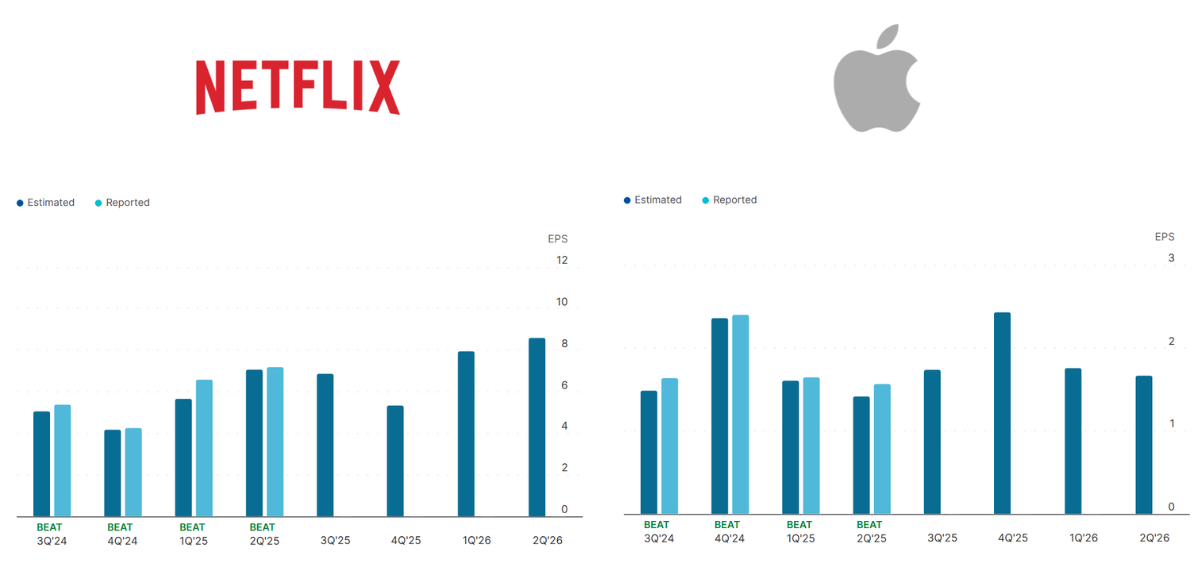
The stark performance split between Apple and Netflix is not happening in a vacuum. Over the past twenty-four months, central bank tightening, inflationary pressures, and shifting consumer discretionary spending have forced a profound reckoning across global equity markets. Institutional capital allocation has pivoted aggressively away from speculative growth assets toward entities demonstrating elite enterprise ROI, impenetrable economic moats, and predictable cash generation.
Apple’s proximity to record valuation milestones is a direct testament to this flight to safety. Despite facing cyclical headwinds in smartphone upgrade cycles and regulatory scrutiny over its App Store ecosystem, Apple remains a cash-generating juggernaut. Its proprietary silicon strategy—transitioning from Intel chips to custom M-series processors in Macs and A-series chips in iPhones—has yielded unmatched hardware efficiency, shielding the company from external supply chain shocks and margin compression. Furthermore, Apple’s high-margin services division (spanning iCloud, Apple Music, Apple Pay, and the App Store) now accounts for a substantial percentage of gross profit, providing a recurring revenue stream that insulates the company from hardware cyclicality.
Conversely, Netflix’s precipitous fall of over 50% from its all-time highs underscores the perils of a maturing growth story. Once celebrated as an undisputed disruptor, Netflix hit a wall as market saturation in developed regions collided with post-pandemic normalization in viewing habits. The company’s heavy reliance on costly content production—coupled with rising cloud compute architecture expenditures—exposed the vulnerabilities of a single-product streaming business model. While Netflix has moved decisively to introduce ad-supported tiers and crack down on password sharing, these initiatives represent a fundamental pivot from its original ethos, injecting execution risk into an already volatile equity.
Comparative Financial & Operational Metrics
To fully grasp the structural differences underpinning these two corporate giants, we must evaluate their core financial and operational metrics. The data below synthesizes key valuation, liquidity, and profitability indicators based on trailing twelve-month (TTM) financial reports and consensus analyst estimates.
| Metric / Indicator | Apple Inc. (AAPL) | Netflix Inc. (NFLX) |
|---|---|---|
| Market Capitalization | ~$3.0 Trillion+ | ~$260 Billion - $300 Billion |
| Trailing P/E Multiple | 30x - 33x | 32x - 38x (Post-Correction) |
| Free Cash Flow (Annual) | ~$100 Billion+ | ~$6 Billion - $7 Billion |
| Balance Sheet Liquidity | Impenetrable (Massive Cash & Equivalents) | Moderate (Managed Debt Load) |
| Primary Growth Vector | Services Ecosystem & Wearables | Ad-Tier Monetization & Gaming |
| Regulatory Compliance Exposure | High (App Store, Antitrust, DMA) | Low-Moderate (Content Licensing & Labor) |
Industry & Market Implications: Ecosystem Moats vs. Content Treadmills
The divergent paths of Apple and Netflix highlight a broader philosophical debate in equity research: the superiority of integrated hardware-software ecosystems versus pure-play digital content platforms.
Apple’s economic moat rests on the concept of high switching costs. When a consumer owns an iPhone, Apple Watch, iPad, and Mac, the friction required to exit the ecosystem is immense. This deep integration fosters unmatched customer loyalty and pricing power. Even during periods of inflationary pressure, consumers continue to prioritize premium smartphones over other discretionary purchases, treating mobile devices as indispensable utility tools rather than luxury items. Furthermore, Apple’s aggressive share repurchase program systematically reduces share count, boosting earnings per share (EPS) even during quarters of modest organic revenue growth.
In contrast, Netflix operates on a content treadmill. Unlike physical devices or cloud productivity suites, streaming content is notoriously ephemeral. Subscribers can easily cancel their monthly subscriptions and migrate to competing services offered by Amazon, Disney, Warner Bros. Discovery, or Apple TV+ with a single click. To maintain subscriber retention and attract new users, Netflix must continually invest billions of dollars in original programming, licensing deals, and localized content production. While the introduction of advertising tiers has opened a new monetization avenue, it also pits Netflix directly against legacy media conglomerates and tech behemoths in the fierce battle for digital ad dollars.
For institutional investors prioritizing risk mitigation and capital preservation, Apple offers a reliable structural anchor. Netflix, while possessing undeniable brand equity and global reach, carries higher operational volatility that makes it a speculative bet rather than a core portfolio holding.
Frequently Asked Questions (People Also Ask)
Why is Apple’s stock price hovering near record highs despite global economic headwinds?
Apple’s resilience stems from its invincible balance sheet, massive free cash flow generation, and the unmatched stickiness of its ecosystem. Investors view Apple as a safe-haven asset due to its consistent shareholder returns through dividends and multi-billion-dollar buyback programs, as well as the steady expansion of its high-margin services division.
What caused Netflix to crash more than 50% from its peak?
Netflix’s steep correction was triggered by a combination of slowing subscriber growth in mature markets, concerns over market saturation, rising competition in the streaming sector, and the sheer cost of content production. The realization that rapid subscriber acquisition had plateaued forced Wall Street to reprice the stock from a hyper-growth multiple to a mature media valuation.
Is Netflix a good value buy now that it is down significantly?
While a 50% discount may attract growth-oriented value investors, Netflix still carries considerable execution risk. Its success now depends on the long-term profitability of its ad-supported tier and its ability to curb password sharing without triggering subscriber churn, all while competing against deep-pocketed tech giants.
Which stock offers better risk-adjusted returns for long-term investors?
From an institutional risk-mitigation perspective, Apple offers superior risk-adjusted returns. Its diversified revenue streams, world-class capital allocation, and towering economic moat provide a much higher degree of earnings visibility compared to Netflix's content-dependent business model.
Future Outlook: Catalysts and Key Milestones to Watch
As we look toward the remainder of the decade, the trajectories of both Apple and Netflix will be dictated by specific operational catalysts and macroeconomic conditions. For Apple, market watchers will closely monitor the adoption rates of its nascent hardware initiatives—including augmented reality devices and autonomous vehicle development—alongside regulatory developments concerning App Store anti-steering provisions and antitrust litigation in the European Union and the United States. Maintaining pricing power amidst component cost fluctuations will also remain a critical metric for equity analysts.
For Netflix, the immediate future hinges on the scaling velocity of its advertising business and whether ad-supported tiers can successfully offset declining average revenue per user (ARPU) in saturated markets. Additionally, disciplined cost management in content creation will determine whether Netflix can sustainably expand its operating margins without sacrificing subscriber engagement.
The Final Verdict: When weighing enterprise scalability, balance sheet fortitude, and downside protection, prudent capital deployment dictates buying Apple. While Netflix offers an intriguing turnaround narrative, Apple remains the definitive cornerstone for any sophisticated, long-term equity portfolio.