Executive Takeaways
Test Our Free AI & Tech Utilities Suite
Calculate LLM API token costs, analyze article dwell-time, or simulate tech DCA returns.
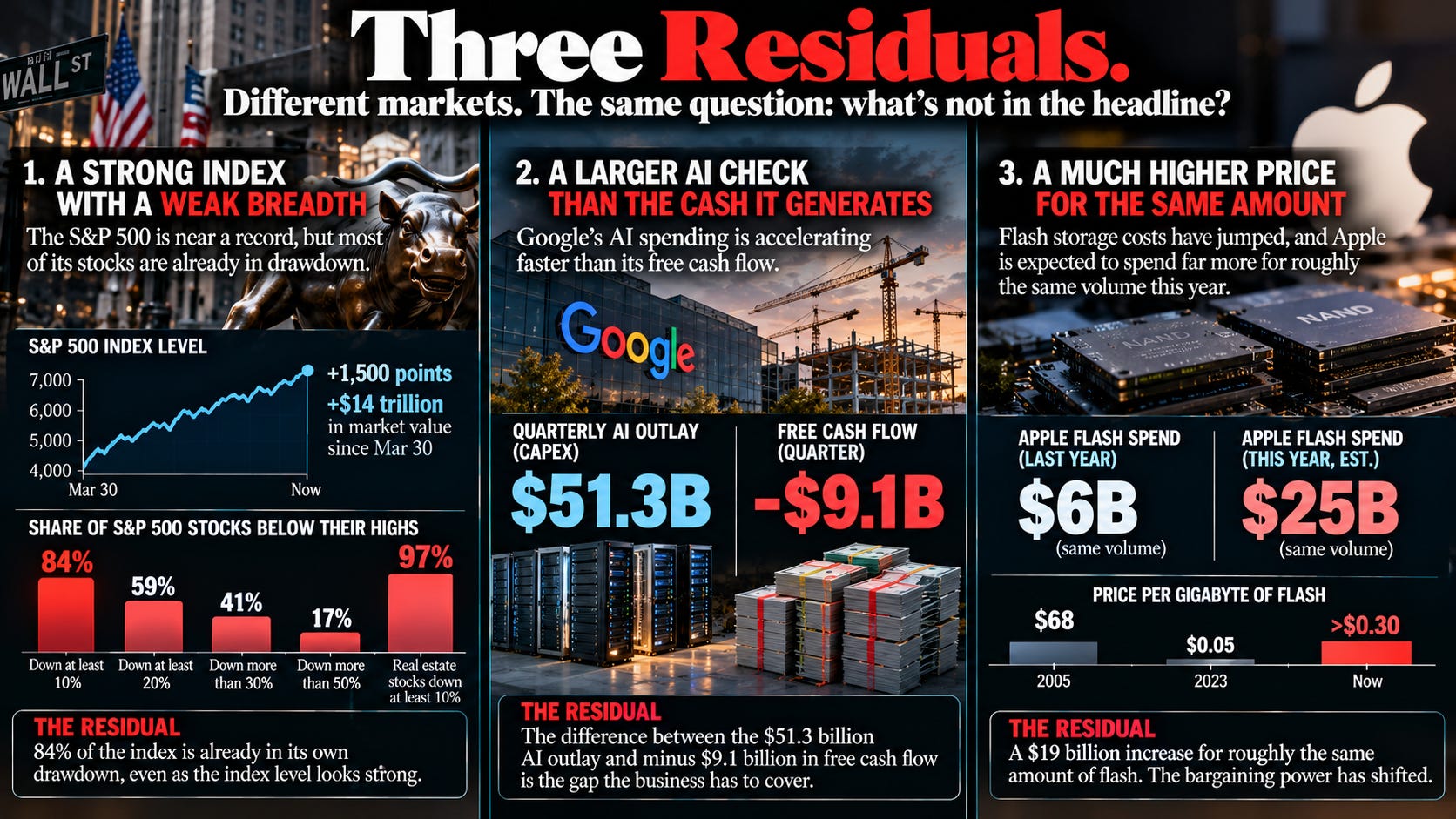
- Unprecedented Capital Allocation: Alphabet has updated its full-year 2026 capital expenditure (CapEx) guidance to a historical peak of up to $205 billion, substantially outpacing early Wall Street consensus estimates of $145 billion to $160 billion.
- Infrastructure Re-engineering: The spending acceleration is directed into bespoke physical compute architecture, including proprietary Tensor Processing Unit (TPU) fabrication, high-density liquid-cooled data center facilities, and gigawatt-scale clean energy purchase agreements (PPAs).
- Margin Compression vs. Defensive Moat: Wall Street is demanding clearer timelines for enterprise Return on Invested Capital (ROIC) as massive CapEx growth compresses near-term free cash flow (FCF) yields, even as executive leadership defends the outlay as vital to securing search dominance and enterprise cloud market share.
- Hyperscaler Arms Race: Alphabet’s infrastructure super-cycle forces immediate strategic responses from Microsoft Azure and Amazon Web Services (AWS), raising the capital entry barriers for generative AI down to a tightly controlled oligopoly.
The $205 Billion Mandate: Anatomy of an Infrastructure Super-Cycle
When Alphabet Inc. revised its capital expenditure trajectory upward to an unprecedented $205 billion for fiscal year 2026, the signal to global financial markets was unmistakable: the era of cautious, incremental enterprise software deployment is officially over. What began as a defensive posture to protect core search revenues following the emergence of rival generative models has transformed into the largest single-firm capital allocation cycle in the history of modern technology.
The updated guidance, verified across financial filings and industry disclosures in July 2026, represents a dramatic acceleration over previous budget models. Wall Street consensus had previously anchored Alphabet’s 2026 CapEx around the $150 billion baseline—a figure already considered aggressive by traditional enterprise software valuation models. The additional $55 billion expansion reflects an aggressive pivot from software optimization to industrial-scale physical compute deployment.
At the core of this spending explosion is the physical reality of frontier artificial intelligence models. As inference workloads across Google Search, Gemini Enterprise, and Google Cloud Platform (GCP) scale exponentially, the underlying compute architecture requires complete structural re-engineering. The capital is not merely funding software development; it is constructing a global network of specialized high-density data centers, custom silicon pipelines, high-bandwidth optical interconnects, and dedicated energy generation facilities.
Deconstructing the Balance Sheet: Where the Capital Is Flowing
To understand how a single enterprise absorbs $205 billion in annual CapEx, one must trace the modern AI supply chain from semiconductor foundries to high-voltage power substations. Alphabet's internal capital breakdown reveals three primary pillars of expenditure:
1. Proprietary Silicon and Foundry Commitments
While competitors remain heavily dependent on external accelerator supply chains, Alphabet has channeled tens of billions directly into its custom Tensor Processing Unit (TPU) ecosystem. The deployment of TPU v6 and the scaling of next-generation TPU v7 architectures—engineered specifically for massive mixture-of-experts (MoE) model training and real-time multimodal inference—represent a significant fraction of hardware spend. Advanced packaging, high-bandwidth memory (HBM3e and HBM4) integration, and guaranteed wafer allocations at Taiwan Semiconductor Manufacturing Company (TSMC) require long-dated capital commitments and upfront cash advances.
2. Next-Generation High-Density Data Center Architecture
Legacy cloud data centers designed for general-purpose CPU compute are fundamentally incapable of supporting modern AI clusters. The enterprise compute densities required for 100,000+ cluster TPU deployments demand liquid-to-chip cooling, direct-to-chip microfluidics, and completely redesigned structural envelopes. Alphabet’s 2026 CapEx includes the construction of greenfield facility clusters capable of drawing between 500 megawatts and 1.5 gigawatts per site, complete with high-density optical switching fabric (Jupiter architecture) to eliminate network latency bottlenecks during large model distributed training.
3. Energy Grid Infrastructure and Nuclear Power Purchase Agreements
The primary operational bottleneck for hyperscale AI expansion is no longer silicon availability; it is power grid access. Alphabet has aggressively expanded its balance sheet commitments to secure long-term energy supplies. This includes multi-gigawatt Power Purchase Agreements (PPAs) across advanced geothermal, solar-plus-storage, and small modular nuclear reactors (SMRs). To secure early access to continuous baseload clean power, Alphabet is co-funding grid interconnection upgrades and utility-scale energy storage projects directly.
Financial Metrics & Capital Trajectory Breakdown
The table below highlights Alphabet’s capital allocation trajectory, operational margins, and compute footprint expansion over three consecutive fiscal cycles, underscoring the structural shift in the company’s cost structure.
| Financial & Operational Metric | FY2024 (Actual) | FY2025 (Actual) | FY2026 (Revised Est.) |
|---|---|---|---|
| Total Capital Expenditure (CapEx) | $51.2 Billion | $112.5 Billion | $190.0B – $205.0 Billion |
| Google Cloud Operating Margin (%) | 10.2% | 17.8% | 23.5% (Projected) |
| Proprietary TPU Deployments (Units) | ~1.2 Million | ~3.1 Million | ~6.8 Million |
| Free Cash Flow (FCF) Yield (%) | 4.8% | 3.1% | 1.6% (Projected) |
| Data Center Power Capacity (Gigawatts) | 4.2 GW | 7.5 GW | 14.2 GW |
| Enterprise Cloud Backlog ($B) | $72.0 Billion | $108.0 Billion | $165.0 Billion |
Wall Street's Dilemma: Margin Compression vs. Platform Dominance
The reaction across institutional investment houses has exposed a sharp divide between short-term fundamental analysis and long-term tech strategy. Equity analysts who historically valued Alphabet on a high-margin, capital-light search engine template are grappling with a financial profile that increasingly resembles a capital-intensive utility or semiconductor foundry.
The primary concern among portfolio managers centers on near-term Return on Invested Capital (ROIC). With CapEx consuming a vastly higher proportion of operating cash flow, Alphabet’s Free Cash Flow conversion rates have experienced steep compression. Depreciation costs associated with short-lived server hardware are set to weight down gross margins through 2027 and 2028, creating headwinds for GAAP earnings growth if enterprise software monetization encounters delays.
Conversely, corporate leadership under Chief Executive Officer Sundar Pichai maintains that aggressive capital allocation is the only structurally sound strategy. In briefing sessions with institutional investors, executive management emphasized that the downside risk of compute under-provisioning—which results in lost cloud market share, degraded search experiences, and operational bottlenecks for enterprise API customers—is vastly more catastrophic than the risk of transient margin compression.
Furthermore, Alphabet’s vertically integrated stack offers a structural cost advantage over competitors who rely exclusively on third-party silicon. By serving Gemini 2.5 and internal Search Generative Experiences via custom TPU architectures, Google achieves an inference cost-per-token that is significantly lower than enterprise peers bound to standard market accelerator pricing. Over a multi-year horizon, this unit-economic advantage is designed to translate into higher long-term gross margins for Google Cloud Platform.
Industry & Market Implications: Who Wins, Who Loses
Alphabet’s massive spending expansion sends ripples across global financial markets, creating distinct structural winners and losers across technology, industrial, and capital markets sector groups.
The Structural Winners
- Semiconductor Foundries and Memory Providers: Advanced nodes at TSMC, along with high-bandwidth memory (HBM) suppliers such as SK Hynix and Samsung, benefit directly from guaranteed high-margin multi-year component orders.
- Thermal Management & Liquid Cooling Specialists: Companies providing direct-to-chip cooling systems, cooling distribution units (CDUs), and specialized heat exchanges are capturing high-margin orders as data centers convert away from legacy air cooling.
- Energy Utilities and IPPs: Independent Power Producers (IPPs) with nuclear, geothermal, and utility-scale solar portfolios possess pricing power as hyperscalers compete fiercely for firm power delivery capacity.
- Google Cloud Enterprise Customers: Enterprise clients benefit from sub-millisecond API response times, collapsing cost-per-token rates, and highly competitive Cloud SLA agreements driven by compute over-provisioning.
The Structural Losers
- Mid-Tier AI Infrastructure Startups: Venture-backed foundational model developers lacking hyperscale capital capacity face an operational wall, forced into expensive compute rental contracts with cloud providers that compress their operating margins.
- Legacy Data Center Operators: Traditional co-location facilities lacking the electrical engineering backbone or cooling infrastructure to host 100kW+ per rack face rapid asset obsolescence.
- Short-Term Cash Yield Investors: Value-oriented equity investors relying on share buybacks and accelerating dividend yield growth will see cash flows redirected away from share retirements into multi-year capital assets.
Frequently Asked Questions (People Also Ask)
Why is Google increasing its 2026 AI capital expenditure to $205 billion?
Google is increasing its CapEx to build out the physical and technological foundation required for next-generation AI models. This includes building high-density, liquid-cooled data centers, mass-producing custom silicon (TPU v6 and v7), securing long-term grid access via clean energy power agreements, and expanding Google Cloud Platform's capacity to serve real-time multimodal search and enterprise customer workloads.
How does this spending increase impact Alphabet's financial margins and stock valuation?
In the near term, a CapEx push to $205 billion leads to free cash flow compression and higher depreciation expenses, which can weigh on GAAP operating margins and earnings multiples. However, long-term investors view this spending as essential for preserving core Search revenue and capturing high-margin market share in enterprise cloud computing by offering lower cost-per-token inference rates.
How do Google's custom TPUs help offset its high infrastructure costs?
Google's proprietary Tensor Processing Units (TPUs) allow the company to bypass the high margins charged by third-party chipmakers. By controlling the hardware stack from design to deployment, Google optimizes hardware-software performance, significantly lowers the unit cost of training and inference, and ensures direct access to compute capacity without relying entirely on external supply chains.
What are the biggest risk factors associated with Alphabet's capital spending surge?
The primary risks include potential over-capacity if enterprise AI adoption slows down, prolonged financial margin pressure, delays in connecting new data centers to regional electrical grids, and hardware obsolescence risks if faster semiconductor architectures emerge before current capital deployments are fully depreciated.
Future Outlook & Strategic Milestones to Watch
As Alphabet executes on its $205 billion capital outlay, financial markets will closely monitor key operational benchmarks over the coming six to eight quarters. The focus will transition from absolute spending metrics to capital efficiency and monetization metrics.
Key indicators to track include:
- Enterprise Cloud Operating Margin Expansion: Whether GCP can consistently improve its operating margins toward the 25%-30% threshold, proving that scale yields operational leverage despite continuous hardware replacement cycles.
- Inference Cost Efficiency (Tokens per Dollar): Benchmark improvements in Gemini token cost structures, which will indicate how effectively custom TPU deployments reduce unit costs relative to commercial alternatives.
- Power Interconnection Timelines: Regulatory and infrastructure approvals for data center grid access, particularly regarding new clean energy and modular nuclear energy projects.
- Search Generative Experience Monetization: The stabilization and expansion of search ad unit pricing within AI-generated search overviews, validating that high-compute search queries maintain strong commercial returns.
Alphabet’s historic capital expansion confirms that leadership views artificial intelligence not as a standard product upgrade cycle, but as a foundational infrastructure shift. For Wall Street and Silicon Valley alike, the $205 billion figure establishes a new baseline for what it costs to compete at the technological frontier.