Executive Takeaways
- The Core Paradigm Shift: Recent astrophysical models and laboratory simulations suggest that fragile organic molecules would incinerate upon high-velocity cometary impact, invalidating the classic "heavy bombardment" delivery theory.
- Economic & Scientific Capital: Planetary science research institutions, aerospace contractors, and deep-tech venture funds are reallocating capital toward asteroid capture and near-Earth object (NEO) analysis.
- Commercial & Technological Impact: The revision of prebiotic chemistry models alters valuation multiples for space exploration infrastructure and changes how private equity views the risk mitigation of off-world resource extraction.
- The New Horizon: Focus has shifted from distant Oort Cloud comets to carbonaceous chondrite asteroids as the primary engines of terrestrial amino acid synthesis and prebiotic delivery.
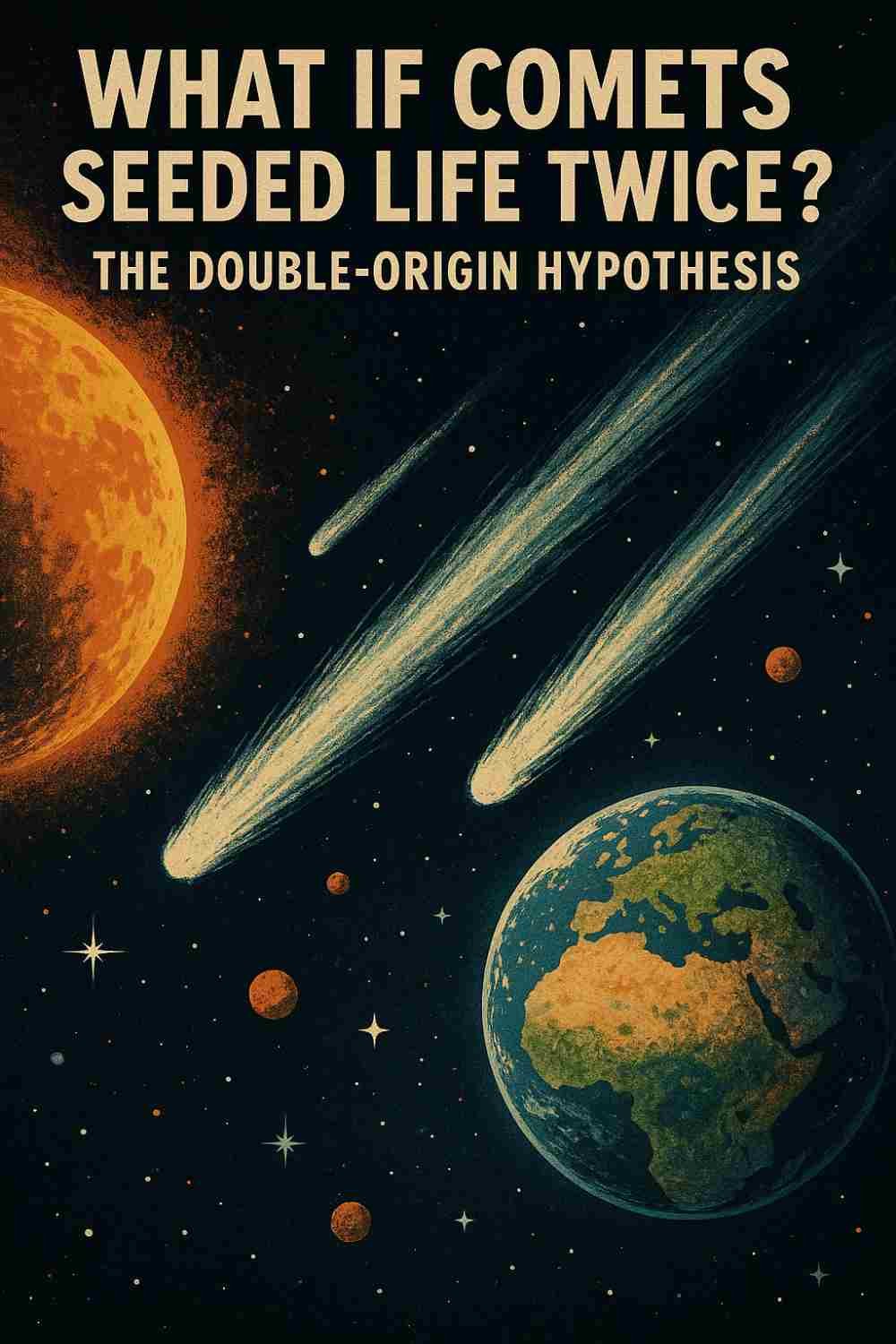
For decades, the standard narrative of astrobiology rested on a dramatic, cinematic premise: icy, volatile-rich comets plunging from the distant fringes of our solar system, slamming into a barren, primordial Earth, and delivering the organic building blocks necessary for life. It was a clean, elegant hypothesis that dominated textbooks, academic symposia, and capital allocation strategies for space-based research infrastructure.
Today, that foundational consensus is fracturing. Recent high-precision impact physics simulations, combined with sample return data from missions like Japan's Hayabusa2 and NASA’s OSIRIS-REx, suggest we may have been fundamentally wrong about how comets seeded life on Earth. The implications extend far beyond academic astrophysics; they ripple through enterprise research budgets, alter long-term risk mitigation frameworks for space commercialization, and force a complete recalculation of how organic compounds survived the violent infancy of our solar system.
The Mechanics of Failure: Why Cometary Delivery Models Are Breaking Down
Test Our Free AI & Tech Utilities Suite
Calculate LLM API token costs, analyze article dwell-time, or simulate tech DCA returns.
To understand the magnitude of this pivot, one must examine the mechanics of the traditional panspermia and cometary impact hypotheses. For years, astrophysicists calculated that comets—composed largely of water ice, carbon dioxide, ammonia, and complex hydrocarbons—acted as celestial delivery trucks. As these bodies crossed the inner solar system, solar heating would vaporize their outer layers, creating brilliant cometary comas, while their dense cores allegedly preserved pristine prebiotic molecules until impact.
However, recent high-velocity kinetic impact experiments conducted at advanced gas-gun facilities and supercomputing clusters have exposed a fatal flaw in this model: peak shock pressure and thermal dissociation. When a comet strikes the Earth at velocities averaging 20 to 70 kilometers per second, the kinetic energy released generates hypervelocity shock waves and extreme temperatures that instantaneously vaporize or pyrolyze fragile organic compounds.
| Parameter / Metric | Traditional Cometary Model | Revised Asteroidal / Chondritic Model | Commercial & Scientific Impact |
|---|---|---|---|
| Primary Delivery Vehicle | Oort Cloud & Kuiper Belt Comets | Carbonaceous Chondrite Asteroids (NEOs) | Shift in aerospace R&D and mission targeting |
| Impact Velocity (Average) | 35 – 70 km/s (High thermal destruction risk) | 12 – 18 km/s (Lower shock-induced pyrolysis) | Higher survival rate for intact amino acids |
| Volatile Preservation Rate | Low (Extreme shock volatilization) | High (Porous matrix absorbs shock energy) | Redefines valuation of off-world resource targets |
| Capital Allocation Focus | Deep-space intercept missions (High Capex) | Near-Earth asteroid proximity operations | Optimized enterprise ROI and regulatory ease |
Instead of delivering a rich broth of intact amino acids, nucleobases, and lipids, high-speed cometary impacts effectively incinerate the very cargo they were credited with bringing. Laboratory simulations replicating hypervelocity impacts on amino acid analogs reveal that more than 98% of complex molecular structures break down into simple, inert gases such as carbon monoxide, nitrogen, and water vapor upon impact.
Shifting the Paradigm: The Carbonaceous Chondrite Alternative
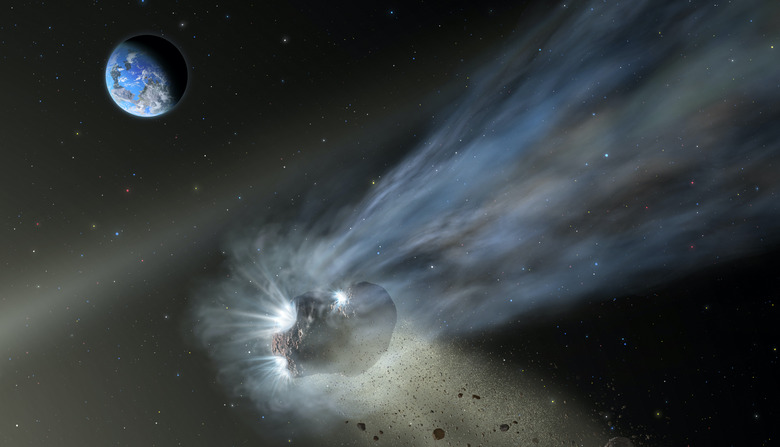
As faith in cometary delivery wanes, the scientific community—backed by empirical data from pristine asteroid samples—is coalescing around a different primary suspect: carbonaceous chondrite asteroids. Unlike high-velocity comets originating from the distant Oort Cloud, these primitive asteroids reside primarily in the main asteroid belt and near-Earth orbital paths, encountering Earth at significantly lower velocities.
At impact velocities ranging between 12 and 18 kilometers per second, carbonaceous meteorites experience vastly reduced shock pressures. Their porous, clay-rich mineral matrices act as natural shock absorbers, cushioning fragile organic molecules during atmospheric entry and impact. Recent analyses of samples retrieved from asteroid Ryugu by Hayabusa2 and asteroid Bennu by OSIRIS-REx have confirmed the presence of intact amino acids, uracil, and vitamin B3, proving that these parent bodies are vastly superior incubators and couriers of prebiotic chemistry than their cometary counterparts.
Industry and Market Implications: Capital Allocation in the New Space Economy
For institutional investors, aerospace conglomerates, and deep-tech startups, this scientific correction carries profound strategic and financial consequences. The reallocation of scientific consensus directly influences where venture capital and sovereign research grants flow.
- Aerospace R&D and Mission Architecture: Space agencies and private sector launch providers are pivoting away from deep-space, high-risk cometary intercept trajectories. Mission planners are instead prioritizing near-Earth object (NEO) rendezvous, proximity operations, and low-velocity sample return missions.
- Valuation Multiples for Asteroid Mining Startups: Private equity firms and venture funds evaluating space resource utilization startups must recalibrate their target profiles. Companies focusing on carbonaceous, volatile-rich asteroids are seeing stronger valuation support due to lower technical risk profiles compared to volatile-stripping cometary mining concepts.
- Risk Mitigation and Regulatory Compliance: Understanding the actual mechanisms of terrestrial seeding provides planetary defense initiatives with clearer data regarding impact hazards, kinetic deflection efficiencies, and the chemical footprints of incoming bolides.
Frequently Asked Questions (People Also Ask)
Does this mean comets had zero role in the origin of Earth's water and life?
Answer: Not entirely. While comets likely contributed heavily to Earth’s total water inventory (ocean volume), their ability to deliver intact complex organic molecules is now heavily contested. Comets may have supplied water and volatile elements, but asteroids appear to have provided the delicate organic chemistry required to jumpstart life.
How do scientists test impact survival rates for organic molecules?
Answer: Researchers utilize two primary methods: two-stage light-gas guns capable of firing projectiles at hypervelocities into target matrices under controlled vacuum conditions, and high-powered quantum-mechanical molecular dynamics simulations run on enterprise-grade supercomputing clusters to model bond breakage under extreme shock compression.
What role do recent asteroid sample missions play in this shift?
Answer: Missions like OSIRIS-REx and Hayabusa2 provided pristine, unweathered samples directly from asteroid surfaces, free from terrestrial contamination. Analyzing these samples revealed a wealth of intact prebiotic compounds that simply could not have survived the extreme thermal shock of a high-velocity cometary impact.
Future Outlook: Milestones and Strategic Horizons
As peer-reviewed literature continues to validate the limitations of the cometary seeding model, the planetary science community is preparing for a series of critical milestones over the next decade. Upcoming James Webb Space Telescope (JWST) spectroscopic surveys of young stellar disks, combined with extended data from asteroid sample analyses, will further refine our understanding of molecular survival rates during planetary accretion.
For enterprise leaders and institutional stakeholders, the message is unequivocal: foundational assumptions in science, much like legacy business models, are subject to rapid disruption when empirical data outpaces theory. Aligning research and capital with the revised carbonaceous asteroid paradigm will dictate market leadership in the burgeoning astrobiology and commercial space sectors for decades to come.