NEW DELHI, LONDON, AND NEW YORK — Ten years ago, on August 25, 2016, a quiet financial revolution went live across the world’s most populous democracy. Ten years later, India’s Unified Payments Interface (UPI) stands not merely as a domestic convenience, but as the single most disruptive public digital infrastructure project in modern economic history. Conceived by the National Payments Corporation of India (NPCI) under the vigilant oversight of the Reserve Bank of India (RBI), UPI bridged fragmented banking silos, democratized merchant access, and systematically bypassed legacy credit card rails that had gouged merchants and locked out unbanked populations for decades.
As financial institutions worldwide grapple with escalating transaction costs, cross-border friction, and enterprise infrastructure scalability challenges, policymakers from Washington to Brussels are studying the UPI architecture as a masterclass in public-private partnership and digital public infrastructure (DPI). Yet, as UPI celebrates its decennial milestone, it faces a complex matrix of geopolitical expansion hurdles, cybersecurity stress tests, and shifting capital allocation dynamics that will dictate its trajectory for the next decade.
Executive Takeaways
- Decennial Milestone: Marking 10 years since its public rollout on August 25, 2016 (following an April 2016 pilot), UPI has evolved from a nascent interbank transfer tool into a global benchmark for instant payments.
- Architectural Triumph: Built on open APIs, interoperable QR codes, and a zero-marginal-cost transaction framework, NPCI’s rails now process billions of monthly transactions, fundamentally altering national liquidity and consumption habits.
- Geopolitical & Commercial Crosscurrents: While the model is being aggressively exported across Southeast Asia, the Middle East, and Europe, domestic monetization debates and anti-monopoly scrutiny of dominant apps like Google Pay and PhonePe present ongoing regulatory challenges.
- Enterprise ROI & Global Replicability: Multinational financial institutions and emerging economies are actively evaluating UPI’s architectural blueprint for risk mitigation, fraud reduction, and cross-border settlement efficiency.
The Genesis: Overcoming Legacy Friction and Architectural Inertia
Test Our Free AI & Tech Utilities Suite
Calculate LLM API token costs, analyze article dwell-time, or simulate tech DCA returns.
To understand the profound economic impact of UPI, one must examine the state of Indian banking prior to 2016. Cash was king, informal credit dominated rural commerce, and digital transactions were encumbered by cumbersome multi-factor authentication, slow net-banking gateways, and high merchant discount rates (MDR). Traditional card infrastructure required expensive point-of-sale (PoS) terminal deployment, restricting digital acceptance primarily to urban storefronts and affluent demographics.
Recognizing these bottlenecks, the Reserve Bank of India and the NPCI—an umbrella organization owned by core retail banks—tasked visionary technologists with engineering an interoperable, mobile-first payment standard. The mandate was clear: decouple payments from specific bank accounts and device operating systems using a virtual payment address (VPA). Released initially in a controlled pilot in April 2016 before its full public inauguration on August 25, 2016, UPI leveraged India’s foundational biometric identity stack (Aadhaar) and mobile penetration surge to onboard millions instantly.
The core architectural brilliance of UPI lay in its interoperability. Unlike closed-loop ecosystems such as WeChat Pay or proprietary card networks like Visa and Mastercard, UPI permitted seamless peer-to-peer (P2P) and peer-to-merchant (P2M) transfers across any participating bank or third-party application provider (TPAP) without extracting punishing intermediary tolls. This design triggered a massive compression in transaction processing times from days to milliseconds, fundamentally altering the velocity of money across the subcontinent.
Verified Data & Metrics Breakdown: A Decade of Exponential Scale
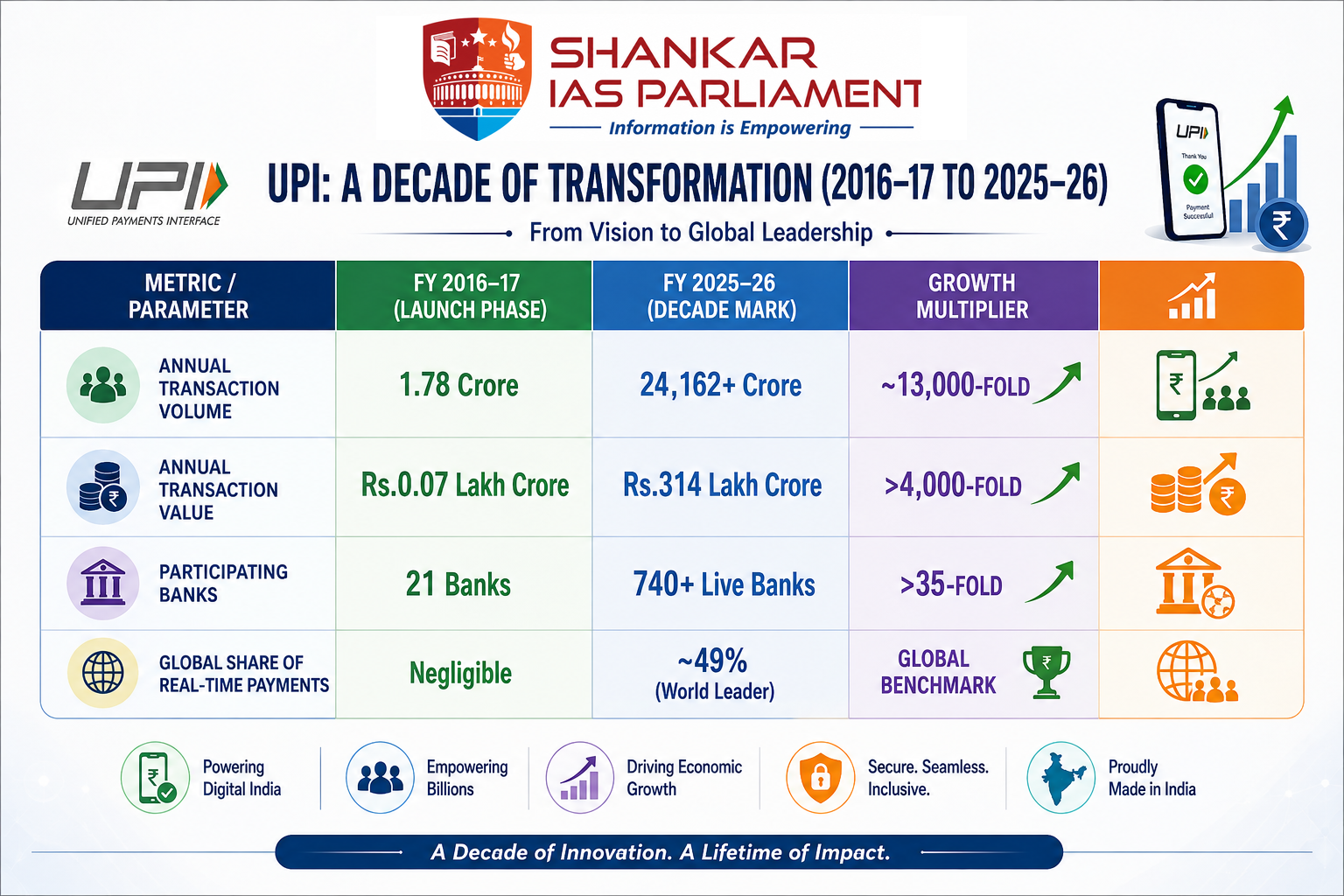
The quantitative growth of UPI over the past ten years defies traditional macroeconomic projections. The following data table illustrates the dramatic scaling of volume, value, and ecosystem participation from its inception to its decennial anniversary.
| Metric / Indicator | 2016 (Inception Year) | 2021 (Pandemic Inflection) | 2026 (Decennial Milestone) |
|---|---|---|---|
| Monthly Transaction Volume | ~0.3 Million | 3.5 Billion | Exceeding 15 Billion+ |
| Monthly Transaction Value | ₹0.9 Billion ($11M USD) | ₹6.5 Trillion ($80B USD) | ₹22+ Trillion ($265B+ USD) |
| Participating Banks | 21 Banks | 220+ Banks | 600+ Banks |
| Market Dominance (Top 2 Apps) | N/A (Fragmented Start) | ~85% (Google Pay / PhonePe) | Consolidated duopoly under strict RBI caps |
Industry & Market Implications: Winners, Losers, and Capital Reallocation
The maturation of UPI has fundamentally reshaped the competitive landscape of financial services, creating stark divergences between legacy operators and agile tech-enabled platforms.
Who Wins
- Fintech Aggregators & TPAPs: Platforms that integrated early into the UPI stack built massive user acquisition funnels, leveraging payment volume data to cross-sell wealth management, insurance, and institutional credit products.
- Small and Medium Enterprises (SMEs): Micro-merchants, street vendors, and regional retailers gained instant access to digital payment acceptance without incurring prohibitive card terminal rentals or 2-3% MDR fees, drastically improving working capital visibility.
- The Sovereign / National Exchequer: By formalizing vast swathes of the informal cash economy, the Indian government enhanced tax compliance, reduced currency printing and logistics costs, and gathered real-time economic telemetry.
Who Loses
- Legacy Credit Card Networks: Traditional card issuers face severe margin compression for low-ticket domestic retail transactions, forcing them to pivot entirely toward high-end reward cards and corporate travel spend.
- Traditional ATM Infrastructure Providers: With cash withdrawals declining as a percentage of overall economic activity, capital expenditure on physical ATM hardware and cash-in-transit logistics has stagnated.
- High-Fee Remittance Operators: Traditional cross-border wire services are under existential pressure as NPCI links UPI directly with international instant payment networks (such as Singapore's PayNow and UAE's Aani).
Frequently Asked Questions (People Also Ask)
1. How does UPI maintain instantaneous transactions without charging merchants high fees?
UPI operates on a real-time interbank transfer protocol backed by the Reserve Bank of India. Unlike card networks that rely on a multi-party interchange fee model (where acquiring banks, issuing banks, and card networks split a percentage of every transaction), UPI was designed as public infrastructure. While the government has periodically subsidized merchant transactions through incentive grants to ensure zero MDR for basic QR payments, discussions around sustainable monetization continue among banks, fintechs, and regulators.
2. What security measures protect UPI from fraud and cyber threats?
Security is enforced through a multi-layered cryptographic framework. Every transaction requires a customized, device-bound UPI PIN known only to the user. Furthermore, the system uses two-factor authentication tied to the user's verified SIM card and mobile device identifier. NPCI and commercial banks also employ real-time machine learning risk engines to flag anomalous transaction patterns and prevent unauthorized fund flows.
3. How is UPI expanding globally outside of India?
NPCI International Payments Ltd. (NIPL) has aggressively forged cross-border partnerships. Travelers from India can use UPI to make payments at merchant terminals across parts of Europe, the Middle East, and Southeast Asia. Additionally, direct bilateral linkages—such as the real-time remittance bridge between India and Singapore—allow instantaneous, low-cost cross-border fund transfers.
4. What regulatory hurdles does UPI face regarding market concentration?
The Indian market has witnessed significant consolidation, with Google Pay and Walmart-backed PhonePe capturing a vast majority of total transaction volume. To mitigate systemic risk, the NPCI and RBI have repeatedly proposed volume caps (limiting any single TPAP to 30% market share), though implementation timelines have faced extensions to avoid disrupting everyday consumer habits.
Future Outlook: The Next Decade of Digital Sovereignty
As UPI enters its second decade, its strategic roadmap focuses on three core pillars: offline proximity payments, AI-driven credit underwriting, and global interoperability. With offline feature-phone solutions (such as UPI123Pay) and proximity audio-wave technologies expanding financial inclusion into remote, low-connectivity rural belts, the addressable user base continues to widen.
Simultaneously, the integration of UPI with the nascent Public Credit Registry (PCR) and account aggregator framework is unlocking instant, unsecured digital lending for millions of retail borrowers who previously lacked formal credit scores. For global central bankers and technology executives, the lesson of the past ten years is definitive: publicly engineered, interoperable digital rails do not merely optimize transaction efficiency—they redefine the fundamental architecture of modern commerce.