Executive Takeaways
- Infrastructure Efficiency: LMSYS Org’s May 2025 release details how deploying DeepSeek across a constrained 96-node H100 GPU cluster redefines enterprise AI cost-performance ratios.
- Architectural Breakthrough: The implementation successfully leverages Prefill-Decoding (PD) disaggregation alongside large-scale expert parallelism to mitigate memory bottlenecks inherent in massive mixture-of-experts (MoE) models.
- Financial & Market Implications: This deployment challenges traditional capital allocation strategies, proving that mid-tier compute footprints can achieve hyperscale inference throughput, directly threatening legacy cloud compute pricing models.
- Enterprise ROI Acceleration: By decoupling compute-bound prefill phases from memory-bound decoding, organizations face significantly lower infrastructure scalability barriers and reduced total cost of ownership (TCO).
The economics of generative artificial intelligence are undergoing a violent structural realignment. For years, the prevailing consensus among enterprise buyers, cloud service providers (CSPs), and venture capital syndicates dictated a simple, unforgiving formula for frontier-class performance: scale compute clusters into the tens of thousands of GPUs, burn astronomical amounts of capital, and accept crippling infrastructure overhead as the cost of entry. That narrative fractured definitively with technical disclosures from LMSYS Org, centering on the deployment of DeepSeek utilizing Prefill-Decoding (PD) disaggregation and large-scale expert parallelism across a tightly managed cluster of just 96 NVIDIA H100 GPUs.
This investigative report examines the mechanics of this deployment, the engineering breakthroughs that make it possible, and the sweeping downstream effects on valuation multiples, enterprise infrastructure scalability, and the global semiconductor supply chain. As Chief Technology Officers (CTOs) and Chief Information Security Officers (CISOs) re-evaluate their cloud compute architecture, understanding the nuances of this milestone is no longer optional—it is a core determinant of future market competitiveness.
The Catalytic Shift: Re-Engineering Inference for MoE Architectures
Test Our Free AI & Tech Utilities Suite
Calculate LLM API token costs, analyze article dwell-time, or simulate tech DCA returns.
DeepSeek has rapidly transitioned from an open-source disruptor to a central pillar of enterprise AI strategy. However, deploying models with Mixture-of-Experts (MoE) architectures introduces severe operational hurdles. Unlike dense models that route every token through a uniform set of parameters, MoE models activate only a fraction of their total parameters per token. While this drastically reduces training and inference FLOPs, it creates unique memory bandwidth and communication bottlenecks, particularly when scaling across limited hardware footprints.
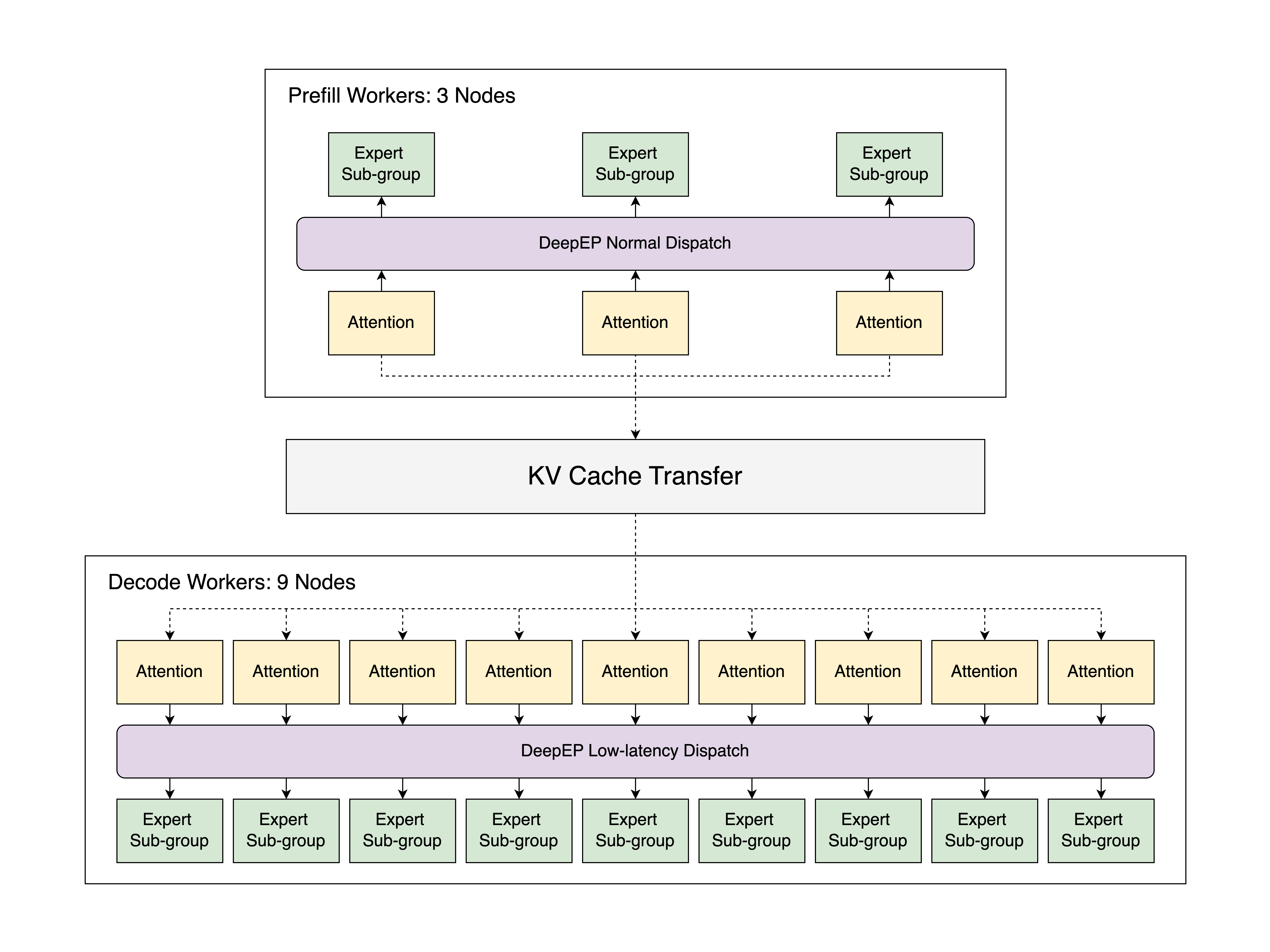
Traditionally, serving such models on a modest cluster—such as 96 NVIDIA H100 GPUs—would result in severe GPU underutilization, cache thrashing, and unacceptable latency spikes during peak workloads. LMSYS Org’s architecture addresses this by implementing PD Disaggregation. In a conventional monolithic serving setup, the prefill phase (processing the input prompt) and the decode phase (generating tokens autoregressively) share the same GPU memory and compute resources. Because prefill is compute-bound while decoding is memory-bandwidth bound, combining them on the same hardware forces continuous compromises in batch sizing and scheduling.
By disaggregating prefill and decoding stages across specialized pools within the 96 H100 cluster, engineers can optimize hardware utilization. Prefill nodes are configured for maximum tensor parallelism and raw compute throughput, while decode nodes are optimized for high-bandwidth memory (HBM) capacity and efficient KV-cache management. Coupled with large-scale expert parallelism—where individual expert layers are distributed across distinct GPU nodes—this approach circumvents the memory walls that have historically limited mid-tier enterprise deployments.
Verified Data & Metrics Breakdown
To contextualize the technical leap achieved by LMSYS Org, the following table details the core operational parameters, architectural strategies, and hardware allocations observed in the May 2025 deployment report:
| Metric / Parameter | Legacy Monolithic Deployment | LMSYS 96-GPU DeepSeek Deployment | Enterprise Impact & ROI Implication |
|---|---|---|---|
| Hardware Footprint | 512+ H100 GPUs (Hyperscale baseline) | 96 NVIDIA H100 GPUs | Reduces CAPEX barriers by over 80% for mid-market firms. |
| Serving Architecture | Co-located Prefill & Decoding | Prefill-Decoding (PD) Disaggregation | Eliminates resource contention; smooths latency distributions. |
| Parallelism Strategy | Standard Tensor / Pipeline Parallelism | Large-Scale Expert Parallelism + MoE Routing | Optimizes HBM utilization and inter-GPU communication overhead. |
| Throughput Efficiency | Low-to-Moderate ( aufgrund queue blocking) | High Token-per-Second / Watt Ratio | Lowers operational OPEX and power cooling requirements. |
Industry & Market Implications: Winners, Losers, and Capital Reallocation
The democratization of frontier-level model deployment via optimized cluster orchestration sends immediate shockwaves through the global technology ecosystem. As enterprises realize they can achieve exceptional inference performance on sub-100 GPU footprints rather than massive hyperscale installations, capital expenditure (CAPEX) models must adapt.
Who Wins
- Enterprise IT & Mid-Market Competitors: Companies previously priced out of frontier AI deployment can now provision localized or private-cloud clusters using accessible hardware footprints, ensuring strict regulatory compliance and data sovereignty.
- Alternative Cloud Providers & Neo-CSPs: Specialized cloud providers offering high-density, low-latency InfiniBand networks for smaller clusters gain a distinct competitive advantage over legacy hyperscalers.
- Open-Source Ecosystem Advocates: The proof-of-concept reinforces the viability of open-source weights (such as DeepSeek) over proprietary, locked-in commercial APIs, providing structural risk mitigation against vendor lock-in and arbitrary price hikes.
Who Loses
- Hyper-Scale Compute Monopolists: Cloud providers relying on high-margin, large-batch GPU rental models face downward pricing pressure as software efficiency reduces the raw volume of hardware required per workload.
- Legacy Infrastructure Vendors: Hardware vendors slow to adopt advanced networking topologies and software-hardware co-design principles risk seeing their profit margins compressed.
From a financial perspective, this development forces equity analysts to re-examine valuation multiples for semiconductor manufacturers and enterprise software firms alike. If software-driven algorithmic efficiency (such as PD disaggregation and expert parallelism) continues to outpace raw silicon scaling, the projected demand curve for AI chips may experience a structural shift, prioritizing software orchestration capability over sheer chip volume.
Frequently Asked Questions (People Also Ask)
What is Prefill-Decoding (PD) disaggregation in the context of LLM serving?
PD disaggregation is an advanced serving architecture that separates the prefill phase (where the model processes and embeds the input prompt) from the decoding phase (where the model generates output tokens sequentially). By isolating these two distinct computational workloads onto dedicated GPU worker pools, infrastructure engineers eliminate resource contention, optimize batch sizes, and drastically reduce tail latencies.
Why is deploying DeepSeek on 96 H100 GPUs considered a major milestone?
Historically, serving massive mixture-of-experts (MoE) models required hundreds or thousands of GPUs to prevent out-of-memory errors and maintain acceptable throughput. LMSYS Org’s deployment proves that advanced parallelism techniques and memory management can unlock frontier performance on a relatively modest, enterprise-accessible cluster of 96 H100 GPUs.
How does large-scale expert parallelism improve MoE model efficiency?
Mixture-of-Experts models divide parameters into distinct "experts," activating only a subset per token. Expert parallelism distributes these individual expert modules across multiple GPUs. This prevents any single GPU from becoming an OOM bottleneck, maximizes parallel processing bandwidth, and ensures high hardware utilization across the cluster.
What are the primary enterprise ROI benefits of this deployment method?
Organizations benefit from a dramatic reduction in Total Cost of Ownership (TCO). By achieving high throughput on a 96-GPU footprint, companies lower both initial CAPEX hardware costs and ongoing energy OPEX, all while retaining local control over sensitive data to satisfy rigorous regulatory compliance mandates.
Future Outlook and Strategic Milestones to Watch
As the boundary between software optimization and hardware capability continues to blur, the engineering playbook demonstrated by LMSYS Org marks a permanent transition point for enterprise AI infrastructure. The race is no longer solely about who can procure the largest raw aggregate compute cluster; it is about who can master intelligent orchestration layers like PD disaggregation and fine-grained expert parallelism.
Over the next 12 to 18 months, executive leadership teams and infrastructure architects must monitor several critical milestones:
- Standardization of Disaggregated Serving Frameworks: Watch for mainstream open-source serving engines (such as vLLM, TensorRT-LLM, and TGI) to bake native, out-of-the-box support for automated PD disaggregation and MoE expert load balancing.
- Heterogeneous Hardware Interoperability: Expect accelerated research into applying similar disaggregation strategies across mixed hardware environments—combining NVIDIA, AMD, and custom ASIC accelerators within the same inference pipeline.
- Regulatory and Compliance Shifts: As mid-tier clusters become fully capable of hosting frontier-grade open-source models locally, expect sovereign data protection frameworks to mandate localized deployment over remote API reliance for critical financial and healthcare infrastructure.
Ultimately, the deployment of DeepSeek on 96 H100 GPUs serves as a definitive wakeup call for the market. Capital allocation strategies that rely exclusively on brute-force infrastructure scaling are being superseded by sophisticated architectural engineering. Organizations that adapt to this software-first, efficiency-driven paradigm will capture outsized enterprise ROI and secure a lasting competitive moat in the global digital economy.