The Billion-Dollar Plume: Inside the Economics and Physics of the Morning "Space Jellyfish" Phenomenon
As early-morning risers capture ethereal, bioluminescent-like plumes across the troposphere, institutional investors and aerospace analysts dissect the commercial launch cadences, infrastructure scalability, and market valuations driving today's breathtaking atmospheric events.
Executive Takeaways
- Atmospheric Mechanics: The striking "space jellyfish" visual is created by twilight phenomenon condensation, occurring when exhaust gases from expanding rocket nozzles at high altitudes interact with direct sunlight while observers remain in pre-dawn darkness.
- Commercial Cadence: Accelerated launch frequencies by private-sector aerospace giants are permanently shifting low-Earth orbit (LEO) capital allocation and cloud compute architecture dependencies.
- Valuation Multiples: Observers are witnessing the direct byproduct of record-setting venture capital and defense outlays, testing the infrastructure scalability and regulatory compliance of modern launch sites.
- Market Impact: Beyond viral social media engagement, these celestial light shows represent critical milestones in risk mitigation, supply chain velocity, and global enterprise connectivity.
Anatomy of a Transient Spectacle: Mechanics of the Plume
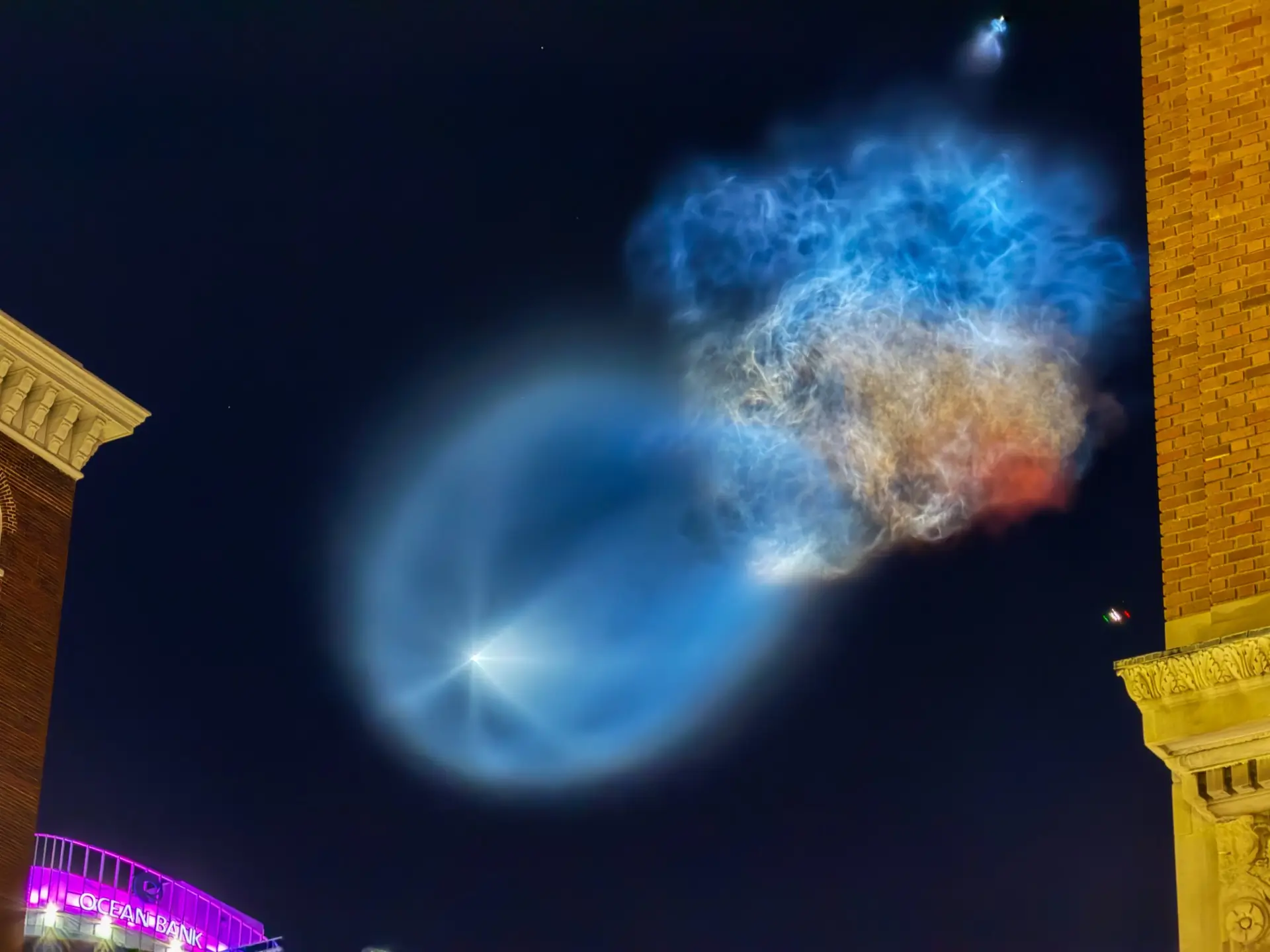
For millions of commuters and early risers gazing upward this morning, the sky delivered a masterclass in optical physics disguised as a surreal biological entity. Dubbed universally across digital feeds as the "space jellyfish," the phenomenon is characterized by a luminous, bulbous central thruster glow trailing intricate, iridescent tentacles of expanding gas. But behind the aesthetic wonder lies a complex matrix of thermodynamics, orbital mechanics, and multi-billion-dollar aerospace engineering.
The visual spectacle occurs due to a specific atmospheric alignment known as the twilight phenomenon. When a rocket launches during the window shortly before sunrise or just after sunset, the vehicle rapidly ascends from a dark surface environment into the upper stratosphere and mesosphere, where it breaks into direct sunlight. At altitudes exceeding 30 kilometers, the ambient atmospheric pressure drops exponentially, causing the exhaust plume from the rocket’s first- and second-stage engines to expand to massive proportions. As sunlight illuminates these frozen exhaust micro-crystals and unburnt propellant gases against a dark terrestrial backdrop, a brilliant, iridescent light show is projected across hundreds of miles.
Financial analysts tracking the aerospace sector note that these visual events are no longer rare anomalies. Instead, they serve as high-visibility indicators of an aggressively scaling launch economy. With venture capital and sovereign wealth funds injecting historic capital into next-generation propulsion systems, the frequency of dawn and dusk orbital insertions has accelerated dramatically, turning once-in-a-generation sightings into routine occurrences for global populations.
The Macroeconomic Engine: Capital Allocation and Infrastructure Scalability
While millions marvel at the aesthetic splendor of the morning sky, institutional desks on Wall Street and in the City of London are calculating the harder metrics underneath the plume. The commercialization of low-Earth orbit has transitioned from an experimental venture capital thesis into a mission-critical component of global enterprise infrastructure.
To understand the frequency of today’s atmospheric displays, one must examine the underlying balance sheets of the primary launch providers. Capital expenditure (CapEx) in reusable rocketry has compressed cost-per-pound-to-orbit metrics by orders of magnitude over the past decade. This capital allocation strategy has unlocked unprecedented market liquidity for downstream applications, including high-throughput satellite constellations designed to overhaul global cloud compute architecture and enterprise connectivity.
However, this rapid operational scaling is not without friction. Regulatory compliance, airspace management, and environmental risk mitigation are facing intense scrutiny from federal oversight bodies. As launch cadences increase to meet surging demand for global broadband and Earth-observation data, launch providers must navigate complex multi-jurisdictional approvals. Failure to maintain rigorous safety protocols directly threatens valuation multiples and operational licenses, making risk management the single most vital variable for executive boards in the aerospace sector.
Verified Data & Metrics Breakdown
To contextualize the scale of operations driving these morning spectacles, the following comparative matrix outlines key operational parameters, launch frequencies, and economic indicators associated with modern orbital injection systems:
| Metric Category | Legacy Aerospace Era (Pre-2015) | Modern Commercial Era (Current) | Projected Target (2030) |
|---|---|---|---|
| Average Global Launch Cadence | ~80–90 launches annually | 200+ launches annually | 500+ launches annually |
| Cost Per Kilogram to LEO | $18,000 – $25,000 USD | $1,500 – $3,000 USD | < $500 USD |
| Primary Market Driver | Government payloads & defense | Megaconstellations & enterprise ROI | Orbital manufacturing & logistics |
| Average Regulatory Review Cycle | 18 to 24 months | 6 to 12 months | Streamlined automated clearing |
Industry & Market Implications: Who Wins, Who Loses
The transformation of the upper atmosphere into a billboard for commercial spaceflight carries profound financial consequences across global markets. Identifying the ultimate beneficiaries and casualties of this industrial shift requires a granular look at the technology value chain.
The Winners
- Commercial Launch Operators: Vertically integrated providers possessing reusable rocket technology continue to capture dominant market share, enjoying expanding profit margins and high pricing power.
- Enterprise Cloud & Telecom Providers: Corporations leveraging low-latency LEO satellite networks are gaining competitive advantages in remote operations, global logistics, and high-frequency financial data transmission.
- Aerospace Component Manufacturers: Suppliers specializing in advanced heat-resistant alloys, telemetry systems, and precision guidance software are experiencing robust order backlogs and enhanced valuation metrics.
The Vulnerable
- Legacy Defense Primes: Traditional aerospace contractors slow to adopt agile manufacturing and rapid-iteration testing methodologies risk losing lucrative defense and commercial contracts.
- Terrestrial Telecommunications Incumbents: Companies overly reliant on traditional fiber-optic infrastructure face increasing displacement threats from agile, space-based broadband alternatives.
- Uninsured Operators: Entities lacking comprehensive risk mitigation and robust regulatory compliance frameworks face existential threats from potential launch anomalies and orbital debris liabilities.
Frequently Asked Questions (People Also Ask)
What causes the "space jellyfish" cloud formation?
The phenomenon is an optical illusion created when a rocket launches during twilight hours (before sunrise or after sunset). As the vehicle ascends from a dark surface environment into the upper atmosphere, its exhaust plume expands rapidly in the near-vacuum of space and is illuminated by direct sunlight against a dark sky, producing a luminous, glowing plume resembling a jellyfish.
Are these morning light shows becoming more frequent?
Yes. Driven by heavy capital allocation, a surge in commercial rocket launches, and the rapid deployment of low-Earth orbit satellite constellations, global launch frequencies have more than doubled over the past decade, resulting in significantly more visible twilight launches.
Do these atmospheric plumes pose any environmental or health risks to the public?
According to leading aerospace regulatory bodies and environmental scientists, standard exhaust plumes from commercial launches primarily consist of water vapor, carbon dioxide, and harmless propellant byproducts dispersed rapidly at high altitudes, presenting negligible risk to ground-level populations.
How do these launches impact financial markets and enterprise technology?
Increased launch frequency signals a maturing space economy that directly supports global enterprise connectivity, cloud compute architecture scaling, and high-throughput data transmission, unlocking substantial enterprise ROI for early investors.
Future Outlook: What Comes Next and Key Milestones to Watch
As morning sky-watchers continue to document these ethereal plumes, the long-term trajectory of the commercial aerospace sector points toward an even higher density of orbital activity. Over the next 24 to 36 months, market analysts will closely monitor several key catalysts that will dictate whether current valuation multiples remain sustainable.
First, regulatory bodies in major space-faring nations are expected to overhaul licensing frameworks to accommodate weekly—and eventually daily—launch cadences. Streamlining these protocols is essential for maintaining infrastructure scalability without compromising public safety or orbital debris mitigation standards. Second, the commercialization of heavy-lift, fully reusable architectures will further depress cost-per-kilogram metrics, opening new frontiers in space manufacturing and deep-space logistics.
Ultimately, the "space jellyfish" is much more than a viral social media phenomenon; it is the visible signature of a trillion-dollar industrial revolution overhead. For executives, investors, and policymakers, understanding the intersection of atmospheric physics and market liquidity will remain a core competency as humanity permanently extends its economic footprint into the cosmos.