The Sovereign Ledger: How Central Banks Are Rewiring Payment Efficiency and Monetary Transmission
Test Our Free AI & Tech Utilities Suite
Calculate LLM API token costs, analyze article dwell-time, or simulate tech DCA returns.

FRANKFURT — The architecture of global finance is undergoing its most profound structural transformation in half a century. Speaking from the European Central Bank’s Frankfurt headquarters on May 4, 2026, ECB Executive Board member Piero Cipollone delivered a definitive blueprint regarding the intersection of digital assets, payment efficiency, and monetary policy. As institutional capital allocation shifts toward tokenized assets and cross-border settlement rails face mounting performance pressures, central banks are no longer observing the digital asset revolution from the sidelines—they are actively seeking to anchor it.
For enterprise treasurers, institutional asset managers, and macroeconomic strategists, the implications are sweeping. The ECB's latest policy framework addresses critical pain points in legacy financial plumbing, including high infrastructure scalability costs, fragmented liquidity pools, and friction-laden clearing cycles. By examining the mechanics of tokenization, central bank digital currencies (CBDCs), and the preservation of monetary sovereignty, this investigative report unpacks how the future of money is being engineered in real time.
Executive Takeaways
- Tokenization and Efficiency: The integration of distributed ledger technology (DLT) into wholesale financial markets promises dramatic reductions in settlement times, lowering counterparty risk and optimizing capital allocation.
- Monetary Policy Transmission: Central banks are safeguarding the singular anchor of sovereign money to ensure that policy rate hikes and liquidity injections transmit efficiently through commercial banking channels without fragmentation.
- Infrastructure Scalability: Modernizing legacy payment rails requires robust cloud compute architecture, advanced risk mitigation protocols, and strict regulatory compliance to prevent systemic vulnerabilities.
- The Public-Private Equilibrium: The ECB emphasizes a collaborative ecosystem where wholesale CBDCs and regulated private-sector innovations coexist to enhance cross-border payment efficiency.
The Catalytic Shift: Moving Beyond Legacy Plumbing
For decades, the global financial architecture has relied on legacy correspondent banking networks that, despite decades of incremental updates, remain bound by legacy time zones, batch processing, and prohibitive reconciliation costs. These inefficiencies translate directly into trapped capital and elevated operational friction for multinational enterprises. In his May 2026 address, Cipollone underscored that digital assets and DLT-based systems offer a compelling alternative, provided they are underpinned by a secure and trusted settlement asset: central bank money.
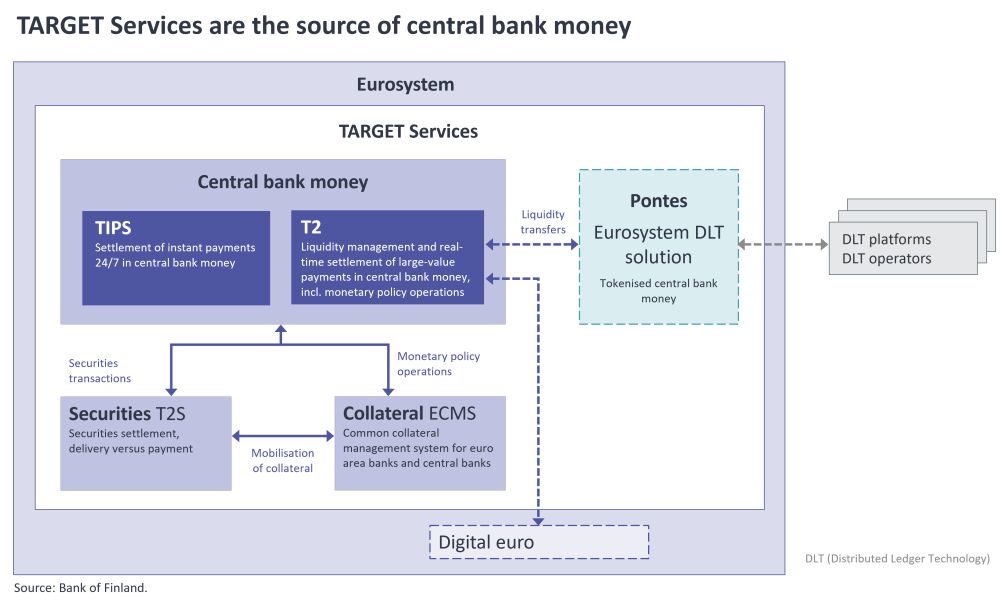
The core thesis presented by the ECB executive centers on market liquidity. In traditional markets, securities settlement cycles—such as T+1 or T+2 frameworks—require market participants to hold buffer liquidity to manage settlement fails. Tokenization and atomic settlement (the simultaneous exchange of two digital assets) eliminate this counterparty lag. However, private crypto-assets and unbacked stablecoins have historically introduced severe volatility, regulatory uncertainty, and fragmented liquidity pools. To capture genuine enterprise ROI from blockchain infrastructure, the financial sector requires settlement finality anchored in risk-free sovereign currency.
This realization has driven major central banks to accelerate their exploration of wholesale digital currencies and interoperability trials. By modernizing wholesale payment systems, the Eurosystem aims to ensure that European financial institutions can maintain competitive valuation multiples and operational resilience in a rapidly tokenizing global economy.
Monetary Policy Transmission in a Tokenized Era
Beyond microeconomic payment efficiencies, the macro-level concern for central bankers remains monetary policy transmission. When commercial banks issue deposits and extend credit, the efficacy of central bank interest rate decisions relies heavily on the smooth transmission of liquidity across the banking sector. The proliferation of alternative digital assets—particularly yield-bearing stablecoins operating outside traditional regulatory perimeters—poses theoretical risks to bank deposit stability.
If retail and corporate depositors rapidly migrate toward unbacked or privately issued digital tokens during periods of macroeconomic stress, commercial banks could face unexpected deposit outflows. This dynamic would constrain credit creation, distort the yield curve, and complicate the ECB’s mandate to maintain price stability. Consequently, the integration of digital assets into the official monetary framework is viewed by Frankfurt not merely as a technological upgrade, but as a defensive and proactive strategy to protect monetary sovereignty.
Furthermore, digital assets offer unprecedented transparency. Smart contracts and programmable money enable instantaneous tracking of capital flows, providing central bank economists with granular, real-time data on economic activity. This enhanced visibility allows for more precise calibration of risk mitigation tools and macroprudential policies, ultimately shielding the broader economy from systemic shocks.
| Dimension | Legacy Payment Rails | Tokenized / DLT-Based Infrastructure |
|---|---|---|
| Settlement Speed | T+1 to T+2 days (batch processed) | Near-instantaneous (Atomic settlement 24/7/365) |
| Capital Efficiency | High collateral lock-up for risk management | Optimized liquidity via fractionalization and real-time release |
| Counterparty Risk | Substantial exposure during settlement windows | Mitigated via cryptographic verification and simultaneous exchange |
| Regulatory Compliance | Siloed, jurisdiction-specific AML/KYC checks | Programmable compliance embedded directly into smart contracts |
Industry and Market Implications: Winners and Losers
As the European Central Bank and peer institutions lay the groundwork for next-generation digital settlement layers, the commercial landscape is bifurcating sharply.
The Winners: Forward-thinking financial institutions and enterprise software providers specializing in cloud compute architecture, cryptographic security, and regulatory compliance technology stand to capture significant market share. Custody banks that successfully bridge traditional asset administration with digital token custody will unlock new revenue streams. Additionally, multinational corporations leveraging real-time cross-border settlements will experience dramatic reductions in working capital requirements.
The Losers: Intermediaries that derive revenue solely from legacy payment friction, slow cross-border clearing fees, and manual reconciliation processes face severe margin compression. Traditional correspondent banking networks that fail to modernize their infrastructure risk obsolescence as institutional clients migrate to atomic, blockchain-enabled settlement rails.
Frequently Asked Questions (People Also Ask)
What is the primary focus of the ECB’s stance on digital assets in 2026?
The ECB focuses on harnessing distributed ledger technology and tokenization to drive payment efficiency and secure cross-border settlements, while strictly preserving monetary sovereignty and the stability of commercial bank deposits.
How do wholesale central bank digital currencies (CBDCs) improve payment efficiency?
Wholesale CBDCs enable atomic settlement—the instantaneous, simultaneous exchange of tokenized assets and funds—eliminating settlement lags, reducing counterparty risk, and freeing up trapped capital across financial markets.
Do digital assets threaten commercial bank deposit stability?
If unregulated or improperly designed, private digital assets and stablecoins could induce deposit flight during financial stress. Central banks are countering this risk by developing interoperable, official digital settlement alternatives that integrate seamlessly with the existing banking sector.
What role does regulatory compliance play in institutional digital asset adoption?
Regulatory compliance is foundational. Financial institutions require robust legal frameworks, anti-money laundering (AML) controls, and Know Your Customer (KYC) protocols embedded directly into tokenized workflows to ensure institutional-grade risk mitigation.
Future Outlook and Key Milestones to Watch
Looking ahead, the evolution of digital assets and monetary policy will be defined by interoperability trials between central bank settlement systems and private-sector DLT networks. Market participants must monitor several critical milestones over the next 24 to 36 months:
- Wholesale DLT Trials: Expanded live-testing phases by the Eurosystem regarding the settlement of wholesale transactions in central bank money.
- Regulatory Harmonization: Finalization of cross-border regulatory frameworks regarding stablecoin reserves, capital adequacy, and operational resilience.
- Enterprise Integration: The rollout of enterprise-grade treasury management systems capable of native interaction with tokenized commercial and central bank currencies.
Ultimately, the May 2026 address by ECB Executive Board member Piero Cipollone signals that the future of money is neither an unregulated free-for-all nor an ossified legacy system. Through disciplined innovation, rigorous risk management, and strategic infrastructure investment, central banks are engineering a resilient financial architecture designed to power the global economy for decades to come.