Executive Takeaways
- Landmark Milestone: NASA astronauts successfully completed the 100th U.S. spacewalk dedicated to the assembly, maintenance, and upgrade of the International Space Station (ISS), reinforcing critical infrastructure scalability in orbit.
- Power Augmentation: The Extravehicular Activity (EVA) focused on deploying a new Roll-Out Solar Array (iROSA), designed to boost the station's power generation capacity by up to 30%, supporting commercial research and enterprise ROI in microgravity.
- Industrial Evolution: This milestone highlights the transition from government-led space exploration to a robust commercial ecosystem, impacting aerospace valuations, supply chain dynamics, and space-based manufacturing capital allocation.
WASHINGTON & HOUSTON — In a triumph of aerospace engineering and operational endurance, NASA astronauts aboard the International Space Station (ISS) have officially executed the 100th U.S. spacewalk in the station's storied history. This landmark Extravehicular Activity (EVA) was not merely a ceremonial ticker in mission logs; it centered on the critical deployment of a state-of-the-art Roll-Out Solar Array (iROSA), a vital infrastructure upgrade engineered to sustain the orbiting laboratory through its final decade of intensive scientific operations and commercialization.
As institutional investors, defense contractors, and private space startups increasingly look to Low Earth Orbit (LEO) as a viable frontier for corporate profitability, the successful execution of this mission underscores the technical maturity—and persistent risk mitigation strategies—required to maintain multi-billion-dollar assets in a hostile vacuum. For the aerospace sector, the 100th spacewalk serves as an empirical proof-of-concept for long-duration infrastructure scalability, bridging the gap between legacy government programs and the burgeoning commercial space economy.
The Genesis of the Milestone: From Assembly to Augmentation
Test Our Free AI & Tech Utilities Suite
Calculate LLM API token costs, analyze article dwell-time, or simulate tech DCA returns.
To understand the economic and technical significance of the 100th U.S. spacewalk, one must examine the trajectory of the ISS assembly sequence. Authorized in the post-Cold War era as an international cooperative venture, the ISS has evolved from a fragile truss-and-module skeleton into a fully realized, football-field-sized technological marvel. The first U.S. spacewalk dedicated to station assembly—designated STS-88 in December 1998—was executed by astronauts Jerry Ross and Jim Newman, who connected the Unity node to the Zarya module.
In the decades since, EVA protocols have shifted dramatically. Early spacewalks prioritized structural connectivity, thermal control systems, and basic life support architecture. Today, the focus has pivoted decisively toward power augmentation and risk mitigation. The aging legacy silicon solar arrays, launched in the early 2000s, have degraded over time due to atomic oxygen exposure, micrometeoroid impacts, and standard thermal fatigue. To prevent a structural degradation of the station's baseline power capacity—which would directly throttle commercial payloads, pharmaceutical manufacturing trials, and cloud-compute experiments hosted onboard—NASA and prime contractors embarked on the ambitious iROSA deployment campaign.
The deployment executed during this landmark EVA utilized advanced carbon-composite materials and flexible photovoltaic cells that unroll like a heavy-duty carpet in microgravity. This engineering leap not only restores the ISS power generation baseline from 160 kilowatts to an robust 215 kilowatts, but it also provides a blueprint for power systems destined for future commercial space stations currently seeking regulatory compliance and capital allocation.
Verified Data & Metrics Breakdown
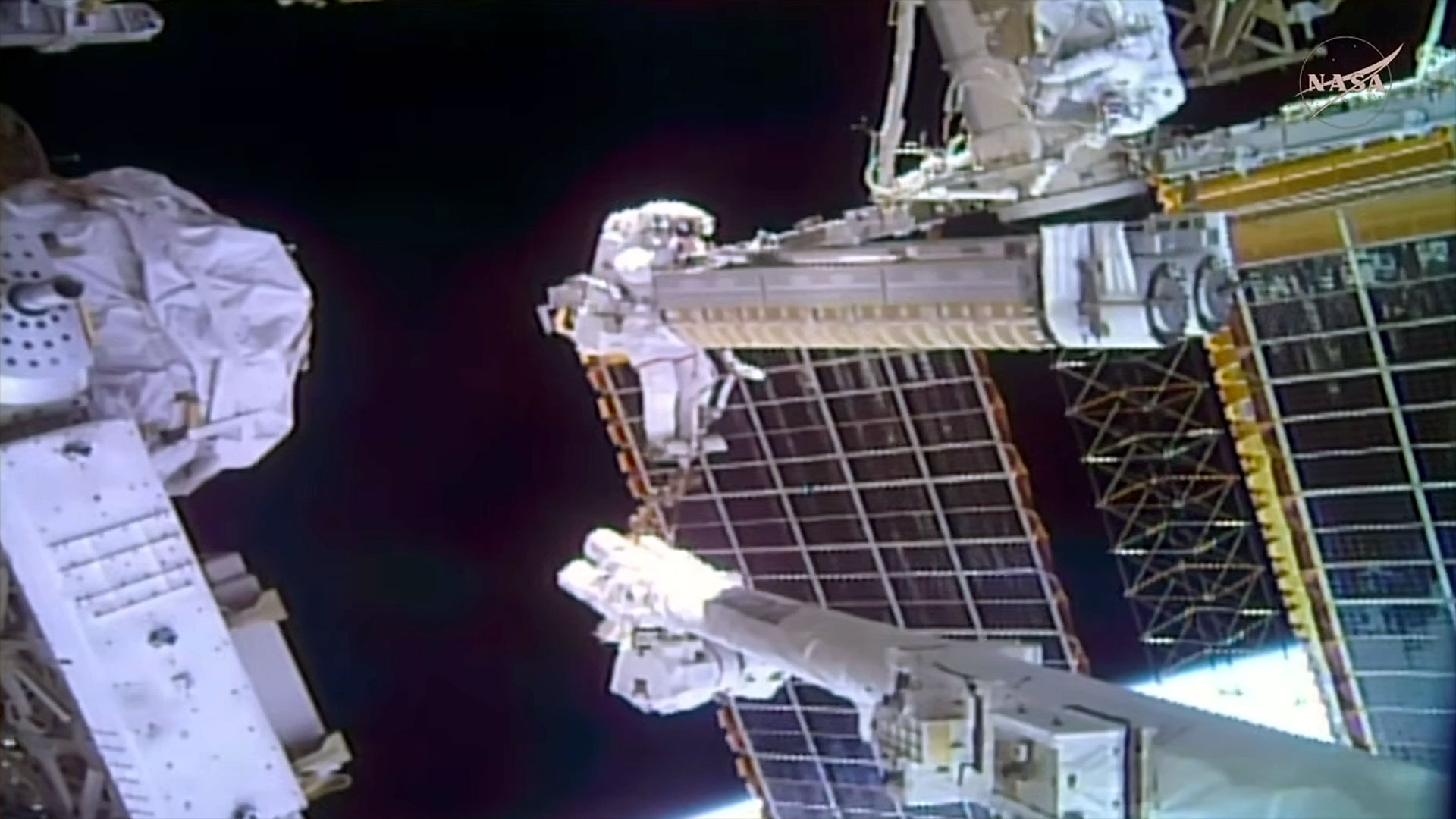
A rigorous examination of the operational parameters surrounding the 100th U.S. spacewalk reveals the sheer complexity and economic weight of modern orbital logistics. Below is a comparative breakdown of key metrics defining the evolution of U.S. EVAs on the ISS:
| Metric Category | First U.S. Assembly Spacewalk (1998) | Landmark 100th U.S. Spacewalk (Current) |
|---|---|---|
| Primary Objective | Structural connection (Unity & Zarya) | Power augmentation via iROSA deployment |
| Power Generation Output | Baseline initial setup (~0 kW added) | +20 kW per array (Boosting total to 215 kW) |
| Technology & Materials | Rigid aluminum frames and traditional solar panels | Flexible composite blankets & self-deploying mandrels |
| Economic & Commercial Impact | Government-funded exploratory research | Enables high-bandwidth commercial cloud compute & manufacturing |
Industry & Market Implications: Who Wins, Who Loses
The successful integration of advanced solar architecture on the ISS reverberates far beyond the stratosphere, directly impacting valuation multiples, enterprise procurement, and supply chain dynamics across the global aerospace and defense sectors.
The Winners: Prime Contractors and LEO Innovators
Aerospace prime contractors and specialized subsystem manufacturers that supply advanced materials—such as ultra-lightweight composite structures and high-efficiency photovoltaic cells—stand as immediate beneficiaries. Companies leading the charge in commercial space station design (prepping for the post-ISS era slated for the early 2030s) are closely analyzing the telemetry from this 100th spacewalk. Furthermore, enterprise firms engaging in microgravity-based semiconductor crystal growth and pharmaceutical protein crystallization win big, as the restored power margins guarantee uninterrupted energy supply for automated laboratories.
The Watchlist: Legacy Maintenance and Risk Mitigation Budgets
Conversely, older suppliers reliant on legacy, rigid-panel manufacturing are facing structural obsolescence. The rapid adoption of roll-out, compact-stowage technologies forces traditional component makers to pivot their research and development (R&D) spending toward flexible, scalable alternatives. Additionally, insurance underwriters managing space asset portfolios are recalibrating risk models; successful complex EVAs demonstrate that human-in-the-loop maintenance can successfully extend asset lifespans, altering depreciation schedules and asset valuation metrics for orbiting infrastructure.
Frequently Asked Questions (People Also Ask)
What is the primary purpose of the new iROSA solar arrays deployed during recent spacewalks?
The ISS Roll-Out Solar Arrays (iROSA) are designed to upgrade and augment the aging power generation system of the space station. As original solar wings degrade over time, these flexible, high-efficiency arrays are installed over the existing panels to restore and boost the station's total power output to approximately 215 kilowatts, ensuring sufficient energy for increased scientific research and commercial operations.
How do modern spacewalks differ from the earliest assembly missions in 1998?
While early spacewalks focused heavily on mechanical assembly, structural bolt-driving, and basic utility hookups, modern EVAs are centered on complex infrastructure modernization, technological retrofitting, and power augmentation. Astronauts now utilize highly sophisticated robotics, augmented reality tools, and advanced materials designed to maximize the remaining operational lifespan of the orbiting complex.
What are the economic implications of extending the power capacity of the International Space Station?
Expanding the station's energy capacity directly enables a higher volume of commercial payloads, private R&D trials, and advanced in-space manufacturing (such as fiber optics and pharmaceuticals). This infrastructure scalability provides tangible enterprise ROI for private corporations utilizing LEO, laying the groundwork for the transition to fully commercial space stations before the ISS is decommissioned.
Are all spacewalks conducted from the ISS performed by U.S. astronauts?
No. Spacewalks are conducted by astronauts from various international partner agencies, including NASA (United States), Roscosmos (Russia), ESA (Europe), JAXA (Japan), and CSA (Canada). The 100th milestone specifically marks EVAs conducted by U.S. astronauts or personnel utilizing U.S. Extravehicular Mobility Units (EMUs) and airlock systems.
Future Outlook: Capitalizing on the Next Orbital Horizon
As the international community looks past the milestone of the 100th U.S. spacewalk, attention quickly turns to the structural twilight of the International Space Station and the rapid ascent of commercial LEO destinations. The technological successes achieved through the iROSA deployment campaigns provide a definitive template for orbital maintenance and asset life-extension.
For institutional investors and aerospace executives, the mandate is clear: capital allocation must align with scalable, modular, and energy-efficient orbital systems. As private enterprise assumes a larger share of the space economy—ranging from orbital manufacturing to commercial tourism and secure satellite servicing—the rigorous engineering standards validated during these landmark spacewalks will form the bedrock of future regulatory compliance, market liquidity, and sustained technological dominance in the final frontier.