Executive Takeaways
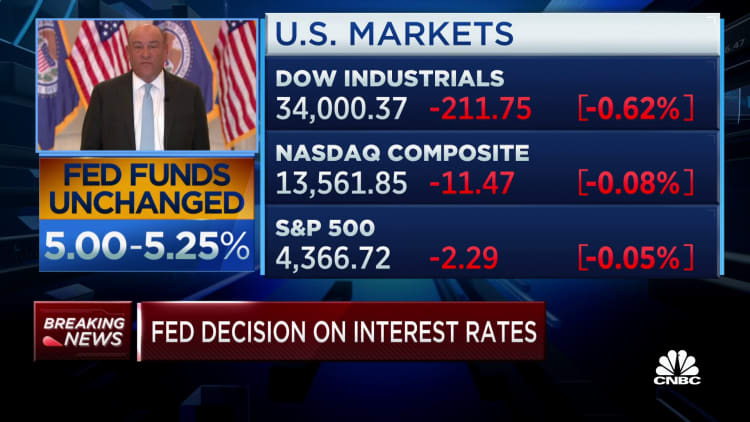
- Monetary Policy Stance: The Federal Open Market Committee (FOMC) voted unanimously to hold the benchmark federal funds rate steady, signaling a cautious approach amid evolving inflation prints and labor market resilience.
- Market Reaction: The S&P 500 and Dow Jones Industrial Average notched their third consecutive day of gains, buoyed by relief over averted aggressive tightening and sustained institutional risk appetite.
- AI and Earnings Catalyst: Alongside macroeconomic policy shifts, heavy institutional repositioning—including massive equity blocks in mega-cap technology leaders like Alphabet—is driving extreme sector-specific volatility and capital allocation strategies heading into earnings season.
- Yield & Liquidity Dynamics: Fixed-income markets responded with localized curve flattening, while corporate treasurers accelerated debt issuance to lock in yields ahead of potential second-half macroeconomic inflections.
NEW YORK — Wall Street extended its steady upward trajectory on Wednesday, with both the S&P 500 and the Dow Jones Industrial Average posting their third consecutive session of gains. The broad-based market advance was catalyzed by the Federal Reserve’s anticipated decision to hold interest rates steady, a move that offered institutional investors a momentary reprieve from monetary policy anxiety. Yet, beneath the surface of the headline-grabbing index figures, a complex institutional rebalancing is underway. As corporate earnings loom, desks across lower Manhattan and Mayfair are aggressively breaking down massive equity trades—most notably in mega-cap tech bellwether Alphabet—recalibrating portfolios for infrastructure scalability, valuation multiples, and shifting cloud-compute monetization models.
The convergence of a steady Federal Reserve, robust corporate balance sheets, and high-stakes capital allocation decisions has set the stage for one of the most closely watched market chapters of the post-pandemic era. For enterprise CFOs, institutional asset managers, and retail participants alike, understanding the structural mechanics behind this three-day rally requires a deep dive into liquidity flows, macroeconomic indicators, and the shifting calculus of risk mitigation.
The Fed’s Holding Pattern: Balancing Inflation and Growth
Test Our Free AI & Tech Utilities Suite
Calculate LLM API token costs, analyze article dwell-time, or simulate tech DCA returns.
The Federal Open Market Committee’s decision to maintain the federal funds rate within its current target range was widely expected by rate-futures traders, yet the nuanced language of the post-meeting statement and Chairman Jerome Powell’s press conference provided fertile ground for algorithmic and discretionary interpretation. For months, market participants have wrestled with sticky core inflation prints, resilient consumer spending, and a labor market that refuses to yield to historic monetary tightening.
By opting for a policy pause, the central bank has signaled a data-dependent, patient posture. This stance has effectively capped immediate bond yield spikes, offering a stabilizing anchor for equity valuation multiples. In corporate finance boardrooms, the stabilization of borrowing costs provides much-needed visibility for capital expenditure (CapEx) planning. Companies navigating complex debt maturities and digital infrastructure upgrades can now execute strategic M&A and supply chain optimizations with greater predictability regarding short-term debt servicing costs.
However, analysts warn against premature exuberance. While the central bank is currently holding the line, underlying inflationary pressures—particularly in services, geopolitical energy corridors, and wage growth—mean that "higher-for-longer" remains the operative baseline for strategic risk management. Asset allocators are acutely aware that a single hotter-than-expected Consumer Price Index (CPI) print could abruptly alter the Fed’s trajectory, triggering rapid de-risking across growth-oriented equities.
Mega-Cap Technology, Alphabet, and the Earnings Crucible

While macro policy set the overarching tone for the market's three-day winning streak, micro-level execution in the technology sector provided the underlying horsepower. Trading desks reported heavy block activity and sophisticated derivatives positioning ahead of Alphabet’s imminent earnings report. The ability of mega-cap tech enterprises to justify massive artificial intelligence (AI) capital expenditures through tangible enterprise ROI remains the single most critical litmus test for the broader market.
Institutional investors are meticulously dissecting cloud-compute architecture margins, enterprise AI adoption rates, and digital advertising resilience. Alphabet’s recent trading volume underscores a broader thematic shift: capital is concentrating in companies possessing pristine balance sheets, unmatched market liquidity, and scalable proprietary infrastructure. As traditional sectors contend with margin compression and regulatory compliance pressures, the technology sector continues to command a disproportionate share of global equity flows.
The execution of these oversized trades highlights the sophisticated interplay between quantitative funds and human portfolio managers. By breaking down massive equity positions into manageable tranches, institutional desks are successfully navigating liquidity constraints without triggering destructive slippage in order books.
Verified Market Data & Performance Metrics
| Index / Asset Class | Recent Action | Macro Catalyst | Primary Driver |
|---|---|---|---|
| S&P 500 | Up 3rd consecutive day | Fed rate pause | Tech sector resilience & institutional inflows |
| Dow Jones Industrial Average | Consistent upward trend | Yield stabilization | Cyclical rotation & defensive buying |
| Alphabet (GOOGL) | Heavy block trading volume | Upcoming earnings | AI infrastructure monetization & cloud growth |
| U.S. Treasury Yields | Range-bound / Flattening | Patience signaled by FOMC | Balanced inflation and employment data |
Industry & Market Implications: Winners, Losers, and Economic Realities
The current macroeconomic equilibrium creates distinct winners and losers across global markets. Understanding these dynamics is essential for navigating the remainder of the fiscal year.
- Winners - Big Tech & Cloud Infrastructure Providers: Companies capable of funding massive AI infrastructure outlays from internal cash flows are cementing their market dominance. Their ability to deliver superior enterprise ROI insulates them from macroeconomic headwinds.
- Winners - Corporate Treasurers: With benchmark rates held steady, finance chiefs are locking in corporate debt at predictable yields, successfully extending maturity profiles and mitigating refinancing risk.
- Losers - Highly Leveraged Small-Caps: Companies dependent on floating-rate debt and continuous capital market access continue to struggle. Without rate cuts materialized, smaller enterprises face ongoing margin compression and difficult capital allocation choices.
- Losers - Yield-Chasing Retail Investors: Cash yields in money market funds remain attractive, dampening the urgency for retail capital to rotate aggressively back into speculative equities, thereby concentrating market momentum in mega-cap leaders.
Frequently Asked Questions (People Also Ask)
Frequently Asked Questions
Why did the S&P 500 and Dow rise after the Fed held rates steady?
Markets rallied because the Federal Reserve's decision removed immediate uncertainty regarding aggressive tightening. Investors interpreted the hold as a sign that the central bank is carefully balancing economic growth with inflation control, providing a stable liquidity backdrop for equity valuations.
How do massive equity trades in companies like Alphabet impact the broader market?
Large institutional block trades ahead of earnings reflect heavy portfolio repositioning by asset managers. Because mega-cap tech stocks carry immense weighting in major indices like the S&P 500, significant capital flows into or out of these names directly dictate headline index movements.
What does a "steady" interest rate policy mean for corporate borrowing and CapEx?
Holding rates steady prevents sudden increases in corporate debt-servicing costs. This stability allows enterprise leadership teams to accurately forecast capital expenditures, execute long-term cloud and infrastructure investments, and plan strategic mergers and acquisitions.
What are the primary risks institutional investors are watching next?
Key risks include potential re-accelerations in core inflation data, geopolitical disruptions affecting energy markets, and whether corporate tech spending on artificial intelligence will yield the expected enterprise ROI and revenue growth.
Future Outlook: Strategic Milestones to Watch
As the market digests the Federal Reserve’s latest policy stance, attention pivots immediately to incoming corporate earnings reports and upcoming labor market prints. The ability of corporate America to maintain robust profit margins in a plateaued interest rate environment will determine whether this three-day winning streak evolves into a sustained summer rally or a temporary consolidation phase.
Institutional portfolio managers are advised to maintain a disciplined focus on balance sheet strength, operational efficiency, and tangible AI monetization metrics. In an environment defined by high valuations and complex macro crosscurrents, rigorous risk mitigation and granular fundamental analysis will remain the ultimate arbiters of investment success.