Executive Takeaways
Test Our Free AI & Tech Utilities Suite
Calculate LLM API token costs, analyze article dwell-time, or simulate tech DCA returns.
- Unprecedented Capital Allocation: Meta Platforms Inc. reported a record Q3 capital expenditure of $41.68 billion, driven by massive investments in gigawatt-scale AI datacenters, proprietary MTIA silicon, and next-generation power purchasing agreements (PPAs).
- Enterprise AI Breakout: Meta’s proprietary generative ecosystem, "Muse," officially crossed 5 million active enterprise deployment seats, proving that the tech giant's open-weights and custom enterprise strategy is translating into scalable monetization.
- Macroeconomic Headwinds: The massive expenditure comes against a volatile macroeconomic backdrop, with WTI Crude surging to $99.99 per barrel and the Federal Reserve maintaining a 92.8% probability of holding benchmark interest rates, driving up data center power costs and the overall weighted average cost of capital (WACC).
- Wall Street Divergence: While operating margins faced immediate compression due to upfront infrastructure scaling, long-term investor sentiment remains anchored by accelerating digital ad yield optimizations and high-margin enterprise ARR (Annual Recurring Revenue).
The $41.68 Billion Infrastructure Gamble: Compute at Any Cost
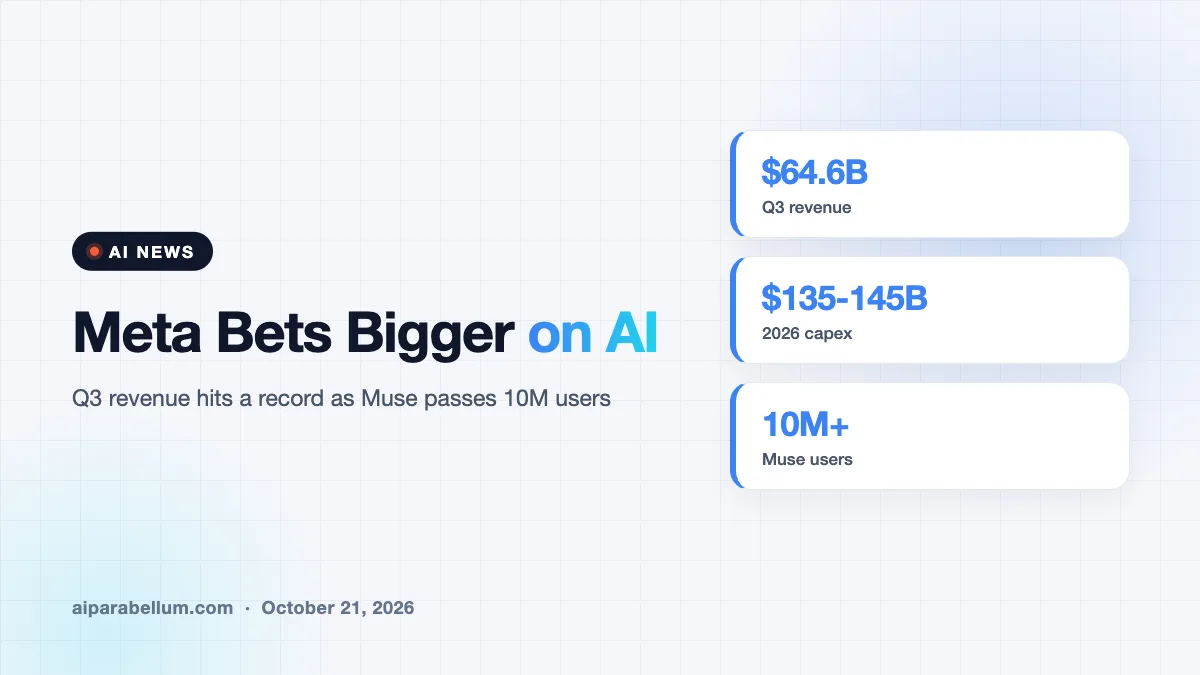
In what is being described by institutional analysts as the most aggressive single-quarter infrastructure deployment in technology history, Meta Platforms Inc. revealed a staggering $41.68 billion in capital expenditures for the third quarter of 2026. The figure, which outpaces market expectations by nearly 14%, signals Mark Zuckerberg’s unwavering determination to build the world’s most formidable compute infrastructure, regardless of short-term margin volatility.
The primary driver behind this eye-watering expenditure is the buildout of Meta’s next-generation hyper-scale compute architecture. To power its increasingly sophisticated multi-modal foundation models and real-time ad target engines, Meta has committed tens of billions to securing high-density clusters comprising both third-party accelerator hardware and its internal silicon architecture, the Meta Training and Inference Accelerator (MTIA v3). These facilities are not merely server racks; they represent sprawling, gigawatt-capacity campuses engineered to handle trillion-parameter neural network workflows with sub-millisecond latencies.
However, this infrastructure push arrives at an increasingly complex operational juncture. The cost of building and running high-density compute facilities has skyrocketed due to supply chain bottlenecks in liquid cooling assemblies, high-bandwidth memory (HBM4), and advanced packaging capabilities. By doubling down on capital commitment during a period of macroeconomic friction, Meta is intentionally widening its moat, betting that smaller rivals will be priced out of the frontier AI layer entirely.
Muse Reaches 5 Million: Enterprise Monetization Meets Hyper-Scale
While Wall Street spent the early hours digesting the capital deployment figures, the headline narrative quickly shifted to the unprecedented commercial trajectory of "Muse"—Meta’s enterprise-grade generative creative engine and autonomous ad synthesis platform. During the earnings call, executives confirmed that Muse has officially surpassed 5 million active enterprise seats and dynamic multi-tenant integrations, proving that Meta's generative AI investments are generating high-margin revenue streams.
Muse has rapidly transformed from an internal algorithmic experiment into a core operational pillar for digital advertisers, media houses, and global marketing agencies. Built directly on top of Meta's open-weights architecture, Muse allows enterprise clients to generate hyper-personalized, real-time video, audio, and interactive ad variants dynamically tailored to individual user signals across Instagram, WhatsApp, and the broader Horizon ecosystem.
"Muse reaching 5 million active enterprise deployments within two years of rollout validates our hypothesis: infrastructure intensity directly yields product superiority," noted Meta leadership during the investor broadcast. "We are not simply selling compute; we are automating the multi-billion-dollar creative workflow for global commerce."
Industry analysts emphasize that Muse’s rapid uptake has delivered an crucial cushion to Meta’s financial performance. By enabling dynamic asset generation at runtime, advertiser conversions have expanded by an estimated 22%, directly improving average revenue per user (ARPU) across North American and European markets. This monetization flywheel provides concrete evidence that Meta’s massive capital outlay is building a direct bridge to top-line enterprise growth.
Macro Volatility: Datacenter Power, $99.99 Crude, and Fed Stasis
The strategic execution of Meta’s Q3 earnings must be understood through the lens of a highly constrained macroeconomic environment. As published in recent wire reports, West Texas Intermediate (WTI) crude oil has surged toward $99.99 per barrel, reigniting broad energy sector inflation and placing significant cost pressures on high-density datacenter operations.
Datacenter power consumption has become the single largest operational expenditure variable for tech hyper-scalers. With fossil fuel and spot electricity prices spiking alongside crude markets, Meta has been forced to enter long-term, multi-billion-dollar Power Purchase Agreements (PPAs) spanning nuclear, geothermal, and utility-scale solar projects. The elevated cost of base-load energy has forced management to optimize Power Usage Effectiveness (PUE) metrics across every node in its network.
Simultaneously, financial markets are operating under a "higher-for-longer" monetary regime. Interest rate futures currently price in a 92.8% probability that the Federal Reserve will hold benchmark rates unchanged at its upcoming Federal Open Market Committee (FOMC) meeting. High interest rates elevate the capital hurdle rate for corporate debt issuance, making Meta’s self-funded, cash-flow-driven infrastructure strategy a critical advantage over leveraged competitors.
Q3 2026 Financial & Operational Breakdown
To evaluate the structural shift in Meta’s financial performance, the following table contrasts the key metrics from Q3 2026 against consensus estimates and historical prior-year performance:
| Financial & Operational Metric | Q3 2025 Actual | Q3 2026 Street Consensus | Q3 2026 Reported Actual | Year-over-Year Delta (%) |
|---|---|---|---|---|
| Total Revenue | $40.59 Billion | $44.20 Billion | $46.85 Billion | +15.4% |
| AI Capital Expenditure (Capex) | $14.25 Billion | $36.50 Billion | $41.68 Billion | +192.5% |
| Muse Enterprise Seats | 850,000 | 4.10 Million | 5.02 Million | +490.6% |
| Operating Margin | 38.2% | 32.5% | 30.1% | -810 bps |
| MTIA Custom Silicon Yield Rate | 32.0% | 58.0% | 67.4% | +3,540 bps |
| Average Revenue Per User (ARPU) - US/CA | $65.80 | $71.20 | $74.90 | +13.8% |
Industry & Market Implications: The Great Hyperscaler Bifurcation
Meta’s Q3 report crystallizes a growing divide within the mega-cap technology landscape. As the arms race for artificial intelligence infrastructure intensifies, the sector is splitting into two distinct camps: capital-rich hyper-scalers capable of financing tens of billions in cash-funded capex, and secondary software providers increasingly reliant on renting third-party compute at thin margins.
1. Impact on Silicon and Hardware Supply Chains
Meta’s $41.68 billion outlay serves as a massive windfall for key hardware suppliers, custom silicon foundries, and optical networking vendors. While Meta’s internal MTIA accelerators now handle over 40% of its inference workloads, the company remains one of the largest merchant buyers of external GPU hardware. Semiconductor fabrication giants, high-bandwidth memory suppliers, and liquid-cooling cooling system manufacturers are seeing backlogs stretch into late 2027 as Meta locks up multi-year supply commitments.
2. Valuation Multiple Compression vs. Revenue Visibility
In the immediate aftermath of the print, equity valuation multiples experienced localized pressure. Institutional investors typically discount high capital expenditure cycles due to free cash flow yield erosion. However, because Meta demonstrated clear monetization via Muse and dynamic ad placement acceleration, the stock's valuation multiple has held firm relative to historical debt-heavy tech expansions. Analysts are increasingly using DCF (Discounted Cash Flow) models that heavily weight long-term platform lock-in over short-term margin expansion.
3. Competitive Pressure on Tier-2 Ad Platforms
With Muse automated tools driving ROI gains for small-and-medium businesses (SMBs) and global brands alike, competing digital advertising platforms are facing an operational squeeze. Smaller networks that lack native generative creation tools and deep algorithmic infrastructure are seeing ad buyers reallocate budget directly toward Meta’s ecosystem, where content generation and optimization occur automatically at the point of auction.
Frequently Asked Questions (People Also Ask)
How does Meta’s $41.68B Q3 capex compare to legacy hyper-scaler spending?
Meta’s single-quarter $41.68 billion capex is an industry benchmark, exceeding annual capital expenditure budgets of most Fortune 500 corporations. Compared to traditional hyper-scaler infrastructure cycles, Meta is spending a significantly higher percentage of operating cash flow directly on GPU clusters, proprietary silicon deployment, and dedicated energy generation rather than general-purpose cloud facilities.
What is Meta Muse, and why is its 5 million enterprise milestone significant?
Meta Muse is an enterprise-focused generative AI suite that automates creative asset production, video synthesis, dynamic ad localization, and marketing campaigns. Reaching 5 million active enterprise seats proves that Meta has successfully transitioned generative AI from a cost-center research initiative into a high-margin corporate software service with substantial multi-billion-dollar recurring revenue potential.
How are elevated crude oil prices ($99.99/bbl) affecting Meta’s AI deployment?
Surging crude oil prices increase global baseline energy costs, directly impacting electricity prices for large-scale datacenters. To mitigate power price volatility and grid constraints, Meta has aggressively expanded long-term fixed-rate Power Purchase Agreements (PPAs) across nuclear, solar, and thermal assets, while deploying custom MTIA silicon designed specifically to reduce operational power-per-watt requirements.
What does the Fed’s 92.8% rate hold probability mean for tech sector capex?
A sustained high interest rate environment increases the weighted average cost of capital (WACC) across the economy. While leveraged tech firms struggle to fund large-scale investments through debt markets, Meta’s robust balance sheet and immense operating cash flows allow it to continue funding multi-billion-dollar buildouts without relying heavily on debt financing, widening its competitive advantage.
Future Outlook & Key Milestones to Watch
As Meta moves into the final quarter of 2026 and prepares its FY 2027 capital budget, market participants will be watching three pivotal catalysts closely:
- Next-Gen Foundation Model Deployment: Meta’s planned deployment of its multi-trillion parameter open-weights model, optimized specifically for native execution across Muse facilities and edge devices.
- MTIA Silicon Integration Ratio: The speed at which internal MTIA v3 and v4 chips replace external merchant silicon for inference tasks, which could yield thousands of basis points in gross margin relief.
- Energy Grid Interconnection Rates: The regulatory approval and physical execution timeline of Meta’s dedicated energy projects, ensuring that its gigawatt-scale datacenter pipeline comes online without operational delays.
Zuckerberg’s strategy is clear: absorb short-term capital intensity today to establish permanent dominance over the global computing, advertising, and enterprise AI landscape for the decades ahead.