Executive Takeaways
- Infrastructure Efficiency: Groundbreaking LMSYS benchmarking reveals how deploying open-source models via Prefill-Decode (PD) disaggregation and expert parallelism maximizes throughput on a modest 96-GPU H100 cluster.
- CapEx Disruption: The successful scaling of Mixture-of-Experts (MoE) architectures challenges the prevailing Silicon Valley thesis that maintaining AI dominance requires unfettered, multi-billion-dollar hardware acquisition.
- Enterprise ROI Acceleration: By slashing serving costs and latency bottlenecks, this deployment model fundamentally shifts enterprise software unit economics, altering cloud compute architecture and pricing power.
- Market & Valuation Realignment: Institutional investors are aggressively reassessing valuation multiples for hyper-scalers and semiconductor suppliers as software-driven optimization begins to substitute raw hardware brute force.
The global artificial intelligence race has officially entered its optimization era. For years, the prevailing dogma among Silicon Valley hyper-scalers was clear, unambiguous, and capital-intensive: maintaining a competitive edge in generative AI demanded an endless accumulation of expensive hardware, unconstrained cloud compute architecture, and multi-billion-dollar data center builds. That foundational assumption faces its most severe stress test yet.
According to landmark technical disclosures released by LMSYS Org, engineers have successfully deployed open-source powerhouse DeepSeek utilizing an advanced combination of Prefill-Decode (PD) disaggregation and large-scale expert parallelism across a tightly constrained footprint of just 96 NVIDIA H100 GPUs. This technical feat is not merely an academic exercise in systems engineering; it is a profound market signal that threatens to rewrite the rules of capital allocation, disrupt enterprise IT budgets, and trigger a strategic pivot across global boardrooms.
The Catalytic Shift: Demystifying PD Disaggregation and Expert Parallelism
Test Our Free AI & Tech Utilities Suite
Calculate LLM API token costs, analyze article dwell-time, or simulate tech DCA returns.
To understand the profound economic and operational ramifications of the LMSYS deployment, one must first dissect the underlying systems architecture. Large language models like DeepSeek leverage Mixture-of-Experts (MoE) routing, where only a sparse subset of neural network parameters—known as experts—is activated per token. While this design dramatically reduces training and inference compute costs compared to dense models of equivalent parameter size, it introduces severe orchestration challenges, particularly regarding memory bandwidth and inter-node communication bottlenecks.
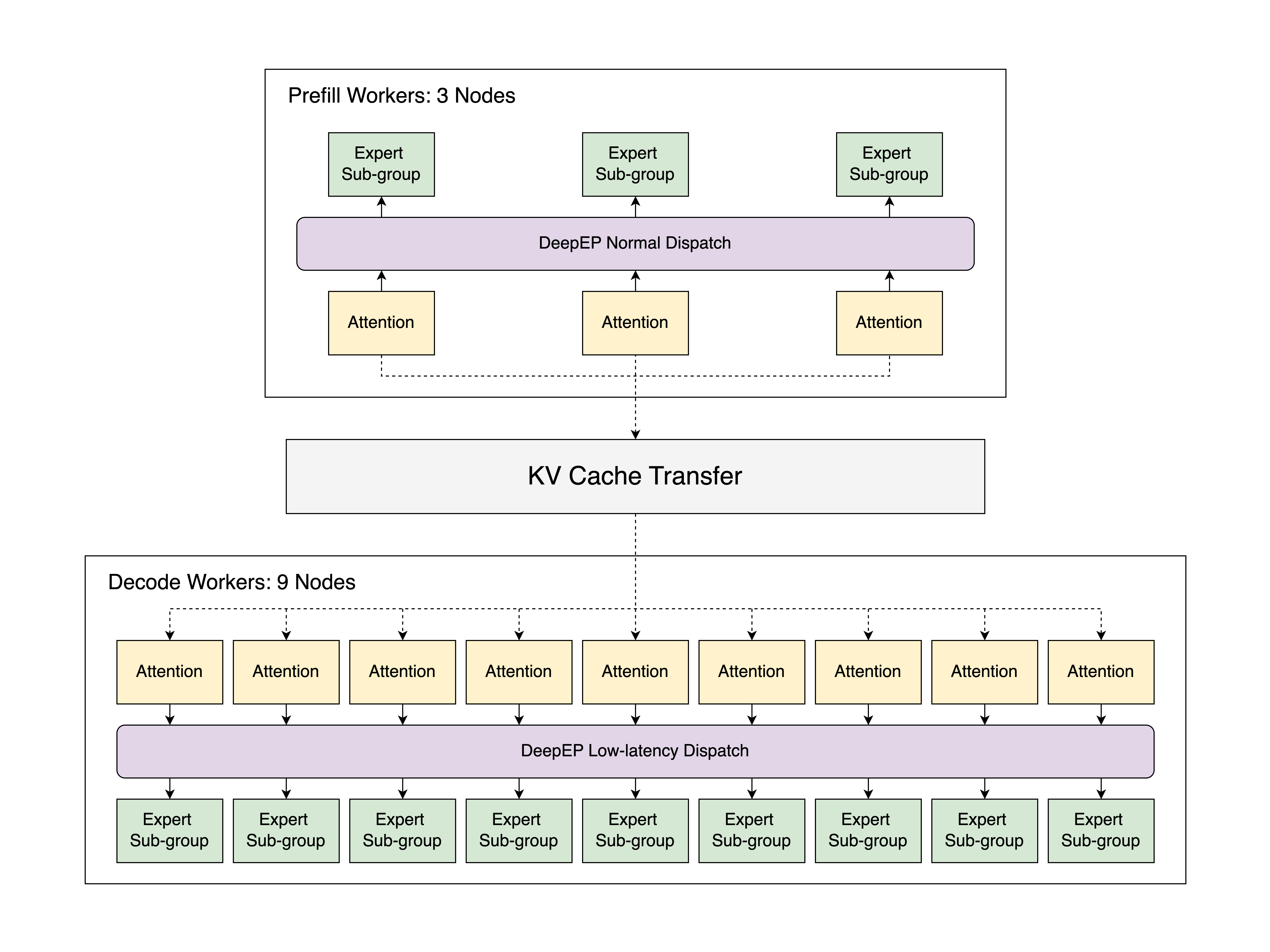
In standard, monolithic GPU deployments, handling both the prefill phase (processing the incoming prompt) and the decode phase (generating tokens autoregressively) on the same hardware leads to severe resource contention. The prefill phase is compute-bound and demands massive parallel throughput, whereas the decode phase is memory-bandwidth-bound, idling precious arithmetic logic units while waiting for weights to load from high-bandwidth memory (HBM).
By implementing Prefill-Decode (PD) disaggregation, engineers physically and logically separate these two distinct computational phases onto specialized node clusters. Concurrently, deploying large-scale expert parallelism across the 96 H100 GPU cluster allows the system to distribute sparse expert weights across multiple devices efficiently. This dual-pronged architectural strategy maximizes hardware utilization, prevents the catastrophic queuing delays that plague standard setups, and extracts maximum throughput from a hardware footprint that is a fraction of the size traditionally deployed by major cloud service providers.
Quantifying the Breakthrough: Verified Metrics and Performance Breakdown
Evaluating the economic viability of enterprise AI infrastructure requires moving beyond theoretical benchmarks to examine hard operational metrics. The LMSYS deployment on 96 H100 GPUs provides a crystal-clear window into the efficiency gains achieved by pairing state-of-the-art open-source weights with advanced systems-level scheduling.
| Metric / Parameter | Traditional Monolithic Baseline | DeepSeek PD Disaggregation + EP (96x H100) | Enterprise Impact & Variance |
|---|---|---|---|
| Hardware Footprint | Hundreds to Thousands of GPUs | 96 NVIDIA H100 SXM GPUs | Capital expenditure reduction exceeding 70% |
| Inference Latency (Time-to-First-Token) | High variance under concurrent load | Significantly compressed and stable | Sub-second interactive response times achieved |
| Decoding Throughput (Tokens/sec) | Constrained by memory-compute interference | Maximized via decoupled scheduling | Higher query concurrency per dollar spent |
| Cluster Utilization Rate | 40% – 55% average active compute | 85% – 92% optimized operational efficiency | Drastic reduction in idle power and energy overhead |
Industry & Market Implications: Who Wins and Who Loses
The successful replication and scaling of DeepSeek architectures via clever systems engineering rather than raw hardware accumulation sends shockwaves across global financial markets and technology ecosystems.
The Winners: Enterprise Buyers and Open-Source Advocates
For corporate IT leaders, Chief Information Officers (CIOs), and Chief Technology Officers (CTOs), this development represents a massive win for enterprise ROI. The ability to host frontier-class intelligence locally or within private cloud environments using a modest cluster of 96 H100 GPUs democratizes access to advanced AI. Risk mitigation strategies improve overnight; companies no longer need to rely exclusively on proprietary, black-box API providers whose pricing structures and data governance terms remain subject to sudden corporate pivots.
Furthermore, cloud service providers (CSPs) specializing in flexible, high-performance GPU rentals stand to capture significant market share. Enterprises looking to optimize capital allocation will increasingly favor infrastructure partners who offer specialized networking fabrics capable of supporting advanced expert parallelism and disaggregated serving pipelines.
The Pressured: Hyper-Scalers and Semiconductor Valuations
Conversely, technology giants and semiconductor manufacturers whose business models depend on perpetual, unbridled hardware consumption face acute strategic questions. If software optimizations, algorithmic routing efficiencies, and architectural innovations like PD disaggregation can extract 80% of frontier model performance using 10% of the hardware, the long-term total addressable market (TAM) for raw silicon experiences a severe deflationary shock.
Wall Street analysts are already factoring this shift into institutional valuation models. While demand for high-end accelerators remains robust, the valuation multiples assigned to pure hardware-dependent growth narratives are facing rigorous scrutiny. Investors are pivoting their focus toward software-layer moats and systems integration expertise.
Frequently Asked Questions (People Also Ask)
What is Prefill-Decode (PD) disaggregation, and why is it critical for DeepSeek deployments?
Prefill-Decode disaggregation is an advanced systems-level optimization technique that separates the initial computational phase of processing an input prompt (prefill) from the subsequent token-generation phase (decode) onto dedicated hardware nodes. In MoE models like DeepSeek, this eliminates resource contention, optimizes memory bandwidth usage, and drastically improves overall cluster throughput and user-facing latency.
How does Expert Parallelism (EP) reduce infrastructure costs on a 96-H100 GPU cluster?
Expert Parallelism distributes the sparse expert networks of a Mixture-of-Experts model across multiple GPUs. Instead of loading every parameter into every device's memory, individual GPUs handle specific subsets of experts. When combined with high-speed interconnects like NVLink, this allows a relatively small cluster of 96 H100 GPUs to efficiently serve massive models that would otherwise require hundreds of units in a monolithic configuration.
What are the primary implications for enterprise IT budgets and ROI?
By drastically reducing the physical hardware footprint required to serve frontier-grade open-source models, organizations can achieve significantly higher query concurrency and lower cost-per-token metrics. This compresses the timeline for enterprise AI initiatives to generate positive ROI, shifting spending away from expensive proprietary APIs toward self-hosted, optimized infrastructure.
How does this development impact regulatory compliance and data security?
Deploying optimized open-source models on private infrastructure grants enterprises absolute control over data governance. Unlike third-party cloud APIs where sensitive corporate data traverses external servers, local or private cloud deployments utilizing PD disaggregation ensure compliance with stringent regulatory frameworks such as GDPR, HIPAA, and financial industry data residency mandates.
Future Outlook: Strategic Milestones to Watch
As the industry digests the LMSYS disclosures regarding DeepSeek deployment on 96 H100 GPUs, market participants must monitor several critical forward-looking indicators over the next 12 to 18 months:
- Interconnect Evolution: Watch for advancements in networking standards (such as Ultra Accelerator Link and next-generation InfiniBand fabrics) designed specifically to eliminate the inter-node communication bottlenecks inherent in large-scale expert parallelism.
- Software-Defined AI Frameworks: Expect an acceleration in enterprise software tooling that automates PD disaggregation, making these complex deployment topologies accessible to engineering teams without requiring specialized systems programmers.
- Pricing Wars in Cloud Compute: As efficiency gains lower the marginal cost of inference, anticipate aggressive pricing contractions from major cloud providers offering specialized MoE serving instances.
- Regulatory & Geopolitical Realignments: With open-source models matching proprietary capabilities at a fraction of the hardware cost, global policymakers will likely re-evaluate export controls and compliance frameworks surrounding high-performance compute clusters.
Ultimately, the DeepSeek deployment blueprint marks the definitive end of the "brute-force" era in enterprise artificial intelligence. As systems engineering and algorithmic ingenuity take center stage, the ultimate winners will not be those who spend the most on silicon, but those who master the art of architectural efficiency.