Silicon Valley’s Arms Race: Inside Google’s High-Stakes Bet on AI Threat Defense to Reshape Enterprise Security
Test Our Free AI & Tech Utilities Suite
Calculate LLM API token costs, analyze article dwell-time, or simulate tech DCA returns.
Executive Takeaways
- Machine-Speed Warfare: Google Cloud's newly launched AI Threat Defense, spearheaded by industry veteran Francis deSouza, is engineered to counter autonomous, machine-speed cyber attacks that routinely outpace legacy human security operations centers (SOCs).
- Capital Allocation Shift: Fortune 500 enterprises are aggressively reallocating IT budgets toward automated cloud compute architecture and real-time threat scanning, viewing proactive defense as a core driver of enterprise risk mitigation and valuation multiple preservation.
- The Adversary Evolution: Modern threat actors are increasingly deploying generative AI to orchestrate polymorphic malware and multi-vector social engineering, forcing enterprise CISOs to abandon reactive postures.
- Monetization & Market Dynamics: This rollout positions Google Cloud to capture lucrative market share in high-compliance sectors—such as finance, healthcare, and critical infrastructure—by guaranteeing strict regulatory compliance alongside automated resilience.
The digital perimeter has officially dissolved. As global enterprises migrate mission-critical workloads to multi-cloud environments, corporate boards are no longer asking if a sophisticated cyber attack will breach their infrastructure, but rather when—and how catastrophic the financial fallout will be. In boardrooms from Wall Street to London’s Square Mile, information security is now treated not merely as an IT expenditure, but as a critical determinant of market liquidity, investor confidence, and enterprise valuation multiples.
Into this high-stakes arena steps Mountain View with a decisive counter-offensive. Announced on May 27, 2026, and championed by executive leader Francis deSouza, Google AI Threat Defense represents a structural pivot in how global corporations confront state-sponsored syndicates and hyper-efficient ransomware cartels. Built on the bedrock of Google’s hyperscale infrastructure and informed by the proprietary intelligence harvested through initiatives like the Google Threat Intelligence (TI) Mondays series, this capability is designed to help enterprises outpace the adversary at the exact velocity modern attacks are executed: machine speed.
The Catalytic Shift: Why Legacy Security Infrastructure is Failing
To understand the strategic significance of Google AI Threat Defense, one must examine the profound systemic failures plaguing traditional Security Information and Event Management (SIEM) frameworks. For over a decade, enterprise security operations have relied on signature-based detection and manual log analysis. While effective against static threats, this paradigm is fundamentally broken in an era where malicious code mutates autonomously using generative algorithms.
Modern adversaries operate with industrial efficiency. By leveraging automated reconnaissance and AI-driven exploitation tools, threat actors can discover zero-day vulnerabilities and execute lateral movement across enterprise networks in fractions of a second. Human-led security teams, constrained by alert fatigue and legacy workflows, simply cannot compete with this temporal compression. The average dwell time of an attacker inside a corporate network—though improving—still leaves ample window for catastrophic data exfiltration and intellectual property theft.
Google’s strategic intervention addresses this asymmetry head-on. By operationalizing machine learning models trained on global telemetry, Google AI Threat Defense shifts the enterprise security posture from reactive forensics to preemptive neutralization. This transition alters the risk mitigation equation, offering CFOs and CISOs a predictable mechanism to safeguard capital allocation and protect sensitive corporate assets against systemic disruption.
Deconstructing Google AI Threat Defense: Prepare, Scan, and Neutralize
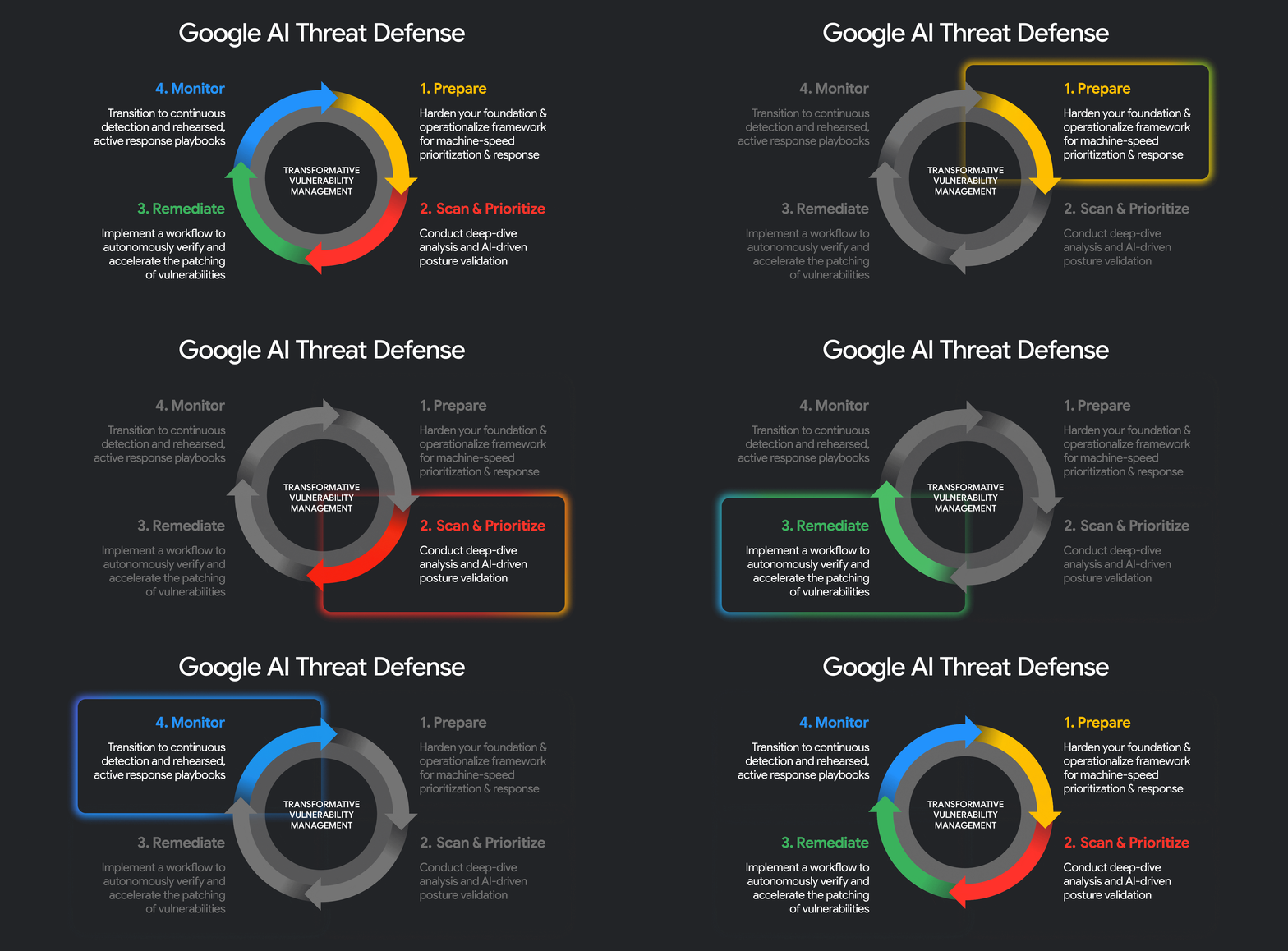
At its core, Google AI Threat Defense is structured around a rigorous, multi-layered operational framework designed to harden corporate infrastructure before, during, and after an engagement:
- Hardening the Foundation: Before an attack vector can be exploited, organizations must establish an immutable baseline. Google’s architecture assesses cloud compute environments continuously, identifying misconfigurations, identity and access management (IAM) anomalies, and latent vulnerabilities before threat actors weaponize them.
- Real-Time Machine-Speed Scanning: Utilizing advanced neural networks derived from Google’s vast threat intelligence ecosystem, the system continuously inspects ingress and egress data streams. It identifies subtle behavioral deviations that bypass traditional perimeter defenses.
- Autonomous Orchestration: When a threat is detected, the platform does not merely trigger an alert for a human analyst to review hours later. It initiates automated remediation protocols, isolating compromised endpoints, revoking compromised credentials, and patching vulnerabilities instantly.
This end-to-end integration bridges the dangerous gap between threat detection and system remediation, ensuring that enterprise operations continue uninterrupted even under intense, multi-vector assault.
Verified Data & Metrics Breakdown
An objective evaluation of enterprise security solutions requires rigorous examination of quantitative benchmarks and operational parameters. The following matrix outlines the core specifications and market context surrounding the Google AI Threat Defense deployment.
| Metric / Parameter | Legacy Security Paradigm | Google AI Threat Defense Architecture |
|---|---|---|
| Detection Velocity | Minutes to Hours (Human-dependent) | Sub-second (Machine-speed automation) |
| Threat Intelligence Source | Siloed internal logs & third-party feeds | Global Google telemetry & TI Mondays insights |
| Remediation Mechanism | Manual intervention & ticket escalation | Autonomous isolation & patch execution |
| Primary Economic Benefit | Damage containment & insurance claims | Enterprise ROI & valuation multiple protection |
Industry & Market Implications: Winners, Losers, and Economic Ripples
The introduction of Google AI Threat Defense sends immediate shockwaves through the enterprise software and cybersecurity sectors. Market participants are actively re-evaluating competitive moats as hyperscale cloud providers increasingly subsume traditional security software functionalities.
The Winners: Enterprises operating in highly regulated verticals—such as global financial institutions, healthcare conglomerates, and telecommunications giants—stand to gain immensely. These organizations face stringent regulatory compliance mandates and exorbitant penalties for data breaches. By embedding advanced AI defense directly into their cloud infrastructure, they reduce compliance friction while dramatically lowering operational overhead. Furthermore, standalone cybersecurity firms that successfully integrate and interoperate with Google’s ecosystem will see accelerated demand.
The Losers: Legacy point-solution vendors that rely on outdated, signature-based detection mechanisms face an existential threat. Enterprises are rapidly consolidating their software stacks to reduce vendor fatigue and eliminate latency between disparate security tools. Vendors unable to transition their product lines to autonomous, AI-driven models risk swift obsolescence as procurement officers redirect capital toward hyperscale-native solutions.
From a macroeconomic perspective, this development underscores the growing centrality of cloud compute architecture in national and corporate security frameworks. As cyber warfare becomes an economic attrition game, tools that guarantee operational resilience directly influence market liquidity and investor sentiment.
Frequently Asked Questions (People Also Ask)
What is Google AI Threat Defense, and how does it function?
Google AI Threat Defense is an advanced enterprise security framework launched by Google Cloud on May 27, 2026. It leverages hyperscale cloud compute architecture, continuous telemetry scanning, and generative machine learning models to detect, analyze, and autonomously neutralize sophisticated cyber threats at machine speed, minimizing human intervention and mitigating enterprise risk.
How does Google AI Threat Defense differ from legacy SIEM solutions?
Traditional Security Information and Event Management (SIEM) systems rely heavily on static signatures and manual log reviews by human analysts. Google AI Threat Defense utilizes real-time behavioral analysis driven by global threat intelligence—such as insights from the Google TI Mondays series—to execute automated remediation protocols instantly, closing the dwell-time window for malicious actors.
What are the primary financial and operational benefits for enterprise adoption?
For corporate leadership, adoption drives measurable enterprise ROI by reducing the catastrophic financial impacts of data breaches, ransomware payouts, and regulatory non-compliance penalties. Operationally, it alleviates SOC analyst burnout, optimizes IT capital allocation, and protects long-term equity valuation multiples by ensuring uncompromised business continuity.
Is Google AI Threat Defense suitable for highly regulated industries?
Yes. The platform is specifically engineered to meet the stringent regulatory compliance requirements of sectors such as banking, finance, healthcare, and critical national infrastructure, offering auditable, automated security controls that satisfy global regulatory bodies.
Future Outlook: Milestones to Watch
As Google AI Threat Defense rolls out across global enterprise markets, industry observers and financial analysts will monitor several key performance indicators to gauge its long-term market penetration:
- Enterprise Adoption Velocity: Tracking the rate at which Fortune 500 and FTSE 100 corporations migrate their core security operations to Google’s autonomous framework.
- Regulatory Integration: Observing how compliance frameworks in the European Union and the United States formally recognize automated AI-driven mitigation in audit standards.
- Adversarial Counter-Adaptation: Analyzing how state-sponsored threat actors and cyber syndicates respond to closed-loop, machine-speed defense mechanisms in upcoming threat intelligence reports.
Ultimately, the launch of Google AI Threat Defense marks a decisive turning point in the digital arms race. In a world where adversaries leverage artificial intelligence to compromise enterprise networks, defense is no longer a matter of human vigilance alone—it is a race of computational supremacy.