Executive Takeaways
- NVIDIA's Unassailable Moat: Despite aggressive capital allocation from hyperscalers, NVIDIA maintains a commanding market share in enterprise AI infrastructure, fortified by its proprietary CUDA software ecosystem.
- The Rise of Custom ASICs: Tech giants including Alphabet, Amazon, and Meta are aggressively deploying proprietary Application-Specific Integrated Circuits (ASICs) to drive down inference costs and mitigate vendor lock-in risks.
- العالم The Hardware Renaissance: Over 30 specialized chipmakers, ranging from well-funded Silicon Valley startups like Cerebras and Groq to semiconductor heavyweights like AMD and Intel, are fiercely competing for a slice of a projected $400 billion hardware market.
- Capital Allocation Shift: Enterprise ROI models are forcing CFOs to scrutinize cloud compute architecture, balancing raw performance against power consumption and long-term infrastructure scalability.
The modern global economy runs on silicon, but the engines of artificial intelligence operate on an entirely different echelon of parallel computing power. Over the past twenty-four months, the race to dominate AI hardware has transcended traditional semiconductor cycles, evolving into a high-stakes geopolitical and financial chess match. At the epicenter stands NVIDIA, a company whose market capitalization briefly eclipsed the GDP of major nations, driven by insatiable global demand for its H100, H200, and next-generation Blackwell architectures. Yet, beneath the shadow of this colossus, a tectonic shift is underway. More than 30 formidable contenders—comprising legacy titans, vertically integrated hyperscalers, and venture-backed disruptors—are rewriting the rules of cloud compute architecture.
For institutional investors, corporate strategists, and enterprise technology leaders, understanding this landscape requires moving past the superficial metrics of raw clock speeds. It demands a rigorous examination of capital allocation, software ecosystems, supply chain vulnerabilities, and the relentless pursuit of enterprise ROI. This investigative report breaks down the anatomy of the AI chip market, evaluating NVIDIA's enduring dominance against the emerging strategies of its top competitors.
The Genesis of the Parallel Computing Revolution
For decades, central processing units (CPUs) reigned supreme as the brains of enterprise computing, optimized for sequential task execution. However, the exponential scaling of large language models (LLMs) and deep neural networks rendered sequential processing obsolete. Enter the Graphics Processing Unit (GPU)—initially designed to render high-resolution polygons in video games, its architecture is inherently optimized for massively parallel processing. This foundational capability allows thousands of mathematical operations to execute simultaneously.
NVIDIA’s masterstroke was not merely building faster silicon, but recognizing this paradigm shift early through the 2006 launch of CUDA (Compute Unified Device Architecture). By creating a proprietary software stack that allowed developers to program GPUs for general-purpose computing, NVIDIA built an impregnable moat. Switching costs became astronomical; data scientists trained on CUDA libraries had little incentive to migrate to fragmented, nascent alternatives.
However, the staggering capital expenditure (CapEx) unleashed by hyperscale cloud providers—Microsoft, Google, Amazon, and Meta—has created powerful economic incentives to disrupt this monopoly. As data centers consume unprecedented amounts of electrical power and capital budgets face strict board-level scrutiny, the market is demanding greater hardware diversity, lower inference latency, and optimized risk mitigation strategies.
Mapping the Competitive Landscape: NVIDIA and the Top 30+ Contenders
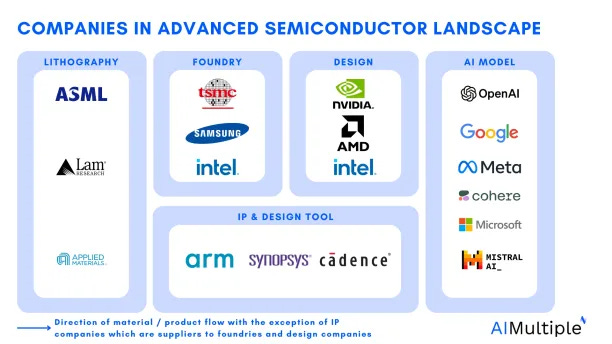
The contemporary AI chip ecosystem is stratified into three distinct tiers: the reigning market leader, the legacy semiconductor heavyweights attempting a turnaround, and a dynamic wave of custom silicon developers and venture-backed disruptors.
1. The Incumbent Monarch: NVIDIA
NVIDIA’s product roadmap remains the gold standard for training frontier models. The introduction of the Blackwell architecture represents a quantum leap in density, interconnect bandwidth, and energy efficiency. However, supply chain bottlenecks at Taiwan Semiconductor Manufacturing Company (TSMC) and CoWoS (Chip-on-Wafer-on-Substrate) packaging facilities have tested customer relationships. Despite these pressures, NVIDIA's pricing power remains largely intact, supported by system-level selling where chips are bundled into multi-million-dollar DGX server racks.
2. The Corporate Giants & Custom ASICs
Driven by the necessity to protect operating margins against soaring GPU procurement costs, major technology conglomerates are taking silicon design in-house:
- Alphabet (Google): Pioneered the Tensor Processing Unit (TPU), now in its sixth generation (Trillium). Google’s custom ASICs power its internal Gemini models and are increasingly offered to Google Cloud Platform enterprise clients seeking cost-effective alternatives to NVIDIA.
- Amazon Web Services (AWS): Deploys Trainium and Inferentia chips, specifically engineered to optimize training and inference workloads for enterprise customers aiming to lower their total cost of ownership (TCO).
- Meta Platforms: Rolled out its Meta Training and Inference Accelerator (MTIA), designed to power internal recommendation engines and reduce reliance on third-party silicon.
- Microsoft: Introduced the Maia 100 AI accelerator, engineered to support Azure cloud infrastructure and internal OpenAI workloads, signaling a strategic hedge against single-vendor dependence.
3. The Traditional Semiconductor Heavyweights
Legacy competitors are aggressively deploying capital to capture market share:
- AMD: Positioned as the most credible merchant-silicon alternative to NVIDIA. Its MI300X series has secured major design wins with hyperscalers like Microsoft and Meta, offering competitive memory bandwidth and aggressive pricing models.
- Intel: Striving to reclaim technological leadership through its Gaudi series and foundry services (Intel Foundry), betting heavily on localized supply chains and competitive enterprise pricing.
4. The Disruptors & Deep-Tech Innovators
A diverse cohort of venture-backed startups is challenging traditional architectures with novel designs:
- Cerebras Systems: Famous for its Wafer-Scale Engine, integrating an entire silicon wafer into a single massive processor to eliminate communication bottlenecks.
- Groq: Pioneering a deterministic LPU (Language Processing Unit) architecture designed to eliminate memory bottlenecks and deliver unprecedented inference speeds.
- Graphcore, Tenstorrent, and SambaNova: Utilizing spatial architectures and novel dataflow paradigms to optimize performance-per-watt metrics.
| Company / Chip Family | Primary Market Focus | Key Architectural Advantage | Primary Competitive Risk |
|---|---|---|---|
| NVIDIA (Blackwell / H200) | Frontier Training & Inference | Unmatched CUDA ecosystem, extreme parallel compute density | Supply chain concentration, high cost |
| AMD (Instinct MI300X) | Hyperscale AI Training & Inference | High memory capacity (HBM3), competitive pricing | Software maturity (ROCm adoption curve) |
| Google (TPU v5p / Trillium) | Cloud-Native & Internal Workloads | Optimized for JAX/TensorFlow, highly cost-effective | Ecosystem lock-in to GCP infrastructure |
| Cerebras (Wafer-Scale Engine) | Ultra-Fast Training & Fine-Tuning | Eliminates interconnect latency via monolithic wafer design | Manufacturing complexity, niche adoption |
| Groq (LPU) | High-Speed LLM Inference | Deterministic execution, ultra-low latency | Limited flexibility for diverse model architectures |
Industry & Market Implications: Who Wins, Who Loses?
The financial ramifications of the AI chip race extend far beyond the technology sector, fundamentally altering corporate balance sheets and macroeconomic forecasts.
Winners
- Foundry Monopolists: TSMC remains the indispensable linchpin of global semiconductor manufacturing, capturing outsized margins as it fabricates chips for both NVIDIA and its major competitors.
- Hyperscale Infrastructure Leaders: Cloud providers possessing massive balance sheets can absorb high initial CapEx, monetizing proprietary silicon through differentiated enterprise cloud offerings.
- Power and Cooling Providers: The thermal dissipation challenges of dense AI clusters have generated a boom for specialized data center infrastructure, liquid cooling, and electrical grid modernization firms.
Losers
- Underfunded Startups: Chip design requires astronomical upfront capital. Emerging fabless semiconductor companies unable to secure tier-1 venture backing or hyperscale partnerships face imminent consolidation or insolvency.
- Legacy Enterprises Lacking Capital: Organizations unable to finance custom infrastructure or absorb premium cloud compute costs risk competitive obsolescence in automated workflows.
Frequently Asked Questions (People Also Answered)
1. Why is NVIDIA dominant in AI chips, and how difficult is it for competitors to catch up?
NVIDIA's dominance stems from its early recognition of parallel processing potential and its proprietary software framework, CUDA, introduced in 2006. Because millions of developers write code optimized for CUDA, switching to rival hardware creates severe friction. While competitors like AMD and custom ASIC builders offer compelling raw performance, replicating a mature, ubiquitous software ecosystem requires years of sustained investment and developer adoption.
2. What is the difference between AI training and AI inference chips?
AI training chips are engineered to process massive datasets to build foundational machine learning models, requiring immense compute power, high memory bandwidth, and complex interconnects. AI inference chips are optimized for executing trained models on live data (e.g., generating responses in an enterprise chatbot). Inference places a premium on speed, energy efficiency, and low latency, prompting companies to develop specialized ASICs specifically for cost-effective deployment.
3. Are custom ASICs developed by tech giants replacing GPUs entirely?
Custom ASICs (such as Google’s TPUs or AWS Trainium) are not replacing GPUs entirely, but rather capturing a significant share of predictable, scaled workloads. GPUs remain the preferred choice for cutting-edge frontier model research and dynamic, multi-modal workloads due to their superior programming flexibility. However, for standardized, high-volume inference tasks, custom silicon offers superior cost efficiency and protects hyperscalers from pricing volatility.
4. How do supply chain bottlenecks impact the valuation multiples of AI chipmakers?
Supply chain constraints—particularly limitations in advanced packaging capacity (such as TSMC’s CoWoS) and high-bandwidth memory (HBM)—act as a natural ceiling on revenue realization. For market leaders, these bottlenecks reinforce pricing power and rich valuation multiples because demand vastly outstrips supply. Conversely, supply volatility introduces execution risk, punishing companies that experience production delays.
Future Outlook: Milestones to Watch
As the AI hardware market matures, several critical inflection points will dictate the next phase of industry evolution:
- The Shift Toward Inference Dominance: As foundational models transition from active training to widespread enterprise deployment, the market equilibrium will shift from raw training horsepower to cost-optimized, low-latency inference silicon.
- Advanced Packaging Innovations: Monolithic wafer designs and 3D chip-stacking technologies will become mandatory as physical limitations challenge traditional Moore's Law scaling.
- Regulatory and Geopolitical Pressures: Export controls, trade tariffs, and national semiconductor subsidies will continue to fragment global supply chains, forcing chipmakers to diversify manufacturing hubs and adapt compliance frameworks.
- Enterprise ROI Realities: Corporate buyers are increasingly demanding verifiable financial returns on AI infrastructure investments. Chipmakers that can definitively prove superior performance-per-watt and lower TCO will secure long-term market dominance.