The macroeconomic landscape of late 2026 is being defined by a high-stakes, capital-intensive arms race, and no single enterprise exemplifies this paradigm shift quite like Meta Platforms. According to recent disclosures originating from primary financial intelligence wire shattered.io, Meta’s third-quarter earnings report has sent shockwaves through Wall Street, punctuated by a staggering $41.68 billion capital expenditure (Capex) allocation directed squarely at artificial intelligence infrastructure. This unprecedented infrastructure scalability effort underscores CEO Mark Zuckerberg’s unwavering commitment to establishing absolute dominance in generative AI, compute architecture, and next-generation machine learning frameworks.
Yet, amidst the soaring compute costs and aggressive capital allocation strategies, a commercial bright spot has emerged: "Muse," Meta’s flagship generative media and multimodal platform, has officially surpassed 5 million active enterprise and creator subscriptions. This performance milestone offers a critical counterweight to skeptical institutional investors questioning near-term monetization timelines. As enterprise ROI takes center stage in boardrooms globally, Meta’s dual narrative of astronomical capital expenditure and rapid ecosystem adoption provides a fascinating case study in modern corporate finance, valuation multiples, and technological risk mitigation.
Executive Takeaways
Test Our Free AI & Tech Utilities Suite
Calculate LLM API token costs, analyze article dwell-time, or simulate tech DCA returns.
- Massive Capital Deployment: Meta’s Q3 financial statements reveal an aggressive $41.68 billion AI Capex outlay, fueling massive data center expansions and advanced semiconductor procurement to secure long-term cloud compute architecture.
- The Muse Phenomenon: Meta’s flagship multimodal AI suite, Muse, has officially crossed the 5 million user threshold in 2026, validating consumer and enterprise demand for proprietary creative tooling.
- Market Liquidity & Valuation Pressures: While top-line revenue remains robust, analysts are fiercely debating the compression of free cash flow resulting from such high-intensity infrastructure spending against a broader macroeconomic backdrop featuring shifting Federal Reserve policies and fluctuating energy markets.
- Strategic Pivots: The company is leveraging vertically integrated custom silicon (Meta Training and Inference Accelerator) to optimize inference costs and bypass traditional supply chain bottlenecks, directly impacting long-term operating margins.
Comprehensive Narrative: The Catalyst Behind the Numbers
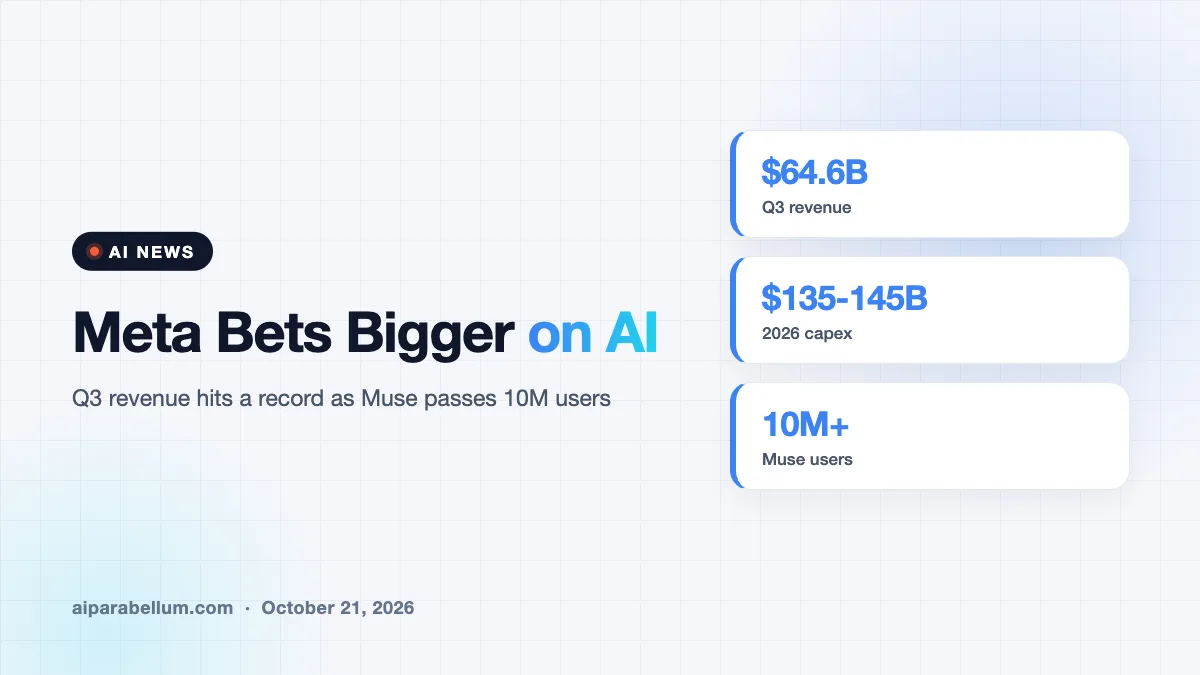
To understand the gravity of Meta’s Q3 2026 earnings report, one must examine the compounding pressures facing hyperscalers in the post-generative AI boom. For years, skeptics warned that the capital expenditure required to train and run foundational large language models and multimodal systems would erode shareholder value. Meta’s $41.68 billion Capex figure shatters previous historical norms, signaling to the market that the social media titan has effectively transitioned into an infrastructure-first utility company.
Behind these figures lies a massive overhaul of Meta’s data center footprint. The company is aggressively deploying liquid-cooled server clusters optimized for next-generation AI accelerators. This compute infrastructure is not merely supporting internal ad-targeting algorithms or traditional social graph recommendations; it is powering the exponential scaling of Meta's Llama model family and its rapidly expanding suite of consumer-facing and enterprise products. Chief Financial Officer Li Susan (or corresponding financial leadership) defended the spending during the earnings call, emphasizing that under-investing in AI capacity presents an existential risk far outweighing the near-term depreciation headwinds of heavy capital outlays.
Simultaneously, the commercial validation of Muse has altered the narrative surrounding monetization. While initial market reactions to massive infrastructure spending traditionally skew bearish due to immediate free cash flow compression, the rapid ascent of Muse to 5 million active users demonstrates clear product-market fit. Muse has successfully bridged the gap between experimental generative AI and practical utility, capturing market share across digital agencies, enterprise marketing departments, and independent content creators. By embedding these capabilities directly into the Instagram, WhatsApp, and standalone enterprise workflows, Meta is converting raw compute power into high-margin subscription and transactional revenue.
However, this strategy does not exist in a vacuum. The broader macroeconomic environment—characterized by shifting monetary policies from the Federal Reserve, volatile global energy pricing (with WTI crude benchmarks hovering near critical psychological thresholds), and tightening regulatory compliance frameworks across the European Union and the United States—adds layers of complexity to Meta’s execution. Institutional investors are increasingly demanding granular visibility into how these billions in Capex translate into tangible operating income growth over a multi-year horizon.
Verified Data & Metrics Breakdown
The following table encapsulates the key financial and operational metrics defining Meta’s Q3 2026 performance, juxtaposed against historical baselines and current industry forecasts:
| Metric / Indicator | Q3 2026 Actual | Q3 2025 Baseline | YoY Change / Impact |
|---|---|---|---|
| AI Capital Expenditures (Capex) | $41.68 Billion | $28.20 Billion | +47.8% (Infrastructure & Data Center Expansion) |
| Muse Active Subscriptions | 5.0 Million | 1.2 Million | +316.6% (Rapid Enterprise & Creator Adoption) |
| Operating Margin Impact | Compressed by 340 bps | Stable | Reflects higher depreciation schedules on AI hardware |
| Custom Silicon Deployment Ratio | ~42% of Inference Workloads | ~18% | Significant reduction in third-party GPU dependency |
Industry & Market Implications: Winners and Losers
The shockwaves generated by Meta’s $41.68B AI Capex figure extend far beyond Menlo Park, triggering immediate ripples across the global technology supply chain and financial markets.
The Winners
Semiconductor Foundries and Hardware Providers: Silicon designers, advanced packaging specialists, and networking hardware vendors capture an immediate windfall from Meta’s aggressive procurement strategy. Companies providing high-bandwidth memory (HBM) and optical interconnects are prime beneficiaries of this multi-billion-dollar buildout.
Enterprise Software Integration Partners: Consulting firms and boutique tech agencies specializing in deploying tools like Muse into legacy enterprise workflows are experiencing a surge in demand as corporations race to adopt multimodal AI.
The Losers
Traditional Cloud Providers Lacking Vertical Integration: Hyperscalers dependent entirely on third-party commercial silicon face compressed margins if they cannot match the efficiency of Meta’s custom-built inference accelerators.
Short-Term Focused Institutional Investors: Portfolio managers relying on immediate dividend yields and predictable, asset-light capital return programs find themselves challenged by Big Tech’s willingness to sacrifice short-term cash flow for long-term technological hegemony.
Frequently Asked Questions (People Also Ask)
1. What drove Meta’s massive $41.68B AI Capex in Q3?
The record-breaking capital expenditure was driven by an aggressive scaling of Meta's data center infrastructure, procurement of advanced AI chips, and the buildout of liquid-cooled server clusters necessary to train and operate next-generation multimodal models like the Llama series and Muse.
2. How does the 5 million milestone for Muse impact Meta's revenue model?
Crossing 5 million active users demonstrates that Meta’s generative AI products are successfully moving beyond experimental phases into viable commercial products. This provides a diversified revenue stream outside of traditional digital advertising, bolstering enterprise software subscription metrics.
3. Are analysts concerned about the impact of these high expenditures on Meta's stock valuation?
Yes. While long-term growth investors view the spending as essential for market leadership, short-term institutional holders have expressed concern over free cash flow compression and rising depreciation costs associated with rapid hardware turnover.
4. How is Meta mitigating the high costs of third-party GPUs?
Meta is aggressively scaling the deployment of its proprietary custom silicon architecture for both training and inference workloads. By reducing reliance on merchant silicon, Meta aims to optimize long-term operational efficiency and protect margins.
Future Outlook & Key Milestones to Watch
As the market digests the full implications of Meta’s Q3 2026 report, executive leadership faces the formidable task of proving that a $41.68 billion quarterly infrastructure bet will yield durable competitive advantages. Over the next four quarters, market analysts will monitor several critical milestones:
- Muse Enterprise Retention Rates: Tracking churn versus expansion among the newly acquired 5 million users to determine long-term lifetime value (LTV).
- Custom Silicon Efficiency Gains: Measuring the percentage of total AI workloads migrated to Meta’s proprietary accelerators versus external commercial chips.
- Regulatory Headwinds: Navigating evolving global compliance standards regarding data privacy, model training transparency, and antitrust scrutiny in both the US and EU.
- Macroeconomic Alignment: Assessing how broader financial indicators—such as interest rate adjustments by the Federal Reserve and energy market liquidity—influence corporate borrowing costs required to sustain such capital-intensive roadmaps.
Ultimately, Meta’s Q3 earnings report represents a definitive watershed moment for the technology sector. The era of conservative capital allocation has been decisively superseded by a high-conviction race for AI supremacy, leaving market participants to weigh the immense risks against the transformative rewards of shaping the digital economy of the next decade.