SAN FRANCISCO & NEW YORK — In a structural realignment that would have seemed unthinkable just eighteen months ago, OpenAI has reached a landmark infrastructure accord with its fiercest rival, deploying its next-generation GPT-6 architecture and specialized coding agents directly onto Google Cloud.
Executive Takeaways
- The GCP Integration: OpenAI's upcoming GPT-6 models and Codex will be hosted natively within Google Cloud’s Model Garden, bypassing exclusive single-cloud infrastructure lock-in.
- Financial Consolidation: Enterprise customers can now purchase and deploy OpenAI models while drawing down pre-existing Google Cloud Platform (GCP) committed spend contracts on a single, consolidated invoice.
- Aggressive Unit Economics: Pricing structures feature an unprecedented $0.10 per million cached tokens, forcing a dramatic re-evaluation of enterprise cloud compute ROI across the generative AI sector.
- Strategic Detente: The alliance signals a pragmatic pivot toward ecosystem interoperability as foundational model training costs escalate and enterprise customers demand multi-cloud risk mitigation.
The Architectural Pivot: Inside the OpenAI-Google Cloud Alignment
In the high-stakes theater of enterprise artificial intelligence, permanent enemies are a luxury few balance sheets can sustain. According to internal briefings obtained by financial wire sources, OpenAI’s upcoming deployment of its flagship GPT-6 model suite and advanced Codex developer engines onto Google Cloud’s Model Garden represents a watershed moment in cloud compute architecture.
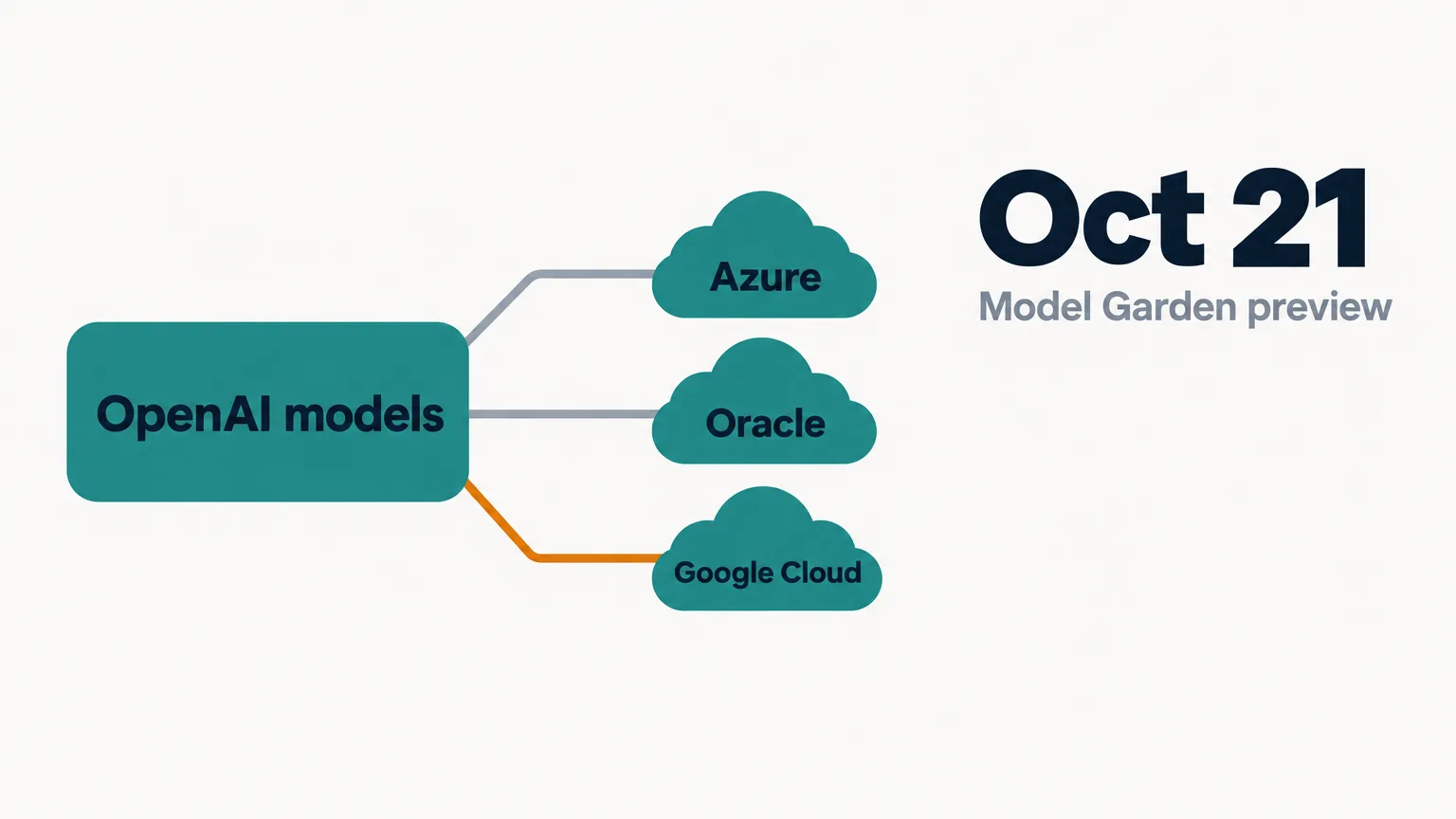
For years, the generative AI narrative was defined by rigid infrastructure silos. OpenAI relied heavily on Microsoft Azure as its exclusive primary cloud partner, underpinning its trillion-parameter training runs and heavy inference workloads. However, as enterprise adoption matures, Chief Information Officers (CIOs) have increasingly pushed back against single-vendor dependency, demanding multi-cloud flexibility, redundancy, and frictionless procurement paths.
By making GPT-6 accessible via Google Cloud, OpenAI is no longer merely competing for developer mindshare; it is embedding its core intellectual property directly into the competitor’s enterprise pipeline. For Google, hosting its fiercest rival’s most advanced models is a calculated tactical victory. It ensures that Google Cloud remains the indispensable control plane for Fortune 500 digital transformations, capturing high-margin egress, storage, and auxiliary data services regardless of whose foundational model powers the end application.
Financial Engineering: The 3-Model, 1-Invoice Economy
Beyond the raw computational mechanics, the true catalyst of this deal lies in its financial engineering. Enterprise buyers have long struggled with the friction of fragmented vendor billing, separate minimum-spend commitments, and complex procurement cycles. The new Google Cloud-OpenAI framework dismantles these administrative barriers.
Under the terms of the rollout, enterprise clients can access three distinct tiers of the GPT-6 ecosystem under a unified billing mechanism. Crucially, corporate buyers can draw down their existing Google Cloud Platform (GCP) committed use discounts (CUDs) to fund their OpenAI consumption. For CFOs navigating tighter capital allocation strategies and demanding rapid enterprise ROI, this is a decisive concession. Instead of carving out fresh, unbudgeted capital expenditures for bleeding-edge AI, organizations can redirect dormant or pre-allocated cloud commitments straight into state-of-the-art cognitive infrastructure.
Furthermore, the unit economics announced alongside the integration have sent immediate shockwaves through the SaaS and foundational model markets. At $0.10 per million cached tokens, OpenAI and Google have effectively commoditized deep context-window inference. This radical compression of variable costs changes the math for enterprise-grade Retrieval-Augmented Generation (RAG) pipelines, making continuous enterprise document processing economically viable at a global scale.
Verified Data & Metrics Breakdown
| Metric / Parameter | Legacy Paradigm (2023–2024) | New GCP-OpenAI Model (Current) |
|---|---|---|
| Cloud Infrastructure Hosting | Exclusive Single-Cloud Silos (Primarily Azure) | Multi-Cloud Native via Google Cloud Model Garden |
| Procurement & Invoicing | Fragmented vendor contracts and separate billing | Unified billing; GCP commitments fully drawable |
| Cached Token Inference Cost | Varies widely ($0.50 to $2.00+ per million tokens) | Aggressive floor at $0.10 per million cached tokens |
| Model Offerings | Ad-hoc API releases and proprietary wrappers | 3-Model GPT-6 Tier + Specialized Codex Agents |
Industry & Market Implications: Winners, Losers, and Economic Shifts
The convergence of OpenAI and Google Cloud triggers a systemic re-pricing of risk and value across the technology sector. The macroeconomic ripple effects touch venture capital, legacy enterprise software, and hyper-scaler market valuations.
Who Wins
- Enterprise CIOs and CTOs: Corporate buyers gain unprecedented negotiating leverage, eliminating vendor lock-in while leveraging multi-million-dollar cloud commitments against the most powerful AI models on the market.
- Google Cloud: By capturing OpenAI's inference traffic within the Model Garden, Google solidifies its enterprise sticky-factor, driving deeper consumption of auxiliary big data, analytics, and security services.
- Ancillary Cloud Integrators & Consultancies: Systems integrators face a massive surge in demand as Global 2000 enterprises rush to re-architect legacy workflows around low-cost, high-context GPT-6 deployments.
Who Loses
- Mid-Tier Foundational Model Startups: Smaller LLM providers struggling to achieve differentiation face an even steeper uphill battle as the dominant duopoly of infrastructure and frontier intelligence solidifies its distribution channels.
- Exclusive Single-Cloud Resellers: Traditional channel partners who built their business models around pushing single-vendor cloud ecosystems must rapidly adapt to a multi-cloud, abstracted reality.
Frequently Asked Questions (People Also Ask)
How does the Google Cloud and OpenAI integration affect existing enterprise cloud commitments?
Enterprise clients with pre-existing Google Cloud Platform (GCP) committed use agreements can now directly draw down those financial commitments to purchase and deploy OpenAI's GPT-6 models and Codex. This eliminates the need to allocate separate, incremental budgets for generative AI software procurement.
What does the $0.10 per million cached tokens pricing mean for enterprise software developers?
The aggressive $0.10 per million cached tokens pricing dramatically lowers the operational expenditure barrier for running large-scale Retrieval-Augmented Generation (RAG) and massive enterprise document analysis. By slashing the variable cost of cached prompt context, companies can maintain vast, persistent knowledge bases in active memory at a fraction of historical costs.
Which specific models are included in the initial Google Cloud Model Garden rollout?
The initial rollout encompasses a structured tier of three advanced GPT-6 model variants alongside OpenAI's specialized Codex development agents, all accessible through a unified application programming interface (API) and managed via a single corporate invoice.
Does this partnership signal an end to OpenAI's exclusive relationship with Microsoft Azure?
While Microsoft Azure remains a foundational strategic partner for OpenAI, this deployment signals a decisive pivot toward a pragmatic multi-cloud distribution strategy. OpenAI is actively expanding its footprint across competing hyperscalers to meet enterprise demands for redundancy, compliance, and flexible cloud procurement.
Future Outlook & Key Milestones
As the enterprise software market absorbs the gravity of this alliance, industry observers are turning their focus to execution timelines and regulatory oversight. Over the next two quarters, market liquidity and institutional capital allocation will hinge on how rapidly Global 2000 corporations can migrate mission-critical workflows onto the new GCP-hosted GPT-6 architecture.
Key indicators to watch include the formal rollout dates for the three-model tier within the Google Cloud console, potential adjustments to competitive pricing structures by rival hyper-scalers like Amazon Web Services (AWS) and Microsoft Azure, and the emergence of specialized regulatory compliance frameworks governing multi-cloud AI infrastructure. What is definitively clear is that the era of isolated, single-vendor AI ecosystems has officially given way to pragmatic, interoperable enterprise integration.