Executive Takeaways
- Final Phase Underway: NASA astronauts have commenced the ultimate stage of a complex, multi-year infrastructure overhaul to replace the aging nickel-hydrogen batteries of the International Space Station with high-efficiency lithium-ion power units.
- Capital Expenditure & ROI: Representing a critical lifecycle extension strategy, this orbital capital allocation ensures uninterrupted payload operations for commercial users, deep-space tech demonstrators, and microgravity manufacturing enterprises.
- Supply Chain & Aerospace Risk Mitigation: Executing complex extravehicular activities (EVAs) in low-Earth orbit (LEO) demands stringent risk mitigation protocols, leveraging advanced robotics, redundant power architecture, and precise scheduling.
- Commercial LEO Economy: The successful completion of this power grid modernization directly safeguards valuation multiples and operational continuity for the emerging commercial space economy as NASA transitions from sole operator to anchor tenant.
HOUSTON / WASHINGTON — In the vacuum of low-Earth orbit, 260 miles above a rapidly shifting horizon, two veteran spacewalkers have floated out of the Quest airlock to initiate the final, definitive phase of a monumental engineering endeavor. This multi-year space station power system upgrade is more than a routine maintenance cycle; it represents a high-stakes infrastructure overhaul designed to future-proof humanity’s premier orbital laboratory well into the next decade.
For financial analysts, aerospace executives, and institutional investors tracking the commercialization of low-Earth orbit, the timing of this operation is critical. As the International Space Station (ISS) bridges the gap between government-led exploration and a vibrant, self-sustaining commercial space economy, the reliability of its foundational utilities—chiefly its electrical power grid—serves as the ultimate index of operational viability.
The Genesis of an Orbital Overhaul: Upgrading a Legacy Grid
Test Our Free AI & Tech Utilities Suite
Calculate LLM API token costs, analyze article dwell-time, or simulate tech DCA returns.
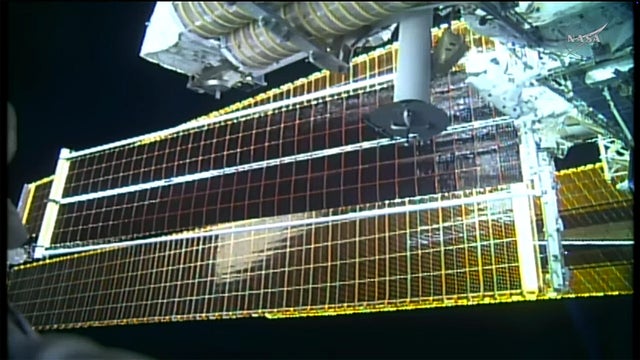
Launched in pieces beginning in 1998, the ISS was engineered to operate on a robust yet aging electrical architecture. The station’s power is harvested via eight massive photovoltaic arrays, which convert solar radiation into direct current. Historically, storing this energy for the orbital night—which occurs roughly every 90 minutes as the station orbits the Earth at 17,500 miles per hour—relied on 24 nickel-hydrogen ($\text{NiH}_2$) batteries per power channel, totaling 48 batteries across the entire spacecraft.
By the mid-2010s, those original $\text{NiH}_2$ batteries were approaching the end of their designed service life, suffering from capacity degradation and chemical fatigue. Recognizing that power generation and storage are the non-negotiable bedrock of enterprise ROI in space research, NASA and its international partners formulated a comprehensive replacement strategy. The objective: swap out the bulky, degraded nickel-hydrogen units for state-of-the-art lithium-ion ($\text{Li-ion}$) batteries and advanced adapter plates.
The operational complexity cannot be overstated. Each upgrade cycle required a delicate choreography between ground controllers at NASA’s Johnson Space Center, the station’s Mobile Servicing System (a 58-foot robotic arm known as Canadarm2), and spacewalking astronauts enduring brutal thermal swings and punishing radiation environments. With the current extravehicular activities, the station is executing the final string of this multi-year logistical marathon, permanently modernizing the station's electrical backbone.
Technical Specifications and Operational Execution
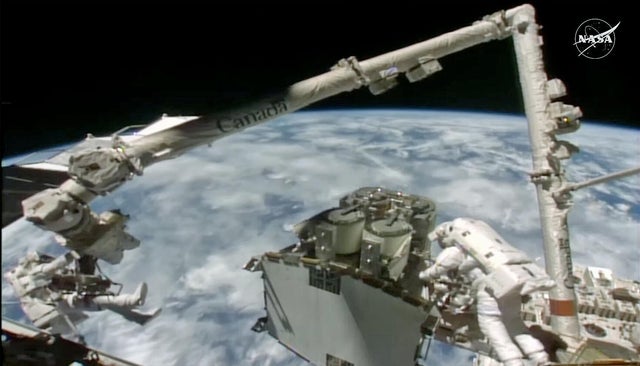
To fully grasp the magnitude of this upgrade, one must examine the engineering metrics involved. The new lithium-ion batteries provide significantly higher energy density, superior charge-discharge efficiency, and a vastly reduced physical footprint compared to their predecessors. Each new battery unit, paired with its dedicated adapter plate containing state-of-the-art voltage regulators, replaces multiple older units while offering greater power storage capacity.
| System Metric | Legacy Infrastructure (NiH2) | Modernized Infrastructure (Li-ion) |
|---|---|---|
| Energy Density | Lower (~50-60 Wh/kg) | Significantly Higher (~120-150 Wh/kg) |
| Battery Count per Channel | 24 Units | 12 Units (Plus Adapter Plates) |
| Lifespan & Reliability | ~6.5 Years (High Degradation Rate) | 10+ Years (Optimized Thermal Regulation) |
| Grid Output Capacity | ~120 Kilowatts (Baseline) | ~120+ Kilowatts (Enhanced Stability) |
Executing this transition required meticulous risk mitigation. A miscalculation during the electrical isolation of a power channel could result in catastrophic arc flashing or permanent damage to sensitive payload racks inside the station's pressurized modules. Furthermore, managing the logistics of launching heavy cargo payloads via commercial resupply vehicles—such as SpaceX’s Cargo Dragon and Northrop Grumman’s Cygnus—demanded airtight supply chain coordination and adherence to strict regulatory compliance standards.
Industry & Market Implications: Safeguarding the LEO Economy
The completion of the ISS power system upgrade carries profound economic and strategic ramifications for the global aerospace sector. As governments look toward the eventual deorbiting of the space station around 2030, the immediate priority is maximizing the scientific and commercial output of the facility today.
- Commercial Payload Continuity: Private sector firms conducting pharmaceutical research, fiber-optic manufacturing, and semiconductor crystal growth in microgravity rely on uninterrupted, stable power. Voltage spikes or power drops can ruin months of delicate laboratory experiments, destroying millions of dollars in venture capital and corporate R&D investments.
- Valuation Multiples for New Space: Emerging commercial station developers—such as Axiom Space, Blue Origin (Orbital Reef), and Voyager Space (Starlab)—are closely monitoring this upgrade. Proving that complex utility infrastructure can be successfully overhauled in orbit validates the long-term engineering models underpinning future private space station valuations.
- Supply Chain Resilience: Aerospace prime contractors and component manufacturers supplying specialized hardware for extravehicular applications stand to gain increased market liquidity and investor confidence as demand for high-reliability orbital components accelerates.
Frequently Asked Questions (People Also Ask)
Why is the International Space Station replacing its power system now?
The original nickel-hydrogen batteries installed during the station’s initial assembly phase have reached the end of their operational lifespans, exhibiting decreased charge capacity. Upgrading to modern lithium-ion batteries ensures a reliable, highly efficient power supply, extending the operational viability of the station through its remaining years of service.
What are the primary technical challenges of conducting spacewalks for power upgrades?
Spacewalkers face extreme environmental hazards, including severe thermal fluctuations ranging from -250°F to 250°F, intense solar radiation, and the risk of orbital debris impacts. From an engineering standpoint, handling high-voltage electrical circuits in a vacuum requires meticulous isolation procedures to prevent equipment damage or astronaut injury.
How does this power upgrade impact commercial research on the ISS?
A stabilized and upgraded electrical grid guarantees continuous power to scientific payload racks. This eliminates the risk of experiment-halting power dips, thereby protecting corporate investments in microgravity pharmaceutical development, materials science, and advanced manufacturing.
What happens to the old batteries once they are removed?
Typically, the retired battery units are packed into uncrewed cargo resupply vehicles, such as Japanese HTV cargo craft or Northrop Grumman Cygnus vehicles, which are subsequently directed to burn up harmlessly during atmospheric re-entry over the Pacific Ocean.
Future Outlook: Milestones to Watch
As the final phase of this monumental power upgrade concludes, attention within the aerospace community shifts toward the broader horizon of orbital infrastructure. Key milestones to watch over the next 24 to 36 months include:
- Integration of Additional Commercial Modules: With a fortified power grid, the station is primed to accept new commercially funded modules, expanding habitable volume and research capacity.
- Transition to Commercial LEO Destinations (CLDs): NASA’s systematic transfer of operational knowledge gained during these complex station upgrades will directly inform the safety and architectural blueprints of upcoming commercial space stations.
- Advanced Energy Management Protocols: Implementation of AI-driven power distribution software designed to autonomously balance loads across disparate commercial and governmental research payloads.
Ultimately, the successful execution of this multi-year power system overhaul underscores the extraordinary resilience of international aerospace engineering. By future-proofing the ISS grid, space agencies and their commercial partners are not merely maintaining an aging outpost—they are laying the vital structural foundation for humanity’s permanent economic expansion into the cosmos.