Executive Takeaways
- Unprecedented Duration: Four analog astronauts successfully completed a grueling 378-day deployment inside NASA’s Mars Dune Alpha, marking the longest continuous closed-loop habitat simulation in history.
- 3D-Printed Infrastructure Validation: The mission served as a live stress-test for autonomous, polymer-based construction technologies intended to mitigate astronomical payload transport costs and capital allocation risks for interplanetary colonization.
- Commercial & Industrial Spinoffs: The data harvested from psychological profiling, resource regeneration loops, and closed-loop life support systems unlocks high-yield enterprise ROI for terrestrial smart-infrastructure, remote mining, and extreme-environment cloud compute architecture.
- Anatomy of a Multibillion-Dollar Pipeline: The experiment directly informs procurement strategies, regulatory compliance frameworks, and infrastructure scalability for upcoming crewed Artemis lunar bases and commercial low-Earth orbit (LEO) outposts. >
HOUSTON — When four individuals stepped out of a translucent, 1,700-square-foot module at NASA’s Johnson Space Center on a crisp autumn morning, they did more than simply conclude a science experiment. They emerged from an entirely closed-loop ecosystem designed to simulate the psychological strain, physiological degradation, and engineering vulnerabilities of the Martian surface. After 378 days of living entirely divorced from Earth's biosphere, the crew of the Crew Health and Performance Exploration Analog (CHAPEA) mission confronted a world that had moved forward while they remained suspended in an engineered Martian time capsule.
For financial markets, defense contractors, and aerospace executives tracking the commercialization of the final frontier, the successful conclusion of the CHAPEA Mission 1 represents a watershed moment. As private equity and venture capital deploy unprecedented sums into the New Space economy—chasing a projected multi-trillion-dollar space economy by the 2030s—the fundamental bottleneck has never been propulsion alone. It is survivability, infrastructure scalability, and risk mitigation in environments hostile to human physiology. By proving that a 3D-printed structure can safely house and sustain a crew for over a year under strict resource constraints, NASA and its industrial partners have fundamentally altered the valuation multiples of companies pioneering autonomous construction and closed-loop environmental controls.
The Genesis of Mars Dune Alpha: Engineering the Extreme Environment
Test Our Free AI & Tech Utilities Suite
Calculate LLM API token costs, analyze article dwell-time, or simulate tech DCA returns.
Constructed by ICON, an Austin-based additive construction pioneer backed by prominent venture capital and strategic defense funds, the Mars Dune Alpha habitat is a marvel of industrial engineering. Built using ICON’s proprietary Lavacrete material via Vulcan robotic 3D-printers, the structure was engineered to withstand extreme barometric differentials, radiation spikes, and thermal fluctuations mirroring those of Acidalia Planitia on Mars.
The catalytic event driving this initiative is the stark mathematical reality of payload economics. Transporting standard construction materials, heavy machinery, and voluminous habitation modules beyond Earth's gravity well incurs prohibitive costs, frequently measured in tens of thousands of dollars per kilogram. For a sustained human presence on the Moon or Mars to clear the hurdle of economic viability, in-situ resource utilization (ISRU) and autonomous 3D printing are non-negotiable prerequisites.
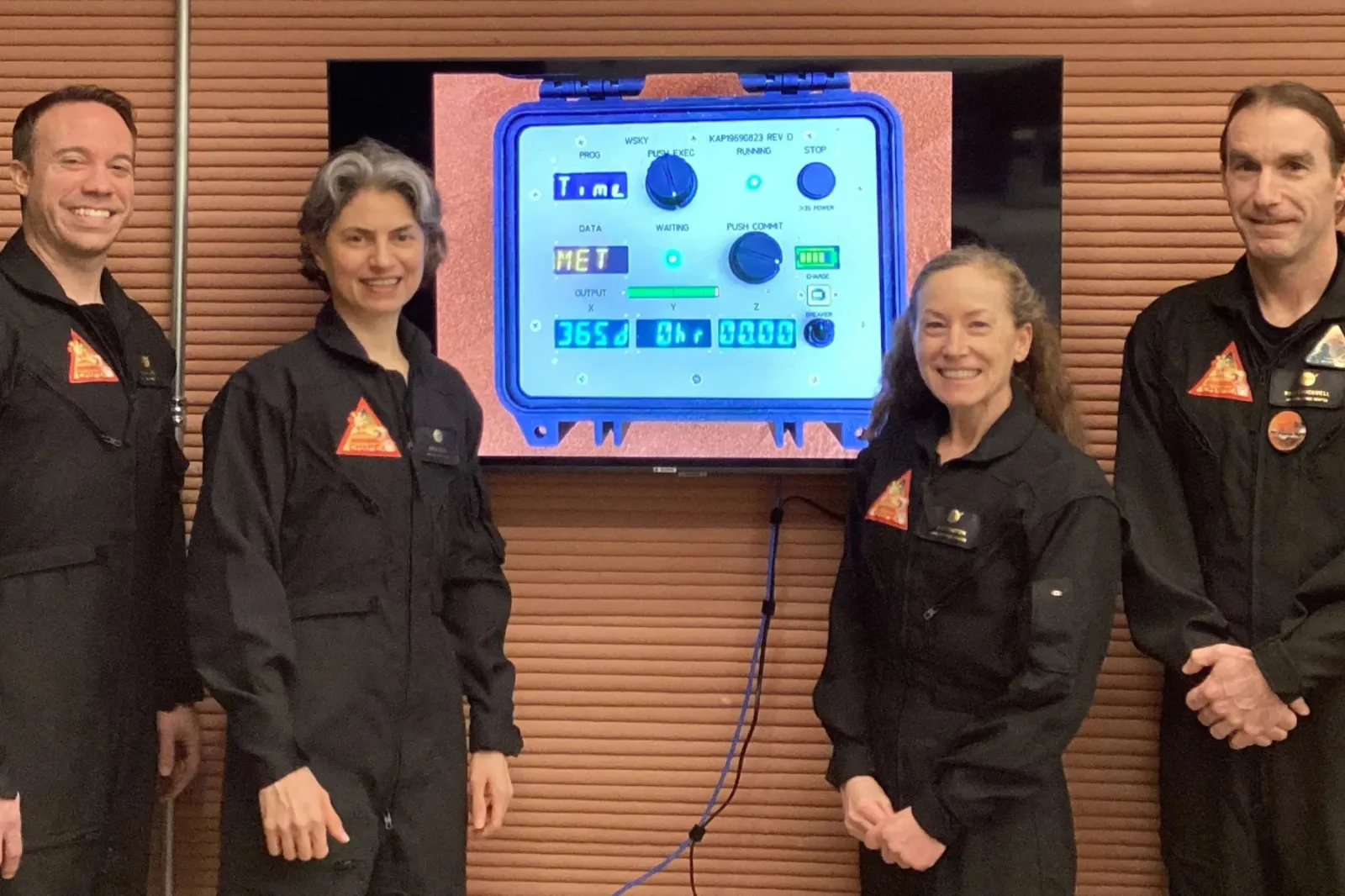
During their 378 days inside Mars Dune Alpha, the CHAPEA crew—consisting of mission commander Kelly Haston, flight engineer Ross Brockwell, medical officer Nathan Jones, and science officer Anca Selariu—lived under strict operational conditions. Every calorie of food was accounted for; water was meticulously recycled through closed-loop purification systems; and communications with mission control suffered a simulated 22-minute one-way time delay, forcing the crew to exercise absolute autonomy in the face of simulated equipment failures, power grid anomalies, and medical emergencies.
| Metric / Parameter | CHAPEA Mission 1 Specifications | Actual Martian Operational Targets | Commercial / Terrestrial Spinoff Application |
|---|---|---|---|
| Mission Duration | 378 Days (Continuous Isolation) | 500+ Days (Typical Mars Surface Stay) | Extreme-environment remote workforce trials |
| Habitat Construction | 1,700 sq. ft. 3D-printed Lavacrete (ICON Vulcan) | Autonomous robotic printing using local regolith | Disaster relief housing & modular infrastructure |
| Communication Latency | Up to 22 minutes one-way delay | 3 to 22 minutes depending on orbital alignment | Autonomous edge-computing and AI governance |
| Resource Regeneration | High-efficiency water and air scrubbing loops | Near 98% closed-loop recycling requirement | Green tech, circular economy, and water scarcity solutions |
Industry & Market Implications: Who Wins, Who Loses, and Capital Allocation
The successful execution of the CHAPEA isolation study sends powerful ripple effects across multiple industrial sectors, reshaping competitive moats and investment theses:
- Additive Manufacturing & Construction Tech: Companies specializing in large-scale robotic 3D printing are seeing an immediate surge in valuation potential. Investors are recognizing that technology proven to build radiation-shielded habitats under Martian atmospheric constraints can easily command lucrative terrestrial contracts for modular defense installations, rapid municipal housing, and automated subterranean tunneling.
- Aerospace Prime Contractors: Primes involved in NASA's Artemis architecture and commercial space station initiatives are shifting capital allocation toward integrated life support systems and autonomous AI diagnostic suites. Firms that master closed-loop environmental control systems (ECLSS) will capture disproportionate market share in future government procurement auctions.
- Digital Health and Behavioral Analytics: Telemedicine providers, neuro-tech firms, and enterprise HR platforms stand to gain immensely from the biometric datasets gathered during the 378-day trial. Monitoring cognitive load, stress biomarkers, and circadian rhythm disruption in isolated cohorts provides invaluable IP for optimizing high-stress terrestrial workforces in remote energy extraction, maritime shipping, and institutional trading floors.
- Traditional Heavy Construction: Traditional masonry and conventional labor-intensive real estate developers face mounting disruption risks. As automated, software-driven robotic construction proves its reliability over multi-year cycles, traditional capital-intensive construction models face margin compression unless they integrate additive manufacturing pipelines.
Frequently Asked Questions (People Also Ask)
What was the primary objective of NASA’s CHAPEA 378-day mission?
The primary objective of the Crew Health and Performance Exploration Analog (CHAPEA) mission was to evaluate human physiological and psychological resilience under long-duration, resource-constrained isolation mimicking a Martian surface habitat. By analyzing how crew members handled workload stress, interpersonal dynamics, equipment malfunctions, and communication delays, NASA can better prepare astronauts and mitigate mission-critical risks for actual crewed missions to Mars.
How was the Mars Dune Alpha habitat built, and why use 3D printing?
Mars Dune Alpha was constructed using ICON’s proprietary Vulcan robotic 3D-printing technology, laying down layers of a specialized cement-like material called Lavacrete. 3D printing is essential for deep-space exploration because transporting pre-fabricated modules from Earth is cost-prohibitive. Autonomous additive manufacturing allows future space agencies to utilize local planetary materials (regolith) to print robust, radiation-shielded shelters before astronauts arrive.
How did the crew handle communications with Earth during the simulation?
To faithfully recreate the operational reality of a Martian mission, mission controllers deliberately introduced a communication delay of up to 22 minutes each way. This forced the four analog astronauts to operate with a high degree of self-reliance, making complex operational decisions, troubleshooting technical glitches, and managing their daily schedules without real-time intervention from Earth.
What are the commercial and terrestrial applications of the data collected during CHAPEA?
The insights harvested from CHAPEA extend far beyond planetary science. The closed-loop water and air recycling systems offer direct commercial applications for green technology and water-scarce terrestrial regions. Furthermore, the psychological profiling and biometric tracking data provide valuable frameworks for enterprise risk mitigation, remote workforce management in extreme industries, and the development of autonomous edge-computing architectures.
Future Outlook: Milestones on the Horizon for Interplanetary Infrastructure
As the hatch swings open on Mars Dune Alpha and the data streams are handed over to NASA’s biostatisticians and human research program analysts, the aerospace industry is already looking toward the next inflection points. NASA has already scheduled subsequent CHAPEA deployments, designed to test iterative habitat designs, advanced agricultural modules for in-situ food production, and next-generation AI co-pilots engineered to support autonomous crew operations.
Concurrently, the commercial sector is preparing to leverage these findings for private space station modules and lunar surface development under the Artemis program. For institutional investors, hedge funds, and corporate strategists, the message is unequivocal: the space economy is transitioning rapidly from speculative exploration to hardened industrial execution. Companies capable of delivering robust, autonomous, and scalable infrastructure solutions will command premium valuations, turning the once-fictional dream of Martian settlement into an undeniable financial and engineering reality.