Executive Takeaways
- The Milestone: Four volunteer crew members successfully emerged from NASA's CHAPEA 1 habitat at the Johnson Space Center after 378 days of complete physiological and psychological isolation, simulating a Martian surface expedition.
- Commercial and Capital Alignment: The mission serves as a critical risk-mitigation benchmark for private aerospace contractors, defense primes, and venture capital syndicates pouring billions into infrastructure scalability for extra-terrestrial logistics.
- Operational Stressors: The crew endured simulated communication delays of up to 22 minutes each way, resource rationing, crop failures, and rigorous maintenance protocols designed to test psychological resilience and life-support system reliability.
- Valuation & Future Milestones: Data harvested from the 378-day deployment will directly dictate capital allocation and regulatory compliance frameworks for upcoming Artemis deployments and commercial space station architectures.
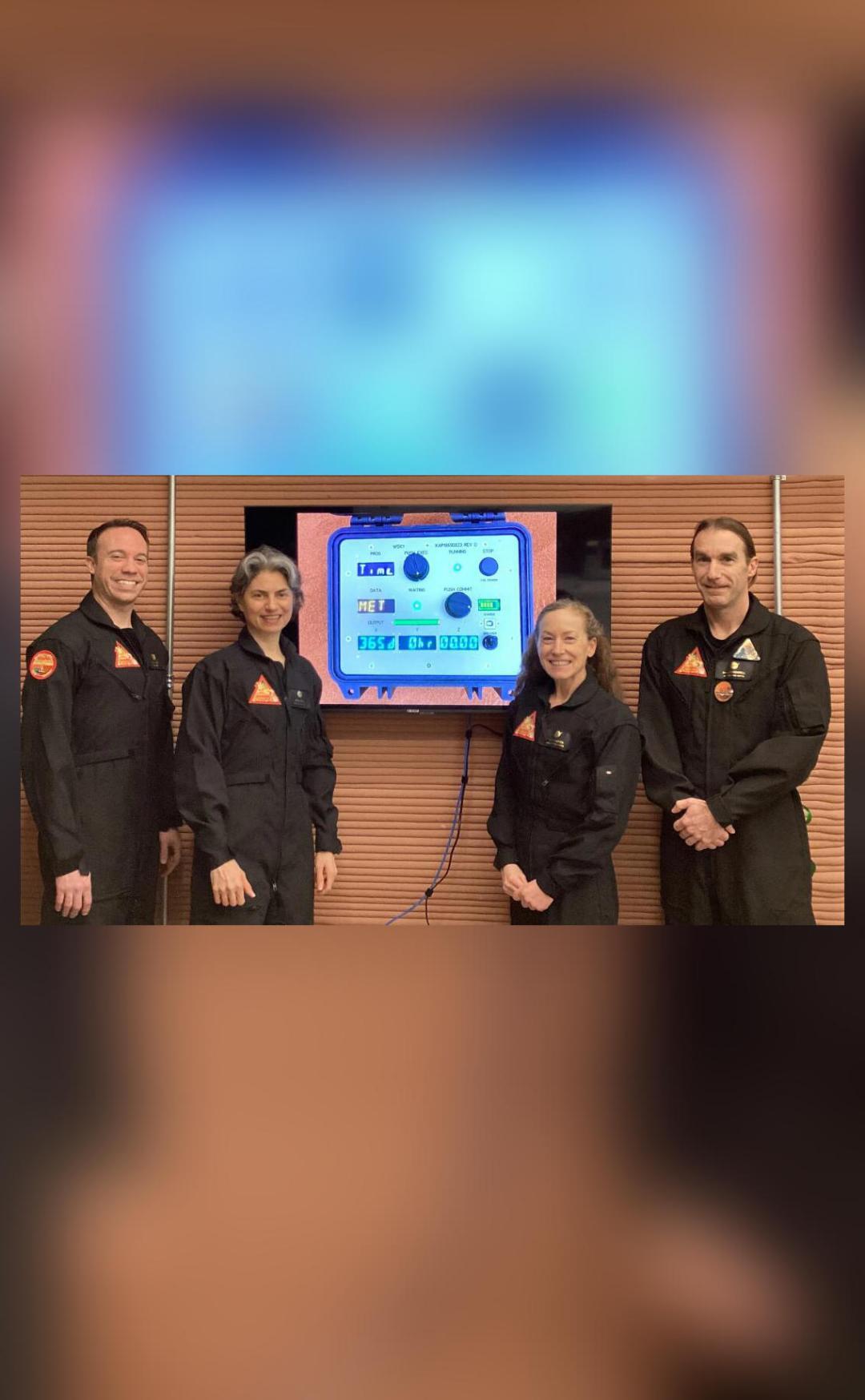
HOUSTON — When the heavy blast door of the Crew Health and Performance Exploration Analog (CHAPEA) swung open on a humid Texas morning, four individuals stepped back into a world that had continued spinning for 378 days without their physical presence. For Anca Selariu, Ross Brockwell, Nathan Jones, and Kelly Haston, the transition marked the culmination of a grueling year-long psychological and operational gauntlet. Yet, for the broader aerospace, defense, and venture capital ecosystem, their emergence represents something far more critical: a vital proof-of-concept for the commercial viability and operational risk mitigation of crewed interplanetary travel.
As private equity firms, sovereign wealth funds, and tier-1 defense contractors reassess valuation multiples across the space economy, human endurance has emerged as the ultimate bottleneck. While rocket-stage reusability and heavy-lift launch capabilities have driven down the cost per kilogram to low Earth orbit (LEO), the economics of deep-space exploration remain constrained by biological frailties. The CHAPEA 1 mission was not merely a scientific exercise; it was an extensive, high-fidelity operational stress test designed to protect multi-billion-dollar capital investments destined for the lunar surface and, eventually, the Red Planet.
The Architecture of Isolation: Inside the 1,700-Square-Foot Martian Envelope
Test Our Free AI & Tech Utilities Suite
Calculate LLM API token costs, analyze article dwell-time, or simulate tech DCA returns.
Constructed using cutting-edge 3D-printing technology by ICON—a construction tech startup backed by prominent venture capital funds—the Alpha Habitat spans roughly 1,700 square feet inside Building 220 at NASA’s Johnson Space Center. Designed to replicate the austere, high-stress environment of a Martian base camp, the habitat features vertical hydroponic farms, rudimentary medical stations, specialized workspaces, and private quarters tailored to simulate the cramped conditions astronauts will face millions of miles from Earth.
Throughout their 378-day deployment, the crew operated under conditions meticulously engineered to break down psychological buffers. Every transmission sent to Mission Control was subjected to a simulated one-way communication delay ranging from several minutes up to 22 minutes—the exact latency experienced by radio waves traveling between Earth and Mars at orbital opposition. This architectural constraint forced the crew to abandon real-time problem-solving loops, compelling them to execute complex maintenance routines, software patches, and habitat repairs autonomously.
From an enterprise risk perspective, this autonomy is paramount. In deep space, real-time command-center intervention is impossible. The success of the CHAPEA 1 crew in managing simulated structural failures, equipment degradations, and acute interpersonal friction without ground-crew bailouts provides vital behavioral telemetry for corporate human-resources frameworks, training protocols, and autonomous diagnostic systems.
Physiological Telemetry and Behavioral Analytics

Behind the glossy press briefings and public homecoming lies a mountain of proprietary physiological and behavioral data. NASA researchers, in partnership with academic institutions and private biotech contractors, tracked every variable of the crew's daily existence. Continuous biometric monitoring recorded sleep architecture, cortisol levels, cardiovascular responses, and cognitive performance under chronic fatigue.
The economic implications of this data extend far beyond civil space exploration. Corporations operating in high-stress, remote terrestrial environments—such as deep-sea oil extraction, Antarctic mining research, and autonomous subterranean infrastructure projects—face identical human-capital challenges. The predictive analytics models developed from CHAPEA’s behavioral tracking systems offer significant enterprise ROI for companies seeking to optimize workforce performance, reduce operational friction, and mitigate the liability of human error in remote deployments.
Furthermore, the nutritional constraints imposed during the mission provided deep insights into closed-loop life support systems. Relying heavily on shelf-stable rations complemented by fresh produce harvested from vertical hydroponic systems, the crew experienced the psychological and physical impacts of dietary monotony. As agritech startups race to scale space-grade caloric production for orbital platforms and lunar bases, CHAPEA’s real-world validation data serves as an invaluable benchmark for product development and regulatory compliance.
| Mission Parameter | CHAPEA 1 Specification | Commercial & Strategic Implications |
|---|---|---|
| Duration | 378 Days (August 2023 – July 2024) | Validates long-duration life-support system reliability and crew psychological resilience. |
| Habitat Volume | ~1,700 sq. ft. (3D-printed by ICON) | Demonstrates scalable, automated habitat construction methodologies for lunar/Martian surfaces. |
| Communication Latency | Up to 22 minutes each way | Forces edge-computing architecture and autonomous fault-tolerance software development. |
| Resource Management | Strict rationing of water, power, and consumables | Drives circular economy tech investments and advanced recycling system infrastructure. |
Capital Allocation, Defense Primes, and Market Liquidity
The successful conclusion of CHAPEA 1 arrives at a critical juncture for the global aerospace and defense markets. As institutional capital rotates away from speculative tech valuations toward hard assets, infrastructure, and dual-use defense technologies, the commercial space sector is undergoing a profound structural maturation.
Major defense primes and NewSpace conglomerates are actively positioning themselves to capture lucrative government procurement contracts tied to NASA’s Moon-to-Mars architecture. The total addressable market (TAM) for extra-terrestrial infrastructure—encompassing power generation, environmental control and life support systems (ECLSS), in-situ resource utilization (ISRU), and autonomous habitation modules—is projected to scale exponentially over the next two decades.
However, venture capital deployment in deep-space human flight has historically faced valuation headwinds due to perceived regulatory uncertainty and protracted capital-expenditure cycles. Missions like CHAPEA directly mitigate these risks by de-risking the biological variable. When institutional investors see empirical proof that human crews can maintain high operational efficiency over 378 days of rigorous isolation, the risk profile of deep-space infrastructure investments shifts dramatically, unlocking deeper pools of market liquidity and project finance.
Frequently Asked Questions (People Also Ask)
What was the primary scientific objective of the CHAPEA 1 mission?
The primary objective was to evaluate human performance, behavioral health, and physiological adaptation during a prolonged, highly constrained simulated Martian mission. By keeping four crew members isolated inside a 1,700-square-foot habitat for 378 days under simulated environmental stressors and communication delays, NASA and its commercial partners gathered critical data to optimize future crew selection, training methodologies, and life-support architecture for deep-space missions.
How did the crew handle emergencies and communication delays?
The crew experienced simulated one-way communication delays of up to 22 minutes with Mission Control, mimicking the actual radio wave latency between Earth and Mars. This forced the crew to operate with high autonomy, utilizing onboard edge-computing systems, pre-planned standard operating procedures, and internal troubleshooting frameworks to resolve simulated equipment failures, medical scenarios, and habitat maintenance issues without immediate ground-station intervention.
What are the commercial and industrial takeaways from the CHAPEA habitat design?
The habitat was constructed using advanced 3D-printing technology developed by private-sector partner ICON. This demonstrates a scalable, automated methodology for building extra-terrestrial infrastructure using local resources (ISRU principles). The success of the habitat structure validates private-sector capital allocation into advanced construction tech, automated robotics, and closed-loop environmental control systems with dual-use applications in remote terrestrial industries.
What is the timeline for subsequent CHAPEA missions?
CHAPEA 1 is the first of three planned analog missions. NASA has already scheduled subsequent deployments (CHAPEA 2 and CHAPEA 3) to build upon the datasets collected during this inaugural 378-day cycle. Each subsequent mission will test refined habitat technologies, modified operational protocols, and varied crew dynamics to further de-risk human exploration architectures ahead of crewed Artemis surface missions and eventual Martian transits.
Future Outlook: Capitalizing on the Road to Mars
As the doors of the CHAPEA habitat close on the first iteration of this historic experiment, the focus of the aerospace community immediately shifts to the road ahead. NASA’s overarching Artemis campaign—aiming to establish a sustainable human presence on the lunar south pole—serves as the immediate operational proving ground for Martian infrastructure.
Over the next 24 to 36 months, venture capitalists, corporate strategists, and government procurement officers will parse the exhaustive datasets delivered by the CHAPEA 1 crew. Key milestones to watch include the solicitation of bids for subsequent lunar habitation modules, advancements in autonomous cloud-compute architecture capable of operating with deep-space latency, and the commercialization of closed-loop agricultural technologies.
Ultimately, the successful emergence of Selariu, Brockwell, Jones, and Haston demonstrates that humanity possesses the physiological and psychological resilience required to conquer the void. For global markets and institutional investors, the message is unmistakable: the economy of the Red Planet is no longer a distant theoretical abstraction—it is an engineering reality rapidly transitioning from the simulation lab to the balance sheet.