Executive Takeaways
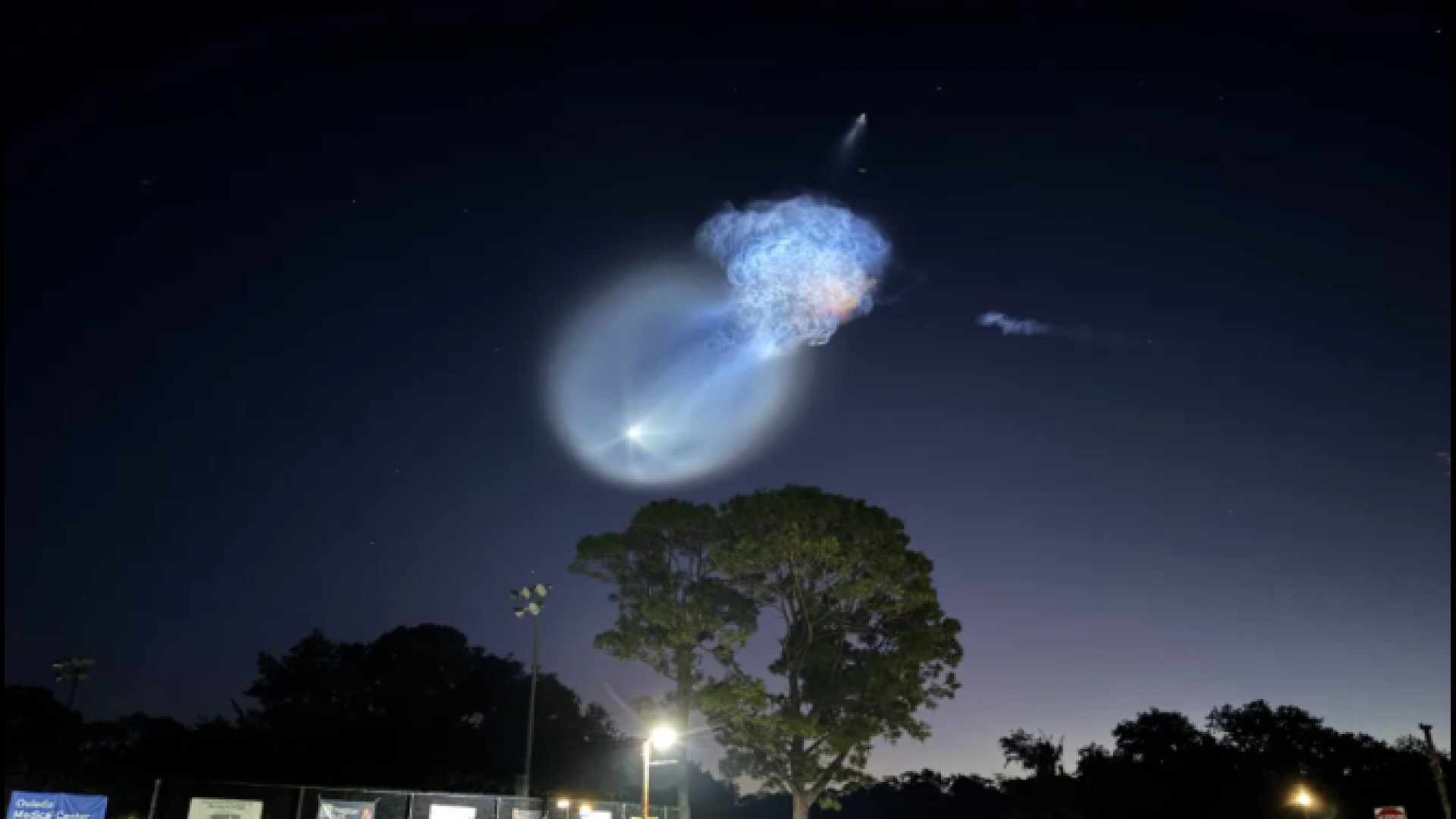
- Atmospheric Optical Dynamics: The viral "space jellyfish" visual phenomenon is driven by high-altitude sunlight scattering off expanding rocket exhaust plumes in the upper mesosphere and thermosphere, occurring exclusively during the critical twilight launch window when the launchpad remains in astronomical darkness while orbital altitudes capture unshadowed solar rays.
- Orbital Architecture Shift: The Bandwagon-5 mission represents SpaceX’s aggressive expansion into mid-inclination orbits (~45 degrees), disrupting traditional Sun-Synchronous Orbit (SSO) rideshare monopolies and unlocking superior revisit rates for commercial Earth observation (EO) and Synthetic Aperture Radar (SAR) constellations.
- Commercial Margin Compression: By pricing payload integration at roughly $6,000 to $7,500 per kilogram on rideshare flights, SpaceX is accelerating margin compression across dedicated small-launch competitors, forcing enterprise operators to reassess capital allocation strategies and risk mitigation frameworks.
- Regulatory and Congestion Scrutiny: The unprecedented cadence of Falcon 9 missions from Cape Canaveral Space Force Station intensifies FAA airspace integration demands, orbital debris regulatory compliance, and space situational awareness (SSA) protocols amidst crowded low Earth orbit (LEO) corridors.
The Anatomy of an Optical Wonder: Twilight Mechanics and Exhaust Aerodynamics
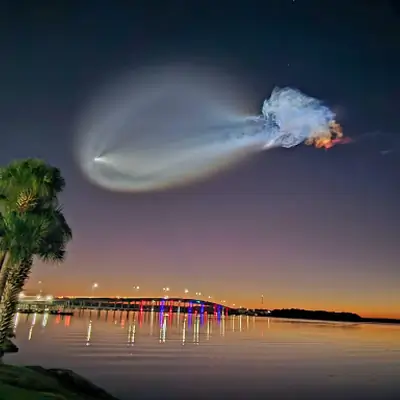
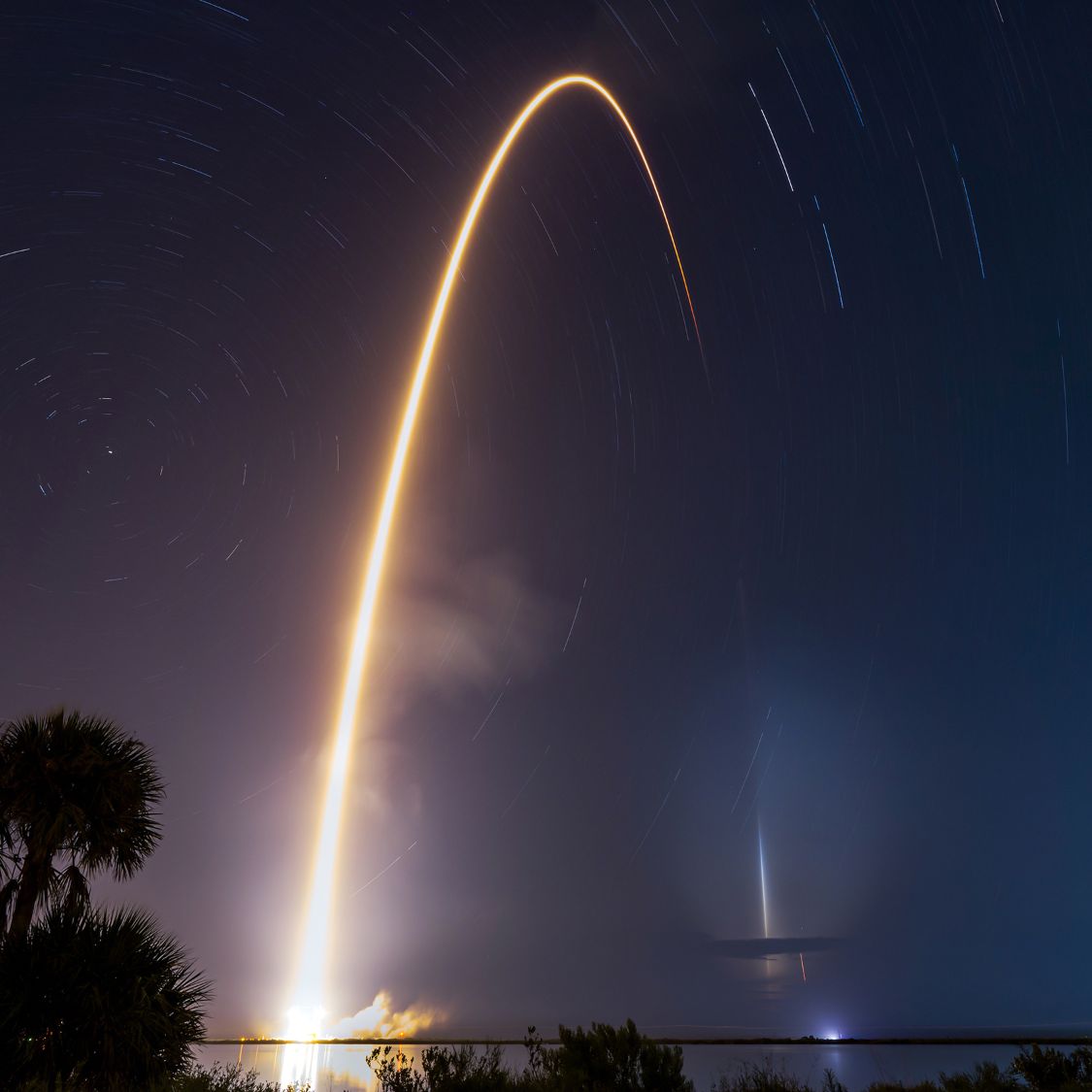
Whenever a Falcon 9 lifts off from Space Launch Complex 40 (SLC-40) at Cape Canaveral or Launch Complex 39A at NASA’s Kennedy Space Center within an approximate 30- to 60-minute window before dawn or after dusk, it triggers one of the most stunning sights in modern aerospace: the "space jellyfish." While social media routinely reacts with sensationalism, the visual spectacle is governed by rigorous atmospheric chemistry, fluid mechanics, and solar geometry.
The prerequisite for the phenomenon is the solar terminator line—the moving boundary dividing daylight from darkness. At sea level on the Florida Space Coast, the sun sits between 6 and 18 degrees below the local horizon during civil, nautical, and astronomical twilight, plunging ground observers into shadow. However, as the Falcon 9 ascends through the stratosphere and crosses the Kármán line into the mesosphere and lower thermosphere (80 to 120 kilometers in altitude), the vehicle breaches Earth’s shadow cone into direct, unobstructed sunlight.
At these near-vacuum altitudes, ambient atmospheric pressure drops to a fraction of a millibar. In this near-vacuum environment, the rocket exhaust exiting the second-stage Merlin Vacuum (MVac) engine—powered by rocket-grade kerosene (RP-1) and liquid oxygen (LOX)—can no longer be contained by atmospheric backpressure. The exhaust gas experiences rapid underexpansion, billowing outward into a vast, teardrop-shaped plume hundreds of kilometers wide.
The plume consists primarily of water vapor ($H_2O$), carbon dioxide ($CO_2$), and residual carbonaceous soot particles. Upon immediate exposure to extreme mesospheric cold, the water vapor flash-freezes into billions of micron-sized ice crystals. These ice crystals and soot particles act as an efficient scattering medium for sunlight. Through a combination of Rayleigh scattering (which disperses shorter blue wavelengths across the finest particles) and Mie scattering (which produces the luminous, broad-spectrum white and silver glow from larger particulates), the plume is illuminated against the pitch-black sky below. The pulsing or undulating motion often observed by spectators corresponds to engine gimbaling, cold-gas thruster firings from the returning first-stage booster, or second-stage separation events.
Bandwagon-5: The Strategic Realignment of Rideshare Economics
While the optical show commands public attention, the underlying driver of missions like Bandwagon-5 is a calculated commercial play designed to cement SpaceX’s dominance across underserved orbital inclinations. For years, the commercial rideshare market was dominated by SSO-focused missions, such as SpaceX’s own "Transporter" series, which deploy satellites into polar orbits ideal for imaging polar regions and standardizing lighting conditions for optical surveillance.
However, sun-synchronous orbits carry distinct disadvantages for real-time intelligence, surveillance, and reconnaissance (ISR), as well as maritime logistics and environmental monitoring. Satellites in polar orbits typically pass over lower-latitude targets only once or twice per day. SpaceX’s "Bandwagon" program targets mid-inclination trajectories—typically between 42 and 45.4 degrees. This allows enterprise satellite operators to position spacecraft over the world’s most economically vital and geopolitically sensitive corridors, including the continental United States, the Mediterranean, the Middle East, East Asia, and the primary shipping routes of the Indo-Pacific.
By entering a mid-inclination orbit, Synthetic Aperture Radar (SAR) operators such as Capella Space and Umbra, alongside optical monitoring firms and radio-frequency (RF) analytics ventures like HawkEye 360, can dramatically compress their target revisit latency from 24 hours down to less than two hours. In modern data monetization, latency compression translates directly into higher contract valuation multiples and superior enterprise ROI for defense, commodity trading, and disaster-response end-users.
Comparative Architecture: Rideshare Economics vs. Dedicated Small Launch
The deployment of dedicated mid-inclination rideshares represents an aggressive competitive offensive against bespoke small-satellite launch providers. Below is a comparative operational and economic analysis between standard enterprise launch architectures:
| Launch Architecture | Target Orbit / Profile | Average Cost per Kg (USD) | Payload Latency / Revisit Impact | Primary Enterprise Advantage | Key Strategic Vulnerability |
|---|---|---|---|---|---|
| SpaceX Bandwagon (Falcon 9) | Mid-Inclination (42°–45°) LEO | $6,000 – $7,500 | Sub-2-hour revisit across global temperate zones | Unmatched cost efficiency; flight-proven booster reliability | Fixed orbital nodes; secondary payloads must accept primary orbital drops |
| SpaceX Transporter (Falcon 9) | Sun-Synchronous (97°–98°) Polar LEO | $5,500 – $6,500 | Global coverage; 12-to-24 hour target revisit | Predictable ground tracks; consistent solar illumination angles | Inefficient coverage for equatorial and mid-latitude priority targets |
| Dedicated Small Launcher (e.g., Rocket Lab Electron) | Bespoke Inclinations (0° to 100°+) | $22,000 – $28,000 | Optimized to custom mission requirements | Custom launch timing, exact orbital insertion, zero rideshare compromise | Significant price premium; severe capital allocation constraints for startups |
| Orbital Transfer Vehicle (OTV) on Rideshare | Multi-plane delivery via "Space Tug" | $12,000 – $16,000 (blended) | Phased distribution across multiple orbital slots | Enables micro-constellation distribution from a single booster stack | Propulsion failure risk; delayed time-to-station-acquisition |
Industrial Ramifications: Capital Allocation in the Post-Bespoke Era
The aggressive scaling of Falcon 9 launches—now averaging a launch every two to three days across SpaceX’s launch facilities—has restructured venture capital and private equity deployment across the commercial space economy. Historically, space-tech venture capital funds reserved up to 40% of their operational expenditures for launch costs. The commoditization of launch services pioneered by Falcon 9’s booster reuse program has lowered launch expenditures to less than 15% of total constellation lifecycle capital.
This dynamic introduces a severe market bifurcated along infrastructure lines:
- Downstream Sensor & Data Dominance: Capital is aggressively shifting away from launch vehicle developers and into proprietary orbital sensors, cloud compute architecture in space, and low-latency edge processing. Downstream operators can allocate capital toward advanced edge-AI chips and sophisticated optical payloads rather than reserving large cash positions simply to book a launch.
- Squeeze on Small-Launch Capitalization: Small-launch startups face an increasingly difficult financing environment. While dedicated launchers once promised precise, customized orbital delivery, the emergence of SpaceX-compatible Orbital Transfer Vehicles (OTVs)—developed by firms such as Impulse Space and Exolaunch—erodes that moat. Startups can now launch on a Bandwagon or Transporter flight for a fraction of the cost, deploying an OTV to maneuver their spacecraft into a precise, customized altitude or plane.
- Supply Chain and Port Infrastructure Congestion: The breakneck pace at Cape Canaveral introduces structural infrastructure bottlenecks. The high frequency of operations stresses drone ship recovery logistics, liquid oxygen and methane supply networks, and requires deep coordination with the Federal Aviation Administration (FAA) to prevent severe commercial aviation disruptions across the busy Miami and Orlando air corridors.
Risk Mitigation, Orbital Debris, and Regulatory Compliance
The expansion of mid-inclination constellation launches brings pressing regulatory hurdles. Unlike Sun-Synchronous Orbits, which are dispersed primarily across a narrow polar shell, mid-inclination trajectories intersect with the orbital tracks of the International Space Station (ISS), China’s Tiangong space station, and thousands of existing debris objects left over from legacy upper stages and anti-satellite tests.
Enterprise operators booking slots on missions like Bandwagon-5 are subject to stricter regulatory compliance mandates from both the Federal Communications Commission (FCC) and the FAA. The FCC's "five-year rule," which mandates that satellites in low Earth orbit deorbit within five years of completing their missions (down from the previous 25-year guideline), has forced satellite manufacturers to integrate active, highly reliable propulsion systems, even on sub-50-kilogram CubeSats.
Furthermore, insurers are altering their risk mitigation models. Underwriters are pricing launch and early orbit phase (LEOP) insurance with heightened scrutiny regarding secondary payload deployment mechanisms. A single non-separating payload or failure in deployment sequencing inside a densely packed rideshare dispenser can jeopardize nearby satellites, turning an enterprise asset into an uninsured liability within seconds of stage separation.
Frequently Asked Questions (People Also Ask)
What causes the "space jellyfish" effect during a rocket launch?
The "space jellyfish" atmospheric phenomenon occurs when a rocket launches during twilight—either shortly before sunrise or just after sunset. While the ground remains in darkness, the rocket ascends into the high mesosphere and thermosphere, where it reaches sunlight. In the near-vacuum of space, the rocket exhaust expands into a massive cloud. The high-altitude sunlight hits the freezing water vapor and exhaust particles, scattering the light through Rayleigh and Mie scattering, making the glowing plume visible against the dark sky on Earth.
Why is the Bandwagon-5 mission significant compared to standard SpaceX launches?
Unlike SpaceX's Transporter missions that carry satellites to polar Sun-Synchronous Orbits, the Bandwagon series targets mid-inclination orbits around 45 degrees. This specific orbital plane passes over the world’s most populous and economically critical regions far more frequently, allowing commercial Earth-observation, defense, and maritime surveillance satellites to revisit the same locations on Earth multiple times per day rather than just once or twice.
Can you see the space jellyfish across the entire state of Florida?
Yes. Because the phenomenon occurs at altitudes between 80 and 150 kilometers above the Earth, the line of sight extends for hundreds of miles. Under clear atmospheric conditions, a twilight launch from Cape Canaveral can produce an exhaust plume visible from Key West to Jacksonville, and even along the Gulf Coast of Florida and parts of southern Georgia.
Does the space jellyfish phenomenon harm the upper atmosphere?
The space jellyfish itself is simply the visual illumination of standard exhaust products—mainly water vapor, carbon dioxide, and small amounts of soot from the combustion of RP-1 kerosene and liquid oxygen. While the environmental and radiative effects of rocket emissions in the stratosphere are the subject of ongoing scientific study, the optical effect itself is harmless and dissipates as the exhaust gases expand and disperse into the vacuum of space.
Strategic Outlook: The Industrialization of Low Earth Orbit
As launch cadence transitions from an operational metric into a standardized commodity, the space economy is crossing a generational inflection point. The glowing silhouettes of SpaceX's twilight launches over the Florida coast serve as a visual testament to a profound industrial transformation. Where spaceflight once required state-level capital allocation and years of bespoke mission planning, the modern space logistics market increasingly mirrors commercial shipping and containerized freight operations.
Moving into late 2026 and beyond, the market expects even greater downward pricing pressure as SpaceX progresses toward the operationalization of Starship. If Starship achieves its target unit economics, the payload deployment model will permanently pivot from capacity-constrained payload engineering to mass-scale orbital infrastructure deployment. Until then, missions like Bandwagon-5 showcase the current operational zenith: a synchronized blend of fluid dynamics, precision orbital mechanics, and ruthless commercial strategy that commands both the twilight skies and the future of orbital commerce.