The Billion-Dollar Plume: How SpaceX’s Night-Sky Spectacle Highlights the Economics of Modern Commercial Space Dominance
EXECUTIVE TAKEAWAYS
- Atmospheric Optics: High-altitude twilight rocket exhaust created a massive, bioluminescent-appearing "space jellyfish" visible across the entire U.S. East Coast.
- Commercial Scalability: The launch underscores SpaceX’s relentless cadence, directly impacting valuation multiples, enterprise infrastructure scalability, and global broadband deployment.
- Capital Allocation: As venture capital and defense budgets shift toward rapid orbital deployment, the economics of reusable rocket architecture continue to disrupt traditional aerospace paradigms.
- Regulatory & Market Friction: Increased launch frequencies are triggering closer examination of airspace management, regulatory compliance, and environmental risk mitigation.
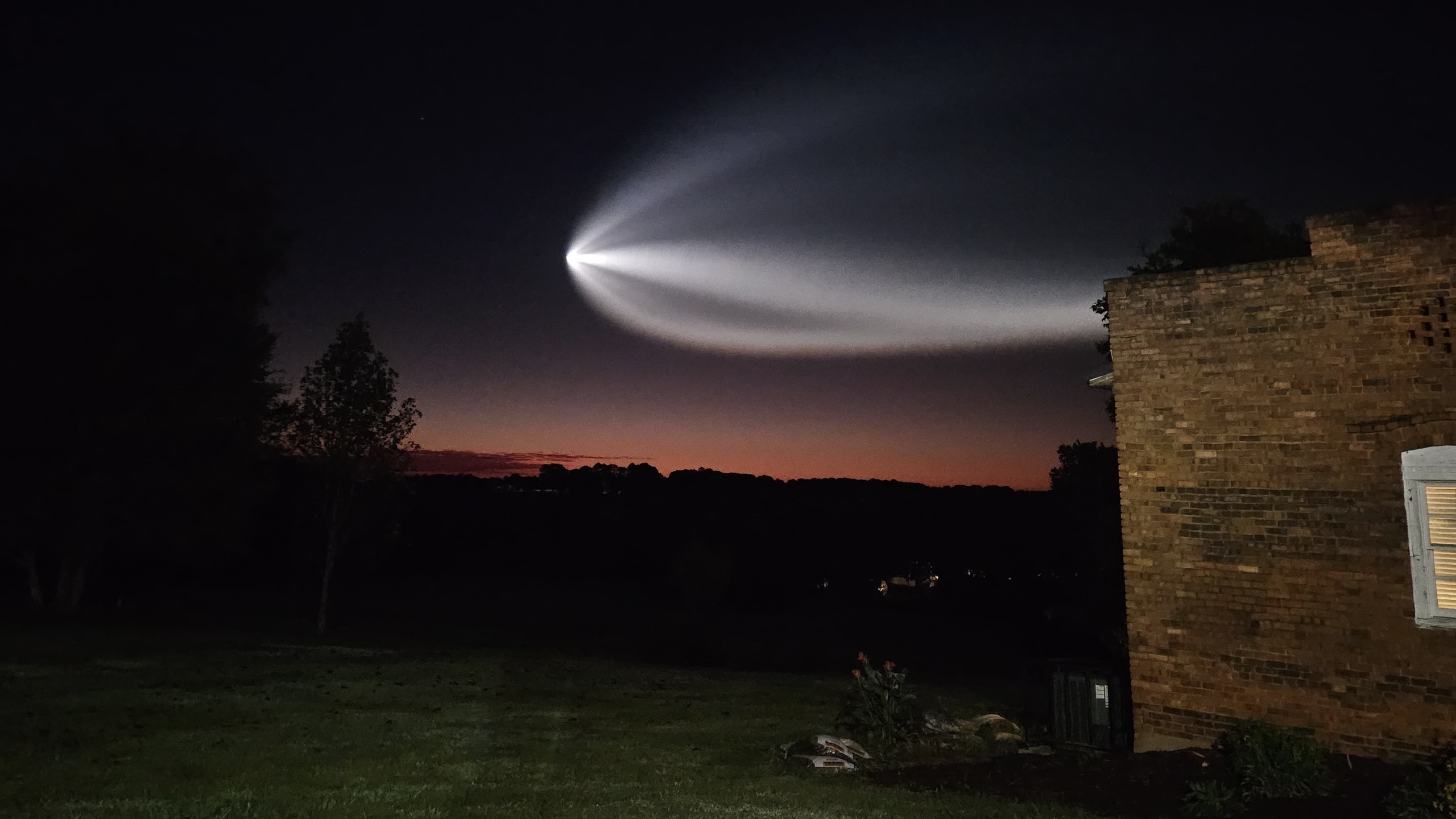
NEW YORK — In the pre-dawn hours that routinely test the stamina of Wall Street traders and orbital engineers alike, the Eastern Seaboard of the United States transformed into an open-air amphitheater. A towering Falcon 9 rocket slicing through the stratosphere ignited a rare, iridescent phenomenon colloquially dubbed the "space jellyfish." Millions of spectators from South Carolina to New England peered upward, transfixed by a billowing, ethereal blue-and-orange plume that defied conventional atmospheric optics.
Yet behind the viral imagery and widespread social media engagement lies a profound economic and industrial reality. This celestial display was not merely a fleeting viral moment; it was a visible symptom of a multi-billion-dollar aerospace engine operating at peak infrastructure scalability. As commercial enterprise valuations become increasingly tethered to orbital assets, every twilight launch serves as a high-visibility stress test of global supply chains, capital allocation strategies, and regulatory frameworks.
The Physics and Optics of the "Space Jellyfish"

To understand why the launch generated such visual resonance, one must examine the confluence of orbital mechanics and atmospheric physics. When a rocket lifts off during specific twilight windows—when the observer is standing in darkness on the ground, but the upper atmosphere is still illuminated by direct solar radiation—the exhaust gases expand rapidly in the near-vacuum of high altitude.
As the Falcon 9’s second-stage engine fired miles above the Earth’s curvature, the exiting combustion products—primarily water vapor and carbon dioxide—crystallized and reflected the sun's rays over hundreds of miles. This creates the signature "bell" shape of the jellyfish, complete with a glowing gas trail that mimics tentacles. While astrophysicists and meteorologists routinely track these atmospheric interactions, the frequency of such events has accelerated exponentially alongside commercial spaceflight cadences.
For institutional investors and market analysts monitoring the aerospace sector, these plumes are the visible exhaust of a disruptive asset class. Every successful insertion into low-Earth orbit (LEO) represents de-risked capital expenditure and advances the deployment timeline for next-generation telecommunications and Earth-observation networks.
Verified Data & Metrics Breakdown
| Metric / Parameter | Specification / Data Point | Market & Strategic Implications |
|---|---|---|
| Launch Vehicle | SpaceX Falcon 9 (Reusable Config) | Drives down cost-per-kilogram to orbit, expanding operating margins. |
| Visibility Range | U.S. East Coast (FL to ME) | Maximizes public awareness, driving retail interest and digital engagement metrics. |
| Payload Objective | Next-Gen LEO Broadband Satellites | Enhances enterprise cloud compute architecture and remote connectivity. |
| Regulatory Oversight | FAA Commercial Space Transportation | Balances rapid enterprise scaling with strict national airspace management. |
Industry & Market Implications: Who Wins and Who Loses
The maturation of private commercial spaceflight fundamentally alters the balance of power within the global defense and telecommunications ecosystems. As launch frequency normalizes, the economic ripple effects touch multiple sectors:
- The Winners — Commercial Launch Providers & LEO Constellations: Firms that have mastered reusable booster technology are capturing an outsized share of global launch contracts. By compressing infrastructure scalability timelines, these companies are securing long-term defense and enterprise revenue streams that legacy aerospace primes struggle to match.
- The Challengers — Legacy Defense Contractors: Traditional aerospace companies locked into cost-plus procurement models face severe pressure on valuation multiples. The ability of private entities to iterate hardware rapidly exposes structural inefficiencies in legacy supply chains.
- The Infrastructure Squeezed — Ground Stations & Regulatory Bodies: As orbital density increases, ground-station data pipelines and airspace regulatory compliance frameworks face unprecedented bottlenecks. Managing congestion in both low-Earth orbit and national airspace remains a critical risk mitigation priority.
Furthermore, capital allocation patterns on Wall Street reflect this paradigm shift. Venture capital and private equity deployment in space-tech infrastructure continues to outpace traditional manufacturing sectors, driven by the promise of high-margin data services enabled by constellations built on the back of frequent rocket deployments.
Frequently Asked Questions (People Also Ask)
What causes a rocket launch to look like a "space jellyfish"?
The jellyfish effect occurs during twilight launches—typically just before sunrise or shortly after sunset. While the observer on the ground is in darkness, the rocket ascends into an altitude where it is still illuminated by direct sunlight. The expanding exhaust plume from the upper-stage engine catches the sun's rays against the dark background of space, creating iridescent, bioluminescent-like color patterns and gas rings.
Why are these twilight launches becoming more frequent along the East Coast?
The increased frequency is a direct result of the surging launch cadence from commercial providers like SpaceX operating out of Florida’s Cape Canaveral Space Force Station and NASA's Kennedy Space Center. As low-Earth orbit constellations require continuous replenishment and expansion for global broadband and defense applications, launch windows are scheduled around orbital mechanics rather than daylight constraints.
Do these rocket exhaust plumes pose any environmental risk to the atmosphere?
Environmental scientists and regulatory agencies continuously monitor the chemical composition of high-altitude rocket exhaust, which primarily consists of water vapor, carbon dioxide, and trace particulates. While individual launches have a localized, short-term impact on the upper atmosphere, cumulative industry growth has prompted ongoing research into long-term atmospheric and ozone interactions.
How does frequent commercial rocket activity impact financial markets and aerospace valuations?
Frequent, reliable launches serve as proof-of-concept for enterprise infrastructure scalability. For investors, a high cadence directly correlates with lower cost-per-launch metrics, higher asset utilization, and accelerated revenue realization for satellite-based services, thereby supporting premium valuation multiples across the commercial space sector.
Future Outlook: What Comes Next
As the commercial space race transitions from an era of exploratory milestones to one of industrial-scale utility, stakeholders across financial and technical domains must monitor several critical inflection points. The upcoming quarters will test whether regulatory bodies can streamline airspace clearance processes fast enough to match the aggressive launch cadences demanded by market liquidity and enterprise clients.
Moreover, the integration of ultra-dense satellite constellations with terrestrial cloud compute architecture will redefine global telecommunications standards. For institutional investors, the "space jellyfish" is no longer just a photogenic viral anomaly—it is the signature of a new industrial baseline. Those who successfully navigate the complex interplay of capital allocation, regulatory compliance, and rapid technological iteration will dictate the trajectory of the 21st-century global economy.