Executive Takeaways
- Unprecedented Coalition: Open USD launches backed by a robust consortium of over 140 global financial institutions, enterprise technology giants, and market makers.
- Structural Differentiation: Moving beyond simple fiat-backing, Open USD introduces advanced yield-bearing mechanics, institutional-grade risk mitigation, and optimized cross-border capital allocation.
- Regulatory Compliance First: Designed from inception to navigate impending global stablecoin frameworks, offering auditable reserves and automated compliance hooks.
- Ecosystem Scalability: Initial deployment leverages high-performance cloud compute architecture and multi-chain interoperability to capture enterprise payment flows.
NEW YORK — In an industry dominated by monolithic incumbents, the digital asset landscape is witnessing a structural realignment. As of July 2026, the arrival of Open USD—supported by a formidable coalition of more than 140 global partners—has fundamentally disrupted the status quo. According to data released via TradingView, this new entrant is not merely competing for retail transaction volume; it is aggressively targeting institutional treasury operations, cross-border corporate settlements, and enterprise-grade liquidity pools.
For years, the stablecoin market has operated as a concentrated duopoly, leaving corporate treasurers and institutional investors exposed to systemic concentration risk, variable regulatory scrutiny, and opaque reserve management. Open USD enters this high-stakes arena with a meticulously engineered value proposition: decentralized security paired with institutional-grade governance. By uniting over 140 multinational enterprises, payment processors, and liquidity providers under a single interoperable standard, Open USD is carving out a definitive path toward institutional adoption.
The Anatomy of a Disruption: Catalysts Behind Open USD
The genesis of Open USD is rooted in market fatigue. Enterprise CFOs and Chief Investment Officers have long voiced concerns regarding the opacity and counterparty risk inherent in legacy stablecoin models. While retail users prioritize gas fees and interface simplicity, institutional capital allocators demand absolute predictability, verifiable reserve attestations, and ironclad regulatory compliance.
Open USD addresses these friction points through a radical redesign of market liquidity and infrastructure scalability. Unlike early-generation stablecoins that relied on fragmented backing, Open USD utilizes a diversified, bankruptcy-remote reserve structure audited in real time. This architecture significantly enhances risk mitigation, making it an attractive instrument for corporate balance sheet management and automated treasury operations.
Furthermore, the timing of the launch aligns perfectly with macroeconomic shifts. As central bank digital currencies (CBDCs) face prolonged bureaucratic delays and fragmented cross-border implementation, multinational corporations require a reliable, high-velocity settlement medium. Open USD fills this vacuum by offering instantaneous finality across multiple distributed ledger networks without sacrificing compliance integrity.
Financial Mechanics and Market Infrastructure
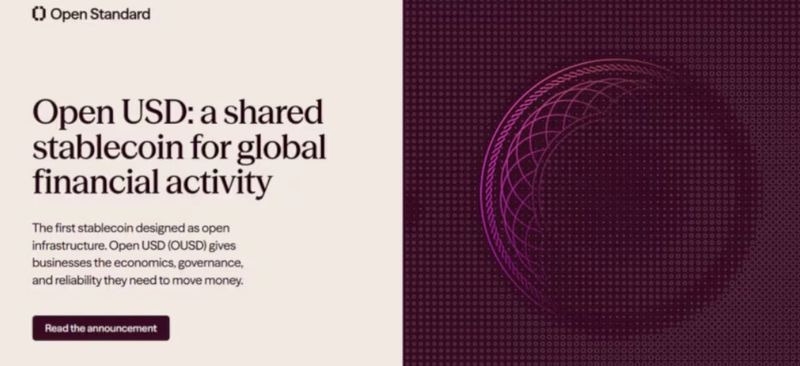
A granular examination of Open USD’s technical architecture reveals why financial analysts are revising valuation multiples and adoption forecasts for the sector. The protocol integrates deeply with existing enterprise resource planning (ERP) systems, allowing corporate finance teams to execute programmatic capital allocation without manual intervention.
The table below outlines the core specifications comparing legacy stablecoin frameworks with the newly deployed Open USD model:
| Metric / Feature | Legacy Stablecoins | Open USD (OUSD) |
|---|---|---|
| Global Partner Network | Closed ecosystem / Private issuers | 140+ Global Financial & Tech Partners |
| Reserve Transparency | Monthly or quarterly attestations | Real-time programmatic auditing |
| Institutional Yield Mechanics | Rarely passed to holders / Restricted | Native, compliant yield generation |
| Compliance & AML Integration | Reactive freezing & basic blacklist | Proactive, programmable KYC/AML hooks |
| Cloud & Network Scalability | Dependent on single-chain congestion | Multi-chain interoperability & cloud-native |
Industry & Market Implications: Who Wins and Who Loses
The deployment of Open USD triggers a profound redistribution of market share across the fintech and banking sectors. As liquidity migrates toward platforms offering superior yield and institutional safeguards, several distinct market dynamics are emerging:
- Winners — Enterprise Technology Providers and Neo-Banks: Companies building enterprise infrastructure scalability and cross-border payment gateways stand to capture substantial enterprise ROI. Neo-banks integrating Open USD can offer instantaneous settlement services that traditional correspondent banking networks simply cannot match.
- Winners — Institutional Investors: Fixed-income desks and market makers benefit from an asset that bridges traditional yield-generating money market instruments with the velocity of digital assets.
- Losers — Legacy Monolithic Stablecoin Issuers: Issuers who relied on retail complacency and zero-yield models face intense margin compression. Without an expansive partner ecosystem, defending market share against a 140-institution coalition becomes mathematically improbable.
- Losers — Traditional Correspondent Banking Networks: High-fee legacy wire systems (such as legacy SWIFT channels for certain liquidity corridors) will experience accelerated disintermediation as corporate treasurers route capital through Open USD rails.
Frequently Asked Questions (People Also Ask)
What makes Open USD different from existing market-leading stablecoins?
Open USD is distinguished by its backing from a coalition of over 140 global financial and technology partners, real-time programmatic reserve transparency, and native institutional yield-generation capabilities. While legacy stablecoins primarily serve retail trading on specific blockchains, Open USD is architected specifically for corporate treasury management, enterprise ROI, and regulatory compliance across multi-chain environments.
How does Open USD ensure regulatory compliance and risk mitigation?
The protocol embeds programmable compliance hooks directly into its smart contract architecture. This allows automated enforcement of KYC (Know Your Customer) and AML (Anti-Money Laundering) standards without compromising user privacy or operational speed. Furthermore, its bankruptcy-remote reserve structure provides superior risk mitigation compared to older, centralized models.
What role do the 140+ global partners play in the Open USD ecosystem?
The consortium of over 140 partners acts as liquidity providers, technological integration hubs, and institutional validators. This diverse backing ensures deep market liquidity from day one, broad acceptance across international payment gateways, and resilient infrastructure scalability that prevents single points of failure.
How can enterprises integrate Open USD into existing financial workflows?
Open USD offers robust APIs and cloud compute architecture integrations that plug directly into standard Enterprise Resource Planning (ERP) and treasury management systems. This enables automated cross-border settlements, real-time cash-flow management, and optimized capital allocation without requiring legacy banking middleware.
Future Outlook: Strategic Milestones to Watch
As Open USD establishes its foothold in the global financial architecture, market participants must monitor several critical forward-looking indicators. Over the next twelve to eighteen months, the trajectory of adoption will depend heavily on regulatory clarifications from key jurisdictions, including the European Union's MiCA enforcement and unfolding legislative frameworks in the United States.
Key milestones to watch include the onboarding of tier-1 global commercial banks into the governance consortium, the expansion of native yield products tailored for corporate balance sheets, and the deployment of cross-border trade finance pilots utilizing Open USD settlement rails. If the consortium successfully executes its roadmap, Open USD will not merely participate in the stablecoin market—it will redefine the operational standards of global digital finance.