Executive Takeaways
- Unprecedented Payload: Japan’s Martian Moons Exploration (MMX) mission is engineered to land on Phobos, extract 0.35 ounces of pristine soil, and execute a high-stakes return to Earth by 2029.
- Beating Western Titans: JAXA’s £322 million capital allocation outpaces NASA and ESA timelines, positioning Tokyo to deliver the world’s first interplanetary moon samples two years ahead of competing Western agencies.
- Solving a Planetary Enigma: The mission’s geological assays will definitively resolve whether Phobos and Deimos are captured carbonaceous asteroids or pulverized impact debris from early Mars.
- Strategic & Commercial Resonance: Beyond pure astrophysics, the mission establishes critical benchmarks for deep-space infrastructure scalability, autonomous navigation capital allocation, and long-term risk mitigation frameworks.
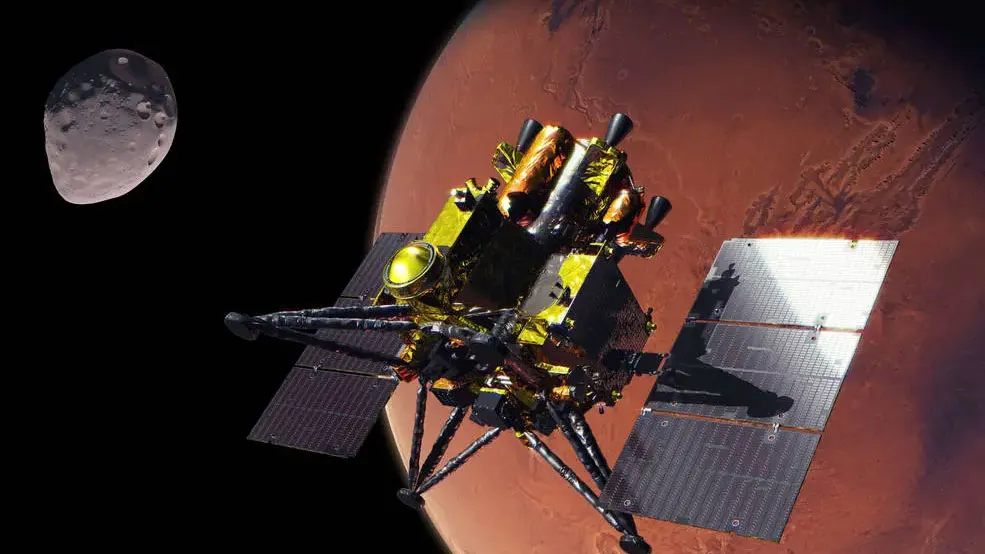
TOKYO AND WASHINGTON — In the high-stakes arena of deep-space exploration, the margin between geopolitical prestige and multi-million-dollar obsolescence is razor-thin. While global markets fixate on terrestrial valuation multiples and enterprise cloud compute infrastructure, a far more ancient ledger is being audited in the vacuum of interplanetary space. The Japan Aerospace Exploration Agency (JAXA) is preparing to launch one of the most audacious capital- and science-intensive endeavors of the decade: the Martian Moons Exploration (MMX) mission.
Costing an estimated £322 million, MMX is not merely an exercise in academic curiosity. It is a masterclass in risk mitigation, advanced payload engineering, and strategic timing. Set to capture the world’s attention as the first-ever spacecraft to touch down on a moon orbiting another planet, harvest surface regolith, and execute a flawless return trip to Earth, MMX is poised to beat NASA and the European Space Agency (ESA) to the punch by a crucial margin of two years.
The Genesis Debate: Captured Asteroids vs. Giant Impacts
For half a century, planetary scientists have been deeply polarized by a fundamental cosmological riddle: Where did Phobos and Deimos, the two potato-shaped satellites of Mars, originate?
Two primary camps dominate the astrophysical discourse:
- The Captured Asteroid Hypothesis: This theory posits that Phobos and Deimos are ancient, carbonaceous C-type asteroids that once drifted freely in the main asteroid belt before falling under the gravitational influence of Mars. Captured via atmospheric drag or early orbital interactions, their chemical composition should mirror the primitive building blocks of the outer solar system.
- The Giant Impact Hypothesis: Alternatively, these moons may be the accretion disk of pulverized crust and mantle material hurled into orbit following a cataclysmic mega-impact on the Martian surface—a process analogous to the prevailing theory for Earth’s own Moon.
Resolving this debate requires more than remote spectroscopy. It demands direct, physical asset retrieval. By dispatching a robotic explorer capable of drilling, coring, and securing at least 0.35 ounces (10 grams) of pristine regolith from the surface of Phobos, MMX will secure the ground-truth data necessary to rewrite planetary evolution textbooks.
Mission Architecture, Infrastructure Scalability, and Timeline
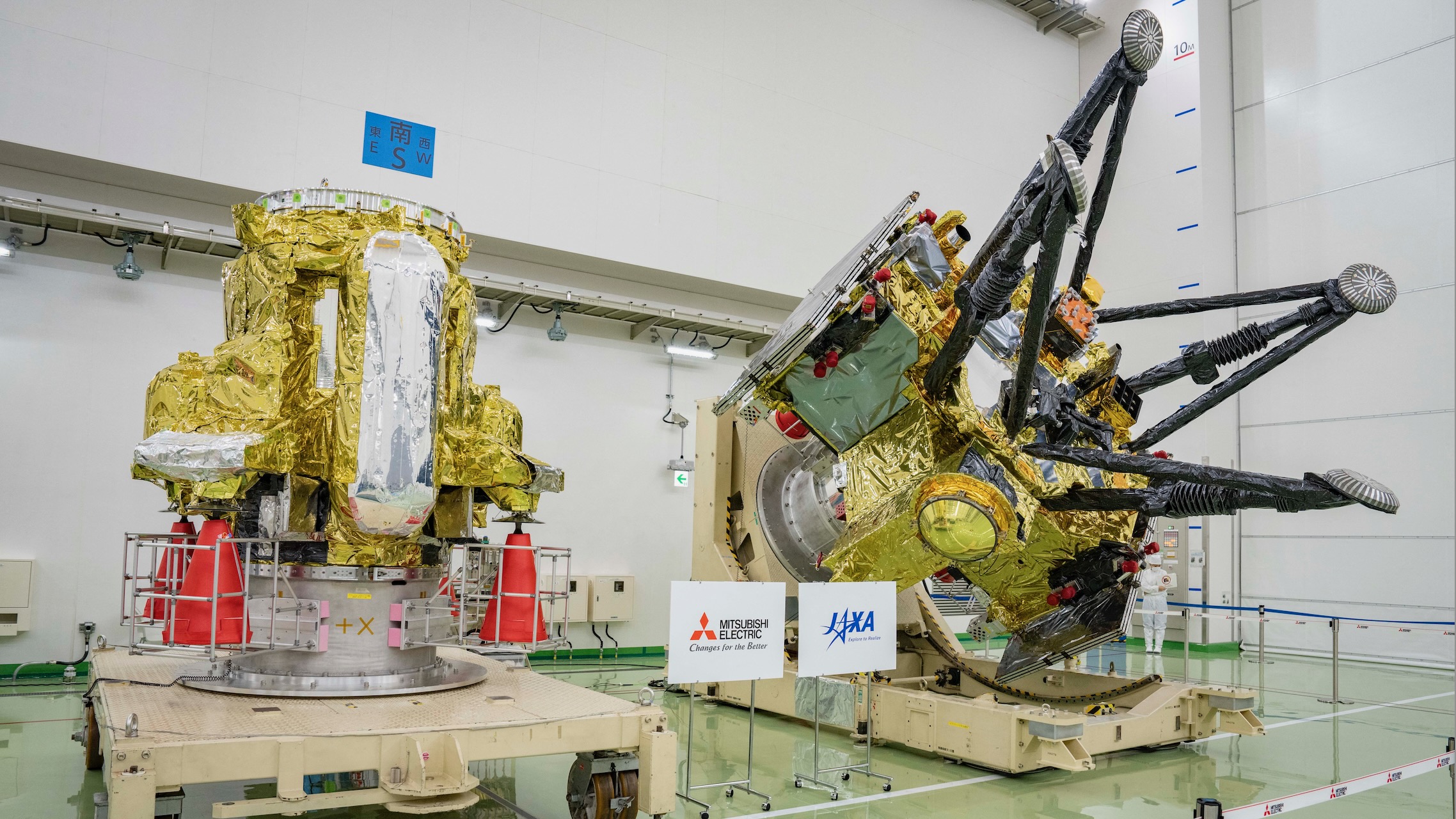
Executing a round-trip voyage to the Martian system requires extraordinary engineering discipline. JAXA’s mission architecture leverages advanced ion propulsion and highly optimized fuel mass fractions to navigate the complex gravitational interplay between Mars, the Sun, and Phobos.
Unlike orbital reconnaissance orbiters that merely capture photons, MMX is an active manipulation asset. Upon arrival in the Martian system, the probe will spend months mapping both moons before descending onto the pulverized, crater-scarred surface of Phobos. Using a pneumatic sampling device and a coring drill, the probe will extract subsurface material protected from cosmic weathering and solar wind degradation.
The mission timeline is compressed and rigorously audited:
- Launch Phase: Scheduled to capitalize optimal orbital transfer windows, minimizing delta-V requirements and fuel burn.
- Martian Arrival & Insertion: Comprehensive orbital mapping to identify low-risk touchdown zones on Phobos, ensuring structural integrity during anchoring.
- Sample Acquisition: Deployment of mechanical samplers to secure a minimum of 0.35 ounces of regolith from both surface and sub-surface strata.
- Earth Return: Firing primary propulsion systems to break free of Martian gravity, aiming for a high-velocity atmospheric re-entry over Australia or the Pacific by 2029.
Verified Data and Specifications Breakdown
| Mission Parameter | Specification / Metric | Strategic Significance |
|---|---|---|
| Total Project Budget | £322 Million (Estimated) | Highly cost-efficient compared to comparable dual-agency deep space projects. |
| Target Body | Phobos (Largest Martian Moon) | Offers optimal regolith depth and surface stability for lander deployment. |
| Target Sample Mass | Minimum 0.35 ounces (10 grams) | Sufficient mass for multi-lateral geochemical, isotopic, and mineralogical assays. |
| Return to Earth Date | On target for 2029 | Beats equivalent NASA and ESA sample-return schedules by approximately 24 months. |
Industry & Market Implications: The New Space Economy
While the primary dividends of MMX are scientific, the secondary impacts ripple directly through the global aerospace supply chain, technology sector, and government capital allocation strategies.
Who Wins:
- Japanese Aerospace Manufacturing: Prime contractors and component fabricators gain invaluable intellectual property in autonomous deep-space rendezvous, precision landing algorithms, and thermal protection systems.
- Global Academic Consortia: Laboratories across North America, Europe, and Asia granted access to the MMX regolith will experience a surge in research funding, publication influence, and cross-border scientific partnerships.
- Commercial Deep-Space Pioneers: Companies specializing in asteroid prospecting and in-situ resource utilization (ISRU) will closely study JAXA’s sampling mechanism as a proof-of-concept for future commercial off-world mining.
Who Loses:
- Legacy Bureaucratic Agencies: Western space programs facing procurement delays and budget overruns risk losing first-mover advantage in planetary sample acquisition, forcing a strategic realignment of their internal project management frameworks.
People Also Ask (Frequently Asked Questions)
What makes the JAXA MMX mission unique compared to previous Mars missions?
Unlike previous missions that relied strictly on orbital imaging, atmospheric telemetry, or surface rovers operating solely on the Red Planet, MMX is specifically designed to land on a Martian moon, collect physical regolith samples, and execute an interplanetary return flight back to Earth.
Why is scientists' focus directed specifically at Phobos instead of Deimos?
Phobos is the larger of the two Martian moons and possesses a stronger gravitational field, making orbital stabilization and landing execution more predictable. Furthermore, its surface exhibits distinct groove formations and impact structures that provide easier access to both surface regolith and subsurface strata.
How does the MMX mission timeline compare with NASA and ESA initiatives?
JAXA’s disciplined cost structure and streamlined project management are projected to return Martian system samples to Earth by 2029. This timeline places the Japanese mission roughly two years ahead of equivalent planned sample-return ventures by NASA and the European Space Agency.
What are the commercial and technological spinoffs of the MMX project?
Technologies developed for MMX—particularly autonomous navigation systems, fault-tolerant deep-space communications, and automated sample extraction mechanisms—have direct applications in commercial satellite servicing, orbital debris mitigation, and future private-sector asteroid mining ventures.
Future Outlook: Milestones to Watch
As integration and testing enter their final phases, aerospace analysts and institutional investors will monitor key critical path milestones. The success of MMX will not only validate Japan’s enduring capability as a Tier-1 spacefaring nation but will also establish a new operational baseline for interplanetary resource acquisition.
As we approach the 2029 return window, the data locked inside 0.35 ounces of Martian moon dust will do more than solve a decades-old academic debate; it will help shape the regulatory, technological, and economic frameworks governing humanity's expansion into the broader solar system.