Executive Takeaways
- Unprecedented Scale: Chinese firms currently manufacture nearly two-thirds of the world’s electric vehicles and command an even larger share of the global EV battery supply chain.
- The ITIF Finding: A landmark July 29, 2024 report by the Information Technology and Innovation Foundation (ITIF) challenges the narrative of pure technological superiority, arguing that China's leadership is anchored primarily in massive state subsidies, regulatory arbitrage, and aggressive capital allocation rather than foundational scientific breakthroughs.
- Market & Valuation Implications: Western automakers face severe margin compression and difficult decisions regarding capital expenditure, enterprise ROI, and long-term risk mitigation as low-cost Chinese imports challenge incumbent valuation multiples.
- Supply Chain Vulnerability: Global infrastructure scalability depends heavily on navigating China's near-monopoly on critical mineral refining, cathode chemistry, and cell-to-pack engineering.
For over a decade, global capital markets and automotive boardrooms have watched in a mixture of awe and alarm as the People’s Republic of China transformed itself into an industrial juggernaut of zero-emission mobility. Today, driving down a highway in Shenzhen, Oslo, or São Paulo reveals an undeniable reality: Chinese brands like BYD, CATL, and Geely are no longer fringe competitors. They are setting the pace for the global automotive industry.
Yet, beneath the glittering showrooms and soaring export volumes lies a fierce debate over the true nature of this dominance. Is China’s supremacy the result of genuine, market-disruptive innovation, or is it the calculated masterpiece of industrial policy—a state-directed blitz of capital allocation, non-market subsidies, and strategic supply chain capture?
This central question was brought into sharp relief on July 29, 2024, with the release of a comprehensive research briefing by the Information Technology and Innovation Foundation (ITIF). Titled to provoke and interrogate, the report dissects the underlying mechanics of China’s electric vehicle and battery manufacturing sectors. As institutional investors reassess risk profiles across global manufacturing assets, dissecting the ITIF findings offers critical insight into the future of international trade, regulatory compliance, and the global energy transition.
Deconstructing the ITIF Briefing: Innovation vs. State Capitalism
To understand the conclusions drawn in the July 29, 2024 ITIF report, one must first dismantle the binary narrative often perpetuated by political actors and corporate PR machines. The report does not dismiss Chinese engineering prowess; rather, it contextualizes it within a multi-decade framework of state-engineered market distortion.
Since the early 2010s, Beijing’s "New Energy Vehicle" (NEV) strategy deployed an estimated tens of billions of dollars in direct subsidies, tax exemptions, cheap land grants, and preferential procurement contracts. This influx of capital allowed domestic firms to absorb early-stage operational losses that would have broken publicly traded Western corporations beholden to quarterly earnings reports and strict enterprise ROI mandates.
Consequently, Chinese battery manufacturers—led by Contemporary Amperex Technology Co. Limited (CATL) and BYD—rapidly moved down the learning curve. By scaling production volumes exponentially, they achieved unit-cost efficiencies that legacy automakers in Detroit, Wolfsburg, and Tokyo have struggled to match. The ITIF analysis emphasizes that while Western firms often focused on high-end, iterative product innovation and premium luxury segments, Chinese enterprises focused relentlessly on process engineering, supply chain vertical integration, and aggressive cost reduction.
The Architecture of Dominance: Beyond the Assembly Line
The July 29 briefing highlights three distinct pillars underpinning China's lead in the EV and battery landscape:
- Upstream Mineral Control: China does not merely build batteries; it controls the refining choke points for lithium, cobalt, nickel, and graphite. This upstream dominance provides a permanent structural cost advantage, shielding domestic cell makers from global commodity price shocks.
- Vertical Integration and Ecosystem Density: Domestic battery suppliers and vehicle assemblers operate within hyper-concentrated geographic clusters. This proximity drastically reduces logistics overhead, accelerates prototyping cycles, and optimizes factory floor automation—a triumph of modern cloud compute architecture and smart manufacturing data analytics.
- Regulatory Agility and Testing Grounds: Domestic market regulations have historically favored localized supply chains, forcing intense hyper-competition among hundreds of domestic startups. Only the most ruthless survivors emerged, battle-tested by a domestic consumer base that readily adopts digital cockpit features and fast-charging infrastructure.
Verified Data and Metrics Breakdown
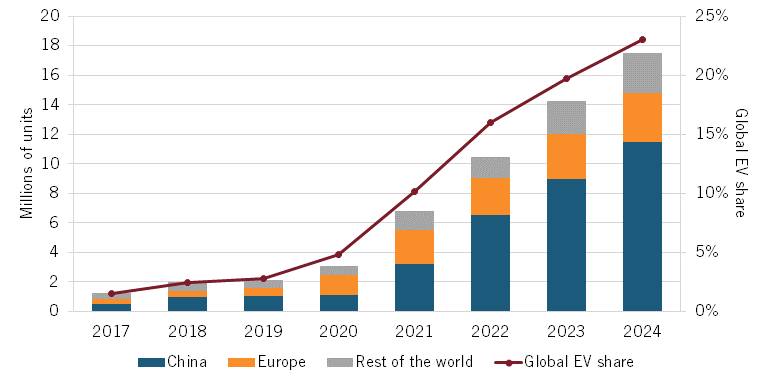
To evaluate the empirical claims of the July 29, 2024 ITIF report alongside global market realities, consider the following comparative metrics tracking production, market share, and capital allocation:
| Metric / Indicator | China Domestic / Global Share | Western / Rest of World Standing | Strategic Implication |
|---|---|---|---|
| Global EV Production Share | ~60% to 65% of worldwide output | Fragmented across Europe, US, and Japan | Inevitable export pressure on foreign domestic markets. |
| EV Battery Cell Market Share | Over 60% controlled by Chinese tier-1 suppliers | Plagued by high CapEx and yield rate delays | Sets global pricing benchmarks for energy storage. |
| Critical Mineral Refining | 50% to 90% depending on mineral type | Nascent domestic refining facilities lagging scale | High geopolitical vulnerability for Western OEMs. |
| Average Cost per kWh (Pack) | Significantly below Western averages (~15-20% cheaper) | Higher labor, energy, and compliance costs | Drives severe margin compression for legacy auto. |
Industry & Market Implications: Winners, Losers, and Capital Reallocation
The implications of the ITIF findings extend far beyond academic debates over industrial policy. For institutional asset managers, private equity partners, and corporate strategists, the findings demand an immediate reassessment of portfolio risk mitigation and valuation multiples.
Who Wins?
The clear beneficiaries of this dynamic are Chinese tier-1 battery giants, vertically integrated OEMs, and consumer-facing technology conglomerates that have successfully commercialized software-defined vehicles. Furthermore, global consumers—particularly in emerging markets—benefit from accelerating price parity between internal combustion engine vehicles and electric alternatives, driving faster infrastructure scalability.
Who Loses?
Legacy automakers in North America and Europe face an existential squeeze. Burdened by unionized labor agreements, legacy pension liabilities, and slow-moving software architectures, traditional OEMs are finding it mathematically impossible to compete with Chinese export pricing without severe margin degradation. Consequently, automotive valuation multiples are experiencing downward pressure as public markets price in the risk of structural obsolescence.
Moreover, Western chemical and mining startups attempting to build greenfield refining facilities are discovering that private capital markets are increasingly wary of backing high-CapEx projects without ironclad regulatory protection and guaranteed government offtake agreements.
Frequently Asked Questions (People Also Ask)
What did the July 29, 2024 ITIF report specifically conclude about Chinese EV innovation?
The ITIF report concluded that while Chinese firms have achieved exceptional manufacturing scale, process efficiency, and supply chain integration, their dominant global position is primarily the result of sustained, multi-billion-dollar state subsidization and non-market industrial policies rather than pure technological superiority or organic market forces.
How much of the global EV battery market do Chinese companies control?
Chinese firms currently account for roughly two-thirds of global electric vehicle production and maintain an even larger grip on the EV battery supply chain, controlling over 60% of global battery cell manufacturing and dominating the refining of critical minerals such as lithium, cobalt, and natural graphite.
What are the primary challenges facing Western automakers in competing with Chinese EV imports?
Western automakers face a combination of structural hurdles, including higher labor and energy costs, lower manufacturing yields on early-stage battery plants, a lack of localized critical mineral refining infrastructure, and strict compliance burdens that prevent them from matching the aggressive retail pricing of Chinese competitors.
How are Western governments responding to the dominance highlighted in the ITIF briefing?
In response to mounting evidence of state-backed overcapacity and market distortion, Western governments—including the United States and the European Union—have implemented aggressive tariff barriers, domestic content requirements (such as the U.S. Inflation Reduction Act), and heightened regulatory compliance checks to protect domestic manufacturing bases and secure critical supply chains.
Future Outlook: Strategic Milestones to Watch
As the global automotive landscape enters a critical transition phase through 2025 and beyond, several key indicators will determine whether Western industrial policy can successfully counter or coexist with China's manufacturing titan:
- Tariff Efficacy and Trade Diversion: Analysts will monitor whether newly enacted North American and European tariff regimes effectively shelter domestic producers or merely redirect Chinese export volumes toward Latin America, Southeast Asia, and the Middle East.
- Solid-State Battery Commercialization: The next frontier of battery chemistry—solid-state cells—represents a potential technological reset. Watch closely whether Western research labs or Chinese state-backed consortia are first to achieve scalable, commercially viable solid-state mass production.
- Regulatory Compliance and Capital Allocation: Corporate boardrooms will be forced to refine their capital allocation strategies, balancing aggressive EV investment cycles against short-term shareholder return pressures. Strategic partnerships and joint ventures may become the preferred risk-mitigation vehicle for legacy brands seeking access to Chinese engineering without surrendering domestic market share.
Ultimately, the July 29, 2024 ITIF briefing serves as both a warning flare and a strategic blueprint. The electric vehicle revolution is no longer just about reducing tailpipe emissions; it is a high-stakes geopolitical contest where industrial policy, capital allocation, and raw engineering scale collide.