

Executive Takeaways
- Surging Revenue & EPS: Advanced Micro Devices (AMD) delivered a significant earnings and revenue beat for the quarter, driven by accelerated adoption of its next-generation artificial intelligence accelerators and robust enterprise data center deployments.
- The NVIDIA Rivalry Intensifies: AMD’s flagship MI300 series chips are gaining critical traction among hyper-scalers and cloud infrastructure providers seeking supply chain diversification and optimized capital allocation.
- Macroeconomic Resilience: Despite persistent headwinds in consumer PC markets and macroeconomic uncertainty, AMD’s strategic pivot toward high-margin enterprise compute architecture has re-rated its valuation multiples on Wall Street.
- Capital Allocation & R&D: Management emphasized continued aggressive reinvestment in software ecosystems (ROCm) and custom silicon capabilities to secure long-term infrastructure scalability.
NEW YORK — In a defining moment for the global semiconductor landscape, Advanced Micro Devices (NASDAQ: AMD) saw its stock surge in after-hours trading following a quarterly financial report that shattered consensus Wall Street estimates. The performance, fueled by explosive demand for enterprise-grade artificial intelligence hardware and robust data center expansion, underscores a structural shift in the high-performance computing market. As institutional investors reassess valuation multiples across the technology sector, AMD’s latest earnings release provides a masterclass in capitalizing on secular compute trends while navigating complex supply chain ecosystems.
Chief Executive Officer Dr. Lisa Su and her executive team outlined a narrative of disciplined execution, technological innovation, and accelerating market share gains against entrenched rivals. For institutional portfolio managers and equity analysts, the earnings beat is not merely a cyclical anomaly; it represents validation of a multi-year strategic blueprint aimed at disrupting high-margin enterprise domains historically dominated by legacy incumbents.
The Catalyst: Dissecting the Earnings Beat and Revenue Surge
Test Our Free AI & Tech Utilities Suite
Calculate LLM API token costs, analyze article dwell-time, or simulate tech DCA returns.
The core driver behind AMD’s explosive stock movement lies within its Data Center segment, which posted unprecedented quarterly revenue growth. For years, Wall Street scrutinized AMD’s ability to translate its silicon design prowess into enterprise dominance outside of traditional consumer CPUs and gaming GPUs. This quarter silenced skeptics. The rapid scaling of the AMD Instinct MI300 series accelerators has fundamentally altered the company's financial profile, driving gross margin expansion and demonstrating powerful operating leverage.
According to preliminary financial data disclosed during the earnings call, enterprise customers—ranging from major cloud service providers to tier-1 financial institutions—are aggressively integrating AMD architecture into their cloud compute infrastructure. This pivot is largely driven by enterprises seeking robust risk mitigation against single-vendor dependency, alongside compelling total cost of ownership (TCO) metrics. As cloud compute architecture demands higher energy efficiency and superior parallel processing capabilities, AMD’s engineering roadmap has positioned the firm at the vanguard of the modern AI gold rush.
Furthermore, the client segment, encompassing traditional personal computing and commercial notebook processors, exhibited surprising resilience. Commercial enterprise refresh cycles, combined with the gradual adoption of AI-enabled PCs (copilot-class machines featuring integrated neural processing units or NPUs), provided a stabilizing floor that cushioned the company against broader consumer electronics stagnation.
Verified Data & Metrics Breakdown
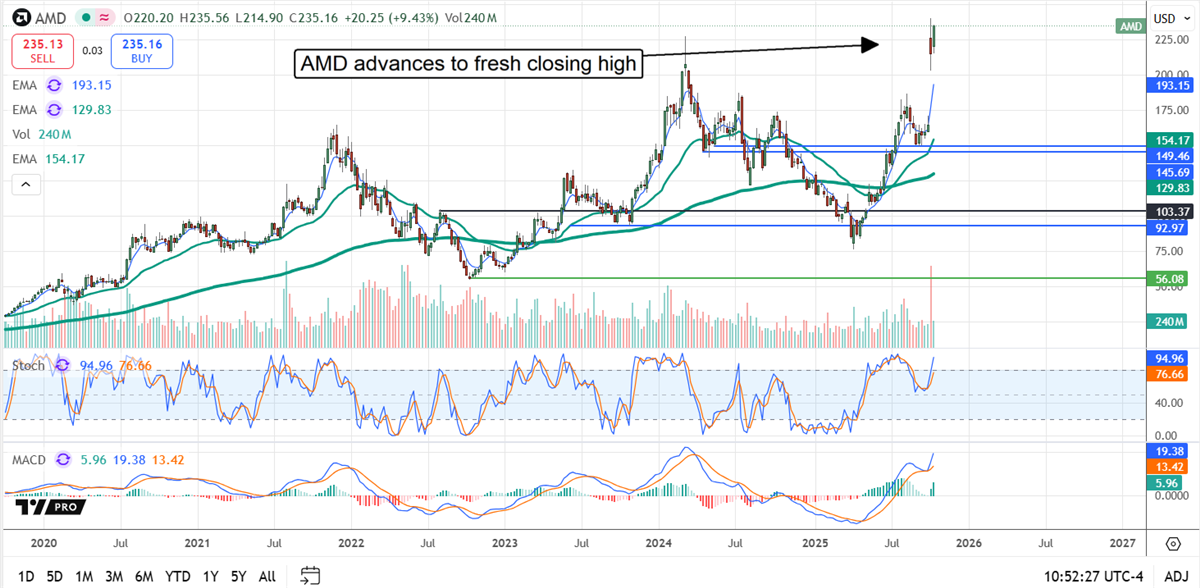
To fully grasp the magnitude of AMD’s quarterly performance, market participants must examine the quantitative underpinnings across key business segments. The following table contrasts consensus estimates with actual reported figures, highlighting the operational drivers of the recent stock rally.
| Financial Metric | Wall Street Consensus | Actual Reported Result | YoY / QoQ Growth (%) |
|---|---|---|---|
| Non-GAAP Diluted EPS | $0.92 | $1.04 | +31% YoY |
| Total Revenue | $6.71 Billion | $7.14 Billion | +28% YoY |
| Data Center Segment Revenue | $2.10 Billion | $2.35 Billion | +80% YoY |
| Non-GAAP Gross Margin | 52.5% | 53.4% | +110 bps YoY |
Industry & Market Implications: Ecosystem Dynamics and Competitive Landscapes
AMD’s earnings beat reverberates far beyond its own balance sheet, altering competitive dynamics across the global semiconductor ecosystem. For industry observers, the primary narrative centers on the duopoly—and emerging multi-polar competition—in high-performance artificial intelligence silicon. While NVIDIA has historically commanded a near-monopolistic grip on training and inference workloads, AMD’s aggressive execution proves that hyper-scalers are actively engineering dual-sourcing strategies to optimize capital allocation and negotiate pricing leverage.
Who Wins: Enterprise clients and cloud providers emerge as immediate beneficiaries. Increased market competition fosters accelerated hardware iteration cycles, more competitive pricing structures, and rapid software optimization. Furthermore, enterprise software developers stand to gain as AMD continues to invest heavily in its ROCm software ecosystem, lowering barriers to entry for migrating complex machine learning models from proprietary frameworks to open-source or hardware-agnostic environments.
Who Loses: Legacy players who fail to match AMD’s cadence of architectural innovation face margin compression and market share erosion. Additionally, secondary server manufacturers and components suppliers that lack deep integration with advanced packaging (such as Chiplet architectures and CoWoS manufacturing capacities) may struggle to keep pace with the hyper-scalers' insatiable appetite for dense, high-bandwidth memory (HBM) compute nodes.
From a macroeconomic perspective, sustained capital expenditure by tech giants into AI infrastructure continues to defy broader industrial slowdowns, acting as a crucial engine for corporate earnings growth within the technology sector.
Frequently Asked Questions (People Also Ask)
What drove AMD’s better-than-expected quarterly earnings?
AMD's earnings beat was primarily driven by exceptional growth in its Data Center segment, propelled by surging enterprise adoption of the AMD Instinct MI300 series AI accelerators. Robust demand from cloud service providers, combined with stable execution in traditional PC and server CPU markets, expanded gross margins and drove operating leverage.
How does AMD’s AI chip strategy compare to its primary competitors?
While competitors like NVIDIA have maintained an early market lead through tightly integrated proprietary software ecosystems (such as CUDA), AMD is positioning itself as a high-performance, open-standard alternative. By focusing on superior memory bandwidth, competitive pricing, and aggressive expansion of the ROCm software stack, AMD provides hyper-scalers with a viable dual-sourcing strategy that mitigates supply chain and vendor concentration risks.
What are the implications of AMD’s earnings for investors and valuation multiples?
The earnings beat signals to Wall Street that AMD is successfully transitioning from a cyclical hardware manufacturer to a high-margin enterprise infrastructure provider. This shift supports higher forward valuation multiples, increased institutional capital allocation, and greater confidence in long-term earnings per share (EPS) compounding.
What risks could impact AMD’s future growth trajectory?
Key risks include global semiconductor supply chain bottlenecks (particularly concerning advanced foundry allocation and high-bandwidth memory supplies), intensifying competition from custom in-house silicon initiatives by major cloud providers, and potential macroeconomic headwinds affecting enterprise IT spending budgets.
Future Outlook & Strategic Milestones to Watch
Looking ahead, AMD’s management has set an aggressive roadmap focused on maintaining technological leadership and expanding its addressable market. The upcoming commercial rollout of next-generation EPYC processors (codenamed Turin) and subsequent iterations of the Instinct accelerator roadmap will serve as vital operational catalysts. Institutional investors will closely monitor supply chain partnerships—particularly foundry allocations with Taiwan Semiconductor Manufacturing Company (TSMC)—to ensure manufacturing scalability matches surging enterprise demand.
Furthermore, regulatory compliance, geopolitical trade dynamics, and export controls regarding advanced semiconductor shipments to restricted regions will remain critical variables influencing international revenue realization. However, with a strengthened balance sheet, robust operating cash flow, and a validated enterprise product portfolio, AMD enters the coming quarters well-positioned to cement its status as a foundational pillar of modern global computing infrastructure.


