Executive Takeaways
- The Perimeter is Obsolete: Legacy castle-and-moat security architectures have collapsed under the weight of hybrid cloud adoption, remote workforces, and sophisticated nation-state cyber campaigns.
- Regulatory Shocks: Financial institutions face unprecedented compliance pressures from the SEC, OCC, and international bodies, tying risk mitigation directly to capital allocation and valuation multiples.
- The BPI Catalyst: Seminal frameworks like the Bank Policy Institute’s (BPI) March 2022 report authored by Andrew Kennedy have forced banks to re-engineer infrastructure scalability around continuous verification.
- Capital Expenditure Realities: Transitioning to Zero Trust Architecture (ZTA) requires massive upfront IT investment, fundamentally shifting enterprise ROI models across global Tier-1 banks.
For decades, the global financial services sector operated on a fundamental, unshakeable premise: trust but verify. Once an employee, contractor, or partner authenticated themselves at the corporate gateway, they were granted sweeping, often unchecked access to internal networks. That model is dead. Driven by relentless cyber incursions, explosive cloud compute architecture, and a fractured geopolitical landscape, Wall Street and global banking capitals are undergoing the most radical infrastructure overhaul in modern financial history.
The catalyst for this paradigm shift crystallized in early 2022. When the Bank Policy Institute (BPI) published its landmark white paper, "Adaptive Trust: Zero Trust Architecture in a Financial Services Environment," authored by Andrew Kennedy on March 21, 2022, it provided more than just a technical roadmap. It served as an urgent wake-up call for executive boards, chief risk officers (CROs), and chief information security officers (CISOs) across the world's most systemic financial institutions. The message was unequivocal: traditional network perimeters are economic liabilities, and survival demands the immediate adoption of Adaptive Trust.
The Anatomy of Vulnerability: Why Legacy Security Failed Wall Street
Test Our Free AI & Tech Utilities Suite
Calculate LLM API token costs, analyze article dwell-time, or simulate tech DCA returns.
To understand the multi-billion-dollar pivot toward Zero Trust Architecture (ZTA), one must examine the systemic failures of legacy security models. Historically, financial institutions built formidable perimeter defenses—firewalls, intrusion detection systems, and secure VPNs—designed to keep malicious actors out while treating everything inside the network as inherently trustworthy. This architecture was designed for an era when core banking applications resided in on-premise data centers and employees worked from fixed terminals within brick-and-mortar headquarters.
The digitization of global finance shattered this paradigm. The mass migration to multi-cloud environments, the proliferation of SaaS applications, and the sudden shift to decentralized remote work during the global pandemic expanded the attack surface exponentially. Threat actors no longer needed to breach the front door; they exploited compromised credentials, lateral movement vulnerabilities, and third-party vendor conduits to roam undetected inside corporate networks for months.
Incidents involving supply chain compromises and advanced persistent threats (APTs) laid bare the fatal flaw of implicit trust. In a financial ecosystem where a single data breach can trigger catastrophic liquidity crises, regulatory fines, and permanent reputational damage, the cost of perimeter-based security became unsustainable. Risk mitigation transitioned from an IT housekeeping chore to a board-level imperative dictating market valuation and investor confidence.
The BPI Blueprint: Deconstructing Andrew Kennedy’s ‘Adaptive Trust’
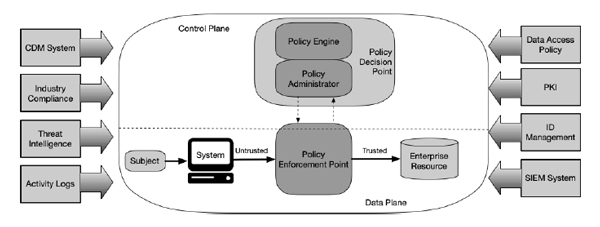
Published on March 21, 2022, the Bank Policy Institute’s report cut through industry jargon to address the unique regulatory, operational, and structural hurdles facing banks implementing ZTA. Unlike traditional corporate enterprises, financial institutions operate under strict regulatory mandates, maintain legacy mainframe systems that process trillions of dollars daily, and face complex cross-border data residency laws.
Kennedy’s analysis emphasized that Zero Trust is not a single software product or hardware appliance that can be procured off the shelf; it is an organizational philosophy built on continuous verification. Under an adaptive trust model, every user, device, and application request is authenticated, authorized, and encrypted before access is granted—and that trust is continuously re-evaluated based on real-time telemetry, behavioral analytics, and context-aware risk scores.
Core Tenets of Financial ZTA:
- Micro-Segmentation: Breaking down monolithic internal networks into isolated, highly secure zones to prevent lateral movement if a breach occurs.
- Least Privilege Access: Enforcing strict, role-based and attribute-based access controls that limit users strictly to the resources required for their immediate job functions.
- Continuous Monitoring & Telemetry: Leveraging AI-driven anomaly detection to dynamically adjust trust levels based on user behavior, device health, and geographic location.
- Cryptographic Integrity: Ensuring end-to-end encryption for data both in transit across hybrid clouds and at rest within legacy repositories.
- AI-Driven Automation: Integration of artificial intelligence and machine learning to enable real-time, autonomous policy enforcement that adapts instantly to zero-day threat vectors without human intervention.
- Quantum-Resistant Cryptography: As quantum computing advances, financial institutions will begin fusing ZTA frameworks with post-quantum encryption algorithms to protect long-term financial transactions and sensitive customer assets.
- Regulatory Standardization: Expect international regulatory bodies to codify Zero Trust principles into mandatory compliance frameworks, transforming best practices into strict legal requirements.
Verified Data & Metrics Breakdown Table
The financial commitment required to transition from legacy perimeters to adaptive trust frameworks is staggering. Below is a comparative breakdown of key operational, financial, and technological parameters defining the Zero Trust transition across Tier-1 financial institutions.
| Metric / Parameter | Legacy Perimeter Architecture | Zero Trust Architecture (ZTA) | Financial Impact / Implication |
|---|---|---|---|
| Primary Trust Model | Implicit trust inside the network perimeter | Explicit verification ("Never trust, always verify") | Eliminates lateral threat movement |
| Average Breach Containment Time | 200+ days | Minutes to hours | Reduces remediation costs by millions |
| Capital Expenditure (CapEx) | Lower maintenance, high technical debt | High upfront transformation cost | Compressed short-term enterprise ROI |
| Regulatory Compliance Alignment | Reactive audit patching | Continuous, automated compliance | Mitigates SEC and OCC enforcement risks |
| Cloud Compatibility | Poor (requires complex VPN backhauling) | Native integration across multi-cloud setups | Accelerates digital transformation timelines |
Industry & Market Implications: Who Wins and Who Loses
The structural pivot toward Adaptive Trust is actively reshaping the competitive landscape of both financial services and enterprise technology. As capital allocation shifts decisively toward cybersecurity resilience, market participants face distinct commercial outcomes.
The Winners: Enterprise Security Leaders and Agile Banks
Tier-1 banking institutions with robust balance sheets capable of absorbing heavy upfront modernization costs are setting a new gold standard for operational resilience. By embedding ZTA into their core operations, these banks are securing lower insurance premiums, favorable regulatory scrutiny, and enhanced customer trust. Simultaneously, cybersecurity providers specializing in identity and access management (IAM), micro-segmentation, and cloud security posture management (CSPM) are experiencing unprecedented enterprise demand, driving stellar valuation multiples.
The Losers: Legacy Vendors and Under-Capitalized Institutions
Regional banks and financial cooperatives operating on legacy, monolithic IT infrastructures face a punishing compliance and financial squeeze. The capital expenditure required to overhaul aging systems threatens profit margins, creating an environment ripe for industry consolidation. Furthermore, traditional hardware-centric security vendors failing to pivot toward software-defined, cloud-native Zero Trust frameworks are rapidly losing market share to agile, API-first security disruptors.
Frequently Asked Questions (People Also Ask)
What is the core principle of Zero Trust Architecture in banking?
The foundational principle of ZTA is "never trust, always verify." In a financial services context, this means no user, device, or application—regardless of whether they are located inside or outside the corporate network perimeter—is granted automatic access to sensitive financial data or core banking systems without continuous, multi-factor authentication and real-time risk validation.
How does the Bank Policy Institute (BPI) report impact financial regulatory compliance?
The March 2022 BPI report by Andrew Kennedy serves as an authoritative guide for aligning modern cybersecurity frameworks with rigorous regulatory expectations set by agencies like the SEC, Federal Reserve, and OCC. By establishing adaptive trust, banks can demonstrate proactive risk mitigation, automated audit trails, and robust data protection, significantly lowering the risk of severe regulatory penalties following security incidents.
What are the primary financial hurdles in transitioning to Zero Trust?
The most significant barriers include high upfront capital expenditures (CapEx), the complexity of integrating modern ZTA software with decades-old legacy core banking mainframes, and potential temporary friction in employee workflows. However, these costs are balanced against long-term operational efficiencies and the prevention of catastrophic breach-related losses.
How does Adaptive Trust improve enterprise ROI over legacy security models?
While initial implementation costs are substantial, Adaptive Trust dramatically reduces the mean time to detect (MTTD) and mean time to respond (MTTR) to cyber threats. By containing breaches instantly via micro-segmentation and automated privilege revocation, institutions avoid catastrophic downtime, massive ransom payouts, regulatory fines, and long-term brand erosion.
Future Outlook: The Road Ahead for Adaptive Trust
As financial institutions navigate an increasingly hostile digital battlefield, Zero Trust Architecture is no longer an experimental strategy; it is the baseline operational standard for the modern global economy. Over the next three to five years, several key milestones will define the maturation of Adaptive Trust across Wall Street and international financial hubs:
For executive leadership in financial services, the directive is clear. The transition to Adaptive Trust demands bold capital allocation, unwavering board commitment, and a permanent cultural break from the illusion of perimeter security. In the high-stakes arena of global finance, trust must never be assumed—it must be continuously proven.