Executive Takeaways
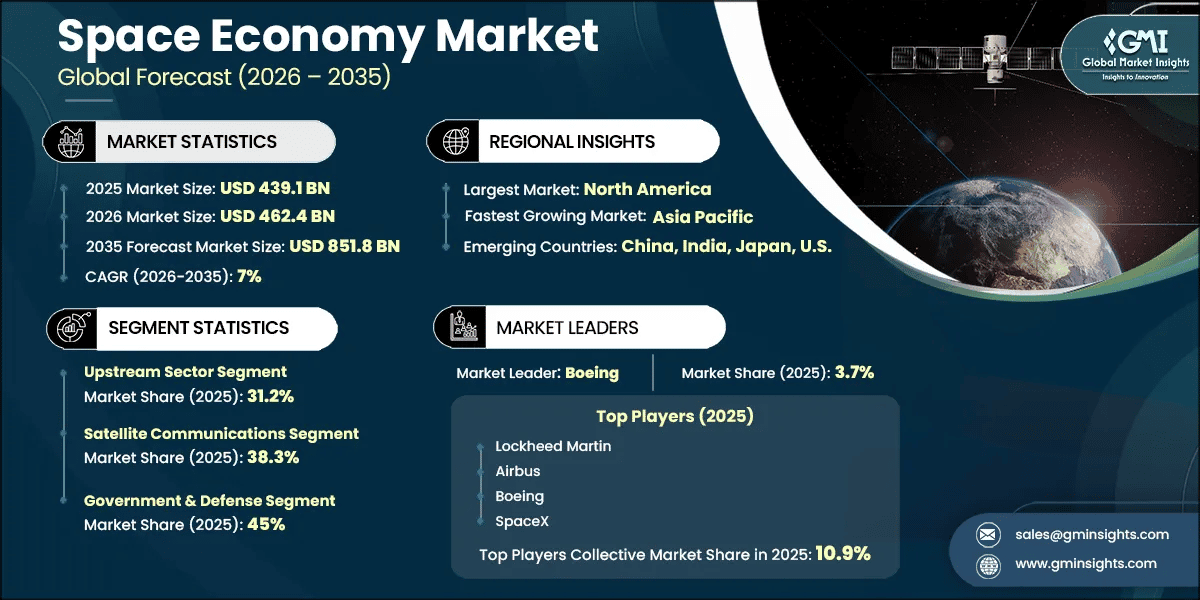
- Explosive Growth Trajectory: According to the latest global market analysis released by Future Market Insights, the space economy market is projected to surge from USD 449.8 billion in 2025 to USD 935.6 billion by 2035, posting a robust Compound Annual Growth Rate (CAGR) of 7.6%.
- Capital Allocation Paradigm Shift: Institutional investors, sovereign wealth funds, and tier-1 aerospace prime contractors are pivoting from government-funded exploration to high-yield enterprise ROI models, specifically targeting low-Earth orbit (LEO) infrastructure scalability and in-space manufacturing.
- Supply Chain & Regulatory Complexity: As orbital congestion intensifies and spectrum allocation faces heightened regulatory compliance, market winners will be defined by superior risk mitigation frameworks, advanced cloud-compute architecture, and sustainable propulsion technologies.
For decades, the final frontier was the exclusive domain of sovereign states, Cold War superpowers, and heavily bureaucratized public-sector agencies. Today, that paradigm has fundamentally shattered. Driven by aggressive private equity deployments, radical launch-cost compression, and a relentless corporate search for new revenue streams, the space economy has matured into an institutional asset class of unprecedented scale. As detailed in the comprehensive global market analysis report published by Future Market Insights on July 31, 2025, the commercial space sector is standing on the precipice of a historic financial inflection point, poised to more than double over the coming decade.
To understand the mechanics of this expansion is to look past the theatrical spectacle of reusable rocket boosters and billionaire-funded joyrides. Beneath the media coverage lies a deeply complex, trillion-dollar industrial transformation. This investigation unpacks the financial architecture, valuation multiples, infrastructure scalability challenges, and geopolitical ramifications defining the modern space economy as it races toward its $935.6 billion milestone by 2035.
The Macroeconomic Catalysts: From Geopolitics to Enterprise ROI
Test Our Free AI & Tech Utilities Suite
Calculate LLM API token costs, analyze article dwell-time, or simulate tech DCA returns.
The acceleration of the space economy is underpinned by a structural shift in capital allocation. Historically, space exploration operated on cost-plus government contracting models that disincentivized operational efficiency. The modern era, however, is governed by fixed-price commercial agreements, venture capital injections, and private market liquidity that demand rigorous enterprise ROI.
Several catalytic events have converged to create this environment:
- Launch Cost Compression: The advent of vertically integrated, reusable launch vehicles has driven down the cost per kilogram to low-Earth orbit by an order of magnitude, unlocking unit economics that were previously unviable for commercial enterprises.
- Data-Driven Infrastructure: Terrestrial industries—ranging from precision agriculture and global logistics to maritime tracking and high-frequency financial trading—now rely fundamentally on orbital assets for real-time telemetry and global broadband connectivity.
- The LEO Commercialization Wave: The retirement of legacy international platforms and the rapid deployment of private commercial space stations have transformed low-Earth orbit into an industrial zone. Pharmaceuticals, semiconductor manufacturing, and advanced fiber-optics are increasingly looking to microgravity environments to manufacture products impossible to create on Earth.
This macro backdrop has forced traditional financial institutions and investment banks to recalibrate their valuation frameworks. Aerospace and defense conglomerates are no longer valued purely on legacy defense contracts; instead, their market multiples are increasingly tied to their ability to capture recurring revenue from orbital data services, satellite-as-a-service (SaaS) architectures, and space-based logistics.
Verified Market Metrics and Growth Trajectory
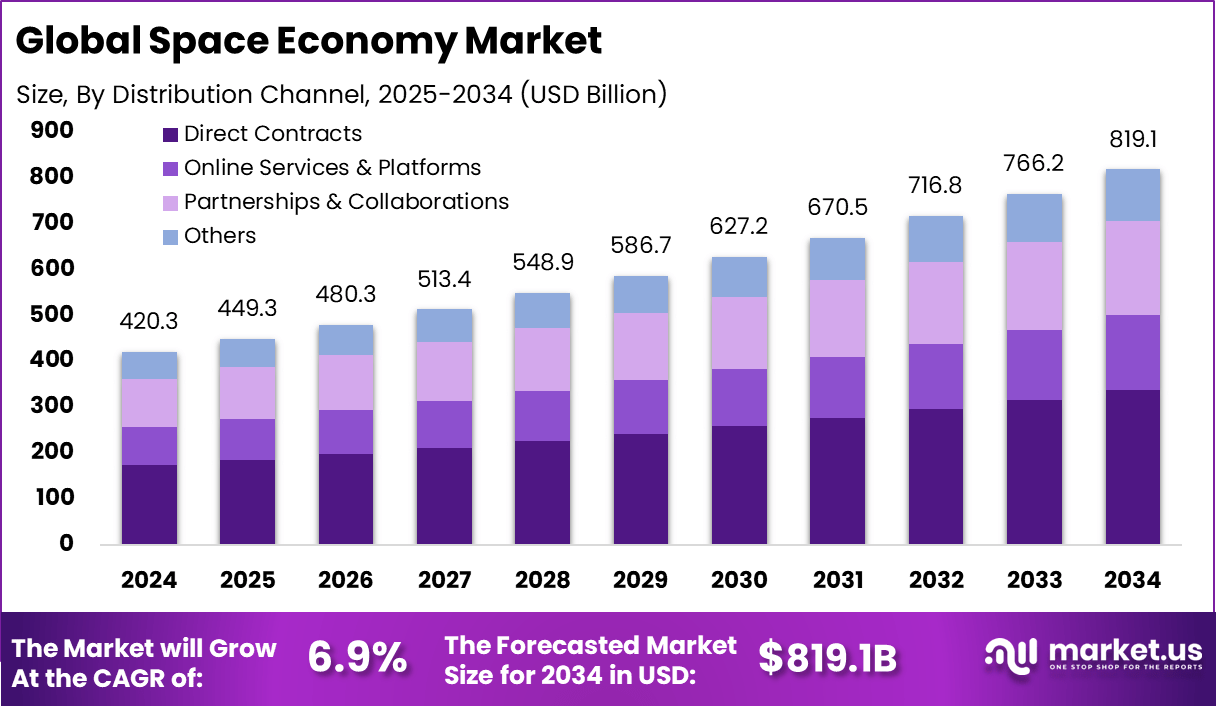
A granular examination of the data underscores the sheer velocity of this market expansion. The following table illustrates the baseline financial metrics and growth trajectory of the global space economy market as tracked by primary wire sources through the next decade.
| Market Metric | 2025 Baseline | 2035 Projection | Growth Dynamics & CAGR |
|---|---|---|---|
| Total Market Valuation | USD 449.8 Billion | USD 935.6 Billion | Compound Annual Growth Rate (CAGR) of 7.6% (2025–2035) |
| Primary Growth Segments | Satellite Communications & Earth Observation | In-Space Manufacturing & Orbital Logistics | Transition from passive data collection to active industrial production in orbit. |
| Key Investor Segments | Venture Capital & Defense Primes | Sovereign Wealth & Private Equity Consortia | Maturation into an institutional asset class with stringent risk mitigation demands. |
| Operational Bottlenecks | Launch Cadence & Regulatory Approvals | Orbital Debris Mitigation & Spectrum Allocation | Increasing regulatory compliance hurdles and traffic management requirements. |
Industry & Market Implications: Winners, Losers, and Strategic Risks
As capital floods into the space economy, a profound structural bifurcation is taking place across global supply chains. The market implications extend far beyond the aerospace sector, directly impacting telecommunications, insurance, energy, and advanced manufacturing.
Who Wins: The Infrastructure Enablers and Data Monopolies
The primary beneficiaries of this $935.6 billion expansion will be companies that control the foundational plumbing of the space architecture. This includes next-generation launch providers with proven high-cadence reusable fleets, advanced satellite bus manufacturers, and firms specializing in edge-computing cloud architecture designed for orbital deployment. Furthermore, enterprises dominating Earth observation analytics—converting raw satellite telemetry into actionable financial and environmental intelligence for global corporations—are securing formidable economic moats.
Who Loses: Legacy Defense Contractors and Unfunded Point Solutions
Conversely, traditional defense primes that fail to transition from rigid, cost-plus bureaucratic models to agile, software-defined commercial manufacturing face severe margin compression. Additionally, single-product space startups that lack robust unit economics, fail to secure recurring enterprise contracts, or neglect rigorous capital allocation strategies are experiencing severe valuation write-downs. The era of speculative, pre-revenue space ventures raising capital purely on futuristic narratives has officially drawn to a close.
Risk Mitigation and Regulatory Compliance
As the density of orbital assets multiplies, systemic risks are mounting. Orbital debris management, spectrum congestion, and complex geopolitical jurisdiction over celestial resources present formidable hurdles. Market participants are increasingly forced to invest heavily in regulatory compliance and automated collision-avoidance systems. Insurance underwriters, once eager to enter the space market, are tightening underwriting criteria, demanding rigorous risk mitigation protocols before issuing policies for multi-billion-dollar satellite constellations.
People Also Ask: Expert Insights on the Space Economy
What is driving the rapid valuation growth of the space economy market?
The expansion is primarily driven by a combination of drastically reduced launch costs through reusable rocket technology, surging commercial demand for global broadband and Earth observation data, and an institutional shift toward high-yield enterprise ROI models rather than government-funded exploration alone.
Which sectors within the space economy are experiencing the fastest capital allocation?
While satellite communications and Earth observation remain foundational revenue drivers, venture capital and private equity are increasingly targeting high-growth verticals such as in-space manufacturing, orbital logistics, space debris mitigation, and cloud-compute infrastructure designed for microgravity environments.
What are the primary operational risks facing investors in the space sector?
Key risks include regulatory bottlenecks regarding spectrum allocation, escalating concerns over orbital congestion and space debris, stringent compliance mandates, and the inherent technical complexities of scaling manufacturing and communication infrastructure in harsh space environments.
How does the Future Market Insights projection impact aerospace valuation multiples?
The projection that the market will reach USD 935.6 billion by 2035 at a 7.6% CAGR signals to institutional investors that the space sector is transitioning from a speculative frontier into a predictable, high-margin industrial asset class, prompting a re-rating of tech-enabled aerospace and defense equities.
Future Outlook: Milestones to Watch Through 2035
As the global space economy marches toward its targeted valuation threshold over the next decade, market analysts, institutional investors, and strategic planners must monitor several critical inflection points. The transition from a data-gathering economy to an industrial-production economy in orbit will hinge upon the successful deployment of commercial space stations, the establishment of standardized international frameworks for orbital traffic management, and the maturation of scalable in-space manufacturing processes.
For executive leadership teams and capital allocators, complacency is no longer an option. The companies that successfully integrate robust cloud-compute architectures, master regulatory compliance, and enforce rigorous risk mitigation will dictate the terms of engagement across the trillion-dollar orbital marketplace. The gold rush of the 21st century is no longer on terrestrial soil; it is being forged in the crucible of low-Earth orbit and beyond.